
August 1
Saints of the day
Also commemorated
Procession of the Precious Cross
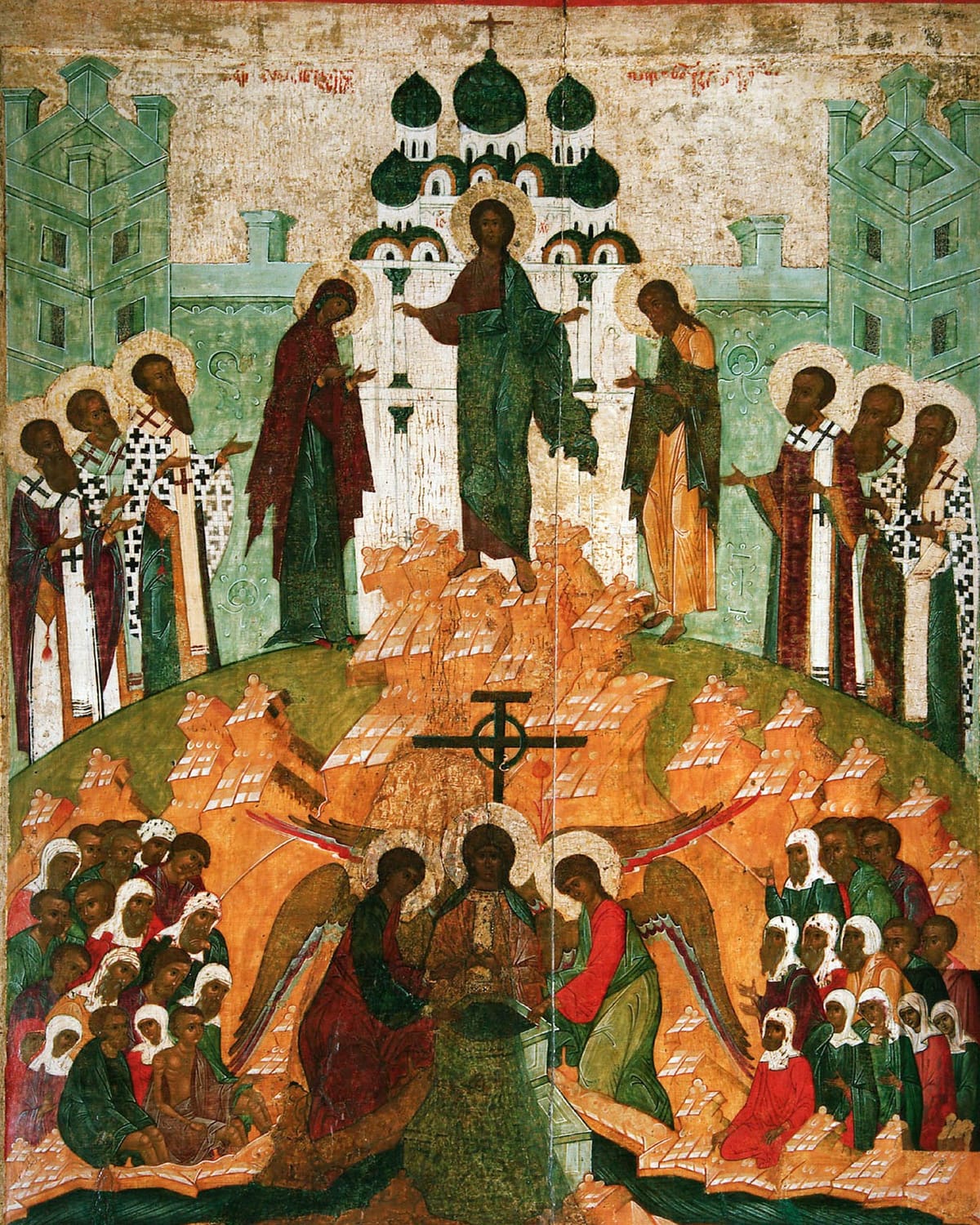
This feast was established by mutual agreement of the Greeks and Russians, in the time of the Greek Emperor Manuel and the Russian Prince Andrew, in commemoration of simultaneous victories: of the Russians over the Bulgarians and of the Greeks over the Saracens. In both these campaigns, crosses were carried with the armies, from which heavenly rays shone forth. Therefore it was established that on the first of August the Cross be brought forth from the Church of Hagia Sophia, first to the center of the church and then through the streets, for the veneration of the people and in commemoration of the miraculous help of the Cross in past wars. This was not an ordinary cross, but the true Precious Cross, which was kept in the church of the imperial palace. On July 31 the Precious Cross was transferred from the imperial palace to Hagia Sophia, and from there was carried through the streets for the sanctification of the land and the air. Finally, on August 14 it was returned again to the church of the imperial palace.
Hymn of Praise
To the Precious Cross of Christ
We all reverently bow;
By the power of the Cross of Christ
We are delivered from temptation.
The Cross is mightier than demons
And than every earthly king,
The Cross delivers from disease
And from the onslaught of barbarians.
Prince Andrew by the power of the Cross
Saved lands that had been enslaved;
By the power of the Cross, Emperor Manuel
Gloriously defeated the Saracens.
From armies of the godless,
From violent conquerors,
From every evil, the power of the Cross
Has proved itself far mightier.
Reflection
A powerless man usually defends himself by hypocrisy and a powerful one by violence. But that a man cannot defend his life before God by either hypocrisy or violence is clearly shown to us by the example of holy Elder Eleazar and King Antiochus. When the violent king brought Eleazar to trial and compelled him to eat swine's flesh if he wished to preserve his life, Eleazar refused this unwaveringly. Then certain friends of Eleazar smuggled him a piece of some other meat, not pork, begging him to eat it before the king and the people, so that he might thus preserve both his life and his conscience. The elder refused this offer too, saying to his friends: "It does not befit me, an old man, to play the hypocrite, to the scandal of many young people." And the elder perished in body but saved his soul. As for the violent King Antiochus, God's punishment overtook him even in this life. A terrible disease attacked him from within, and his body seethed with worms, and a stench from him spread far around. In his despair he remembered the innocently shed blood of thousands and thousands of human beings who, by his orders, had been mercilessly slain. He became terrified before God, and began to confess the one God, Whom he had formerly persecuted by persecuting His faithful. But heavenly mercy did not manifest itself upon him.
Contemplation
Contemplate God's punishment upon Israel (Judges 10), namely:
- How the Israelites did what was evil before the Lord, bowing down to the idols of the Syrians, the Sidonians, the Moabites, and others;
- How the Lord delivered them into the bondage of the Philistines, who trampled and crushed them for eighteen years;
- How the Lord is fearsome toward those who fall away from the true faith.
Homily
On the prophetic visions
The vision of Isaiah the son of Amos
Isaiah 1:1
He who has understanding can come to know the one true God. He who is without understanding, let him hearken to one who has understanding, and both shall be saved. God can be known clearly from created nature, yet more clearly from the inspired men of God, and most clearly of all from the Lord Christ. The inspired men of God before the Lord Christ were the prophets. Among the foremost was Isaiah, the son of Amos. The Spirit of God opened his vision, and he saw what other men did not see. Therefore he calls his message to his people a vision. How the prophets saw the mysteries of heaven and the mysteries of future events cannot be described; it can only be experienced by him to whom it is granted by God. The visions of the holy prophets are true, for the words and heavenly images from those visions were subsequently confirmed in reality. They are true also because they served the good of mankind and the turning from evil to good. They are true, furthermore, because the prophets fearlessly proclaimed them regardless of the sufferings that befell them on that account, and even regardless of the bitter death that many of them endured. What did Isaiah receive from the earth and from men for his visions? Riches, or honor, or high office? The Jews sawed him in two with a saw! That is the wealth, that is the honor, that is the glory of a prophet: to suffer for the truth of God. Let us hearken, then, to the prophets of God, for they are paths that lead to the city of the Great King; they are rays of the great Sun of Righteousness, Christ, Who from afar illumines men with heavenly light, pointing them toward the Sun.
O Lord Christ, Who through the prophets didst reveal Thyself and didst prepare a way for Thyself to descend into our valley, help us. Help us to know Thy light and Thy providence in Thy holy prophets. To Thee be glory and praise forever. Amen.
From the Prologue from Ochrid, translated by Marcian Sakarya, OCHRID.COM. CC BY-SA 4.0.
The Prologue, every day
Axios! brings the day’s Hymn of Praise, Reflection, Contemplation and Homily to Today, with the saints, the feasts and the saying of the day, on iPhone, iPad and Android.