
August 19
Saints of the day
Hymn of Praise
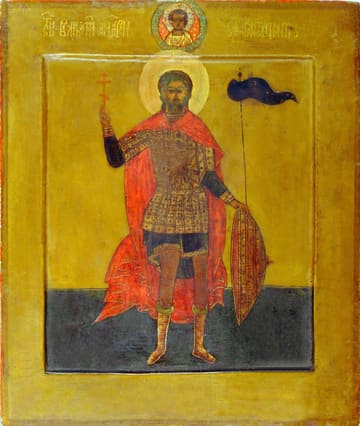
Nature's song amid the Taurian mountains
Echoed without a human voice to answer.
Until one day the mountain trembled,
And a new echo resounded through it;
The mountain halted its eternal echo
To hear a new one, never heard before.
There came the end of Andrew's valiant company,
There wolves slaughtered innocent lambs.
Andrew had saved the Roman realm from Persia,
And now the Roman army struck at Andrew.
With two thousand comrades Andrew knelt to earth
And spoke a gentle counsel to his companions:
"Now is the acceptable hour, now is the day of salvation,
Of our separation from earthly life.
On our knees let us humbly kneel before God
And for His many blessings warmly give thanks,
And most of all, brethren, for a martyr's death,
Without wrath or outcry at the hand of the executioner."
Thus Andrew spoke. Upon their knees they fell,
Two thousand men began to pray;
The hosts of fierce pursuers flashed their swords,
Choirs of angels shone above the mountain,
In heaven the gates of Paradise opened wide
For holy Andrew, the glorious stratelates,
And for his army that conquered the devil
And shed its honorable blood for its Christ.
Reflection
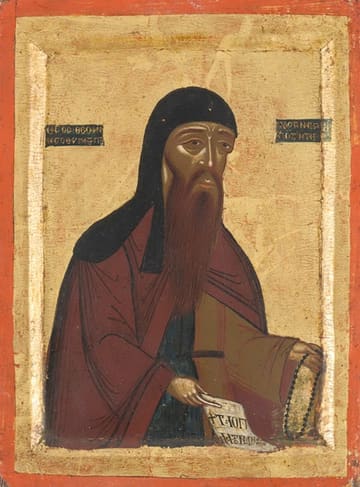
When an unexpected misfortune befalls us innocently, we should not immediately begin to lament, but should see in it the Providence of God, who through that misfortune is arranging something new and beneficial for us. One day an unexpected message came to the divine Theophanes, abbot of Docheiariou, that the Turks had seized his sister's son, converted him to Islam and taken him to Constantinople. Theophanes immediately went to Constantinople and, with God's help, succeeded in finding his nephew and secretly leading him out of Constantinople and bringing him to his monastery on the Holy Mountain. There he restored him to the Christian faith and then tonsured him a monk. But the brethren began to murmur against their abbot and against his nephew out of fear of the Turks, for they were afraid that the Turks would find out and come and destroy the monastery. Not knowing what else to do, Saint Theophanes took his nephew and withdrew with him secretly, not only from Docheiariou but from the Holy Mountain altogether, and came to Beroea. Theophanes's subsequent activity in Beroea and in Naoussa showed how beneficial that misfortune had been for the Church. What he never could have accomplished on the Holy Mountain, he accomplished in these other places to which he had fled from that misfortune. Namely, he founded two new monasteries in which in time a multitude of monks found salvation and countless people found consolation. Moreover, his holy relics, in the midst of the Christian people, became a source of healing, strengthening the faith of many unbelievers and those of little faith. Thus God wisely arranges the destinies of men through sudden misfortunes which at the moment seem to people to lead to their final ruin.
Contemplation
Contemplate the wondrous Providence of God in the life of David (I Samuel 16), namely:
- How the Spirit of God departed from Saul because of Saul's sin;
- How an evil spirit attacked Saul, so that he sought a minstrel (harpist) to soothe him;
- How the king's servants found none other than David and brought him to the king, to comfort him with the harp.
Homily
On the power of the Lord and the impotence of idols
Behold, the Lord rideth upon a swift cloud, and shall come into Egypt: and the idols of Egypt shall be moved at His presence
Isaiah 19:1
Fleeing from King Herod, the Pharaoh of Jerusalem, the Lord came to Egypt. True Israel is reckoned not by place but by spirit and deeds. At the time of the Lord's birth, a greater evil reigned in Jerusalem than once in Pharaoh's Egypt, as it often happens that when the faithful fall away from the faith they become worse than the unbelievers who never knew the true faith. And so Egypt at that time was a milder and more hospitable place for the Savior of the world than Jerusalem. Compare the words of the prophet with the words that the angel spoke in a dream to righteous Joseph: Arise, take the young Child and His mother, and flee into Egypt (Matthew 2:13), and at once you will be convinced that the words of Isaiah cannot refer to anyone other than Christ the Lord. You will be confirmed in this even more when you hear another prophet who says: Out of Egypt have I called My Son (Hosea 11:1). What does the swift cloud signify, upon which the Lord shall come into Egypt? It signifies the body of the Lord, in which He shall clothe His Divinity. For the body of man is like a condensed cloud in which the soul dwells. This, then, is the prophetic vision of the incarnate Lord. Some interpreters think that the swift cloud also signifies the Most Pure Theotokos, who by long fasting and prayer and other ascetic labors had made her body as light as a cloud. That cloud, the body of the Theotokos, was especially light because of the absence of passions, which burden human bodies.
O most merciful Lord, who desirest the salvation of all men, and lookest not upon who is Jew and who is Egyptian, save and have mercy on us also, for in Thy name we hope unceasingly. To Thee be glory and praise forever. Amen.
From the Prologue from Ochrid, translated by Marcian Sakarya, OCHRID.COM. CC BY-SA 4.0.
The Prologue, every day
Axios! brings the day’s Hymn of Praise, Reflection, Contemplation and Homily to Today, with the saints, the feasts and the saying of the day, on iPhone, iPad and Android.