
December 16
Saints of the day
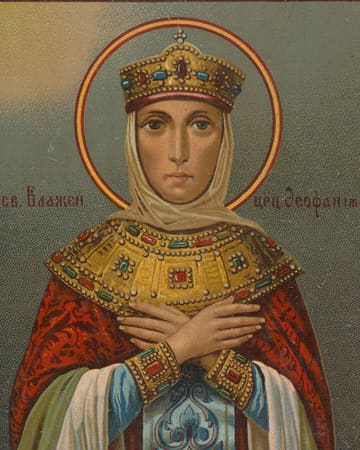
Hymn of Praise
From the imperial throne one sees better
The vanity of the world, swift vanity,
And the imperial throne mercilessly beat
The stormy waves of this world.
Theophania clearly beheld
The mad ocean of this world,
And her heart, her restless heart,
She anchored firmly to the Living God.
Are earthly emperors truly emperors?
Many sentries in swift change!
Death stands, counts, and makes the change:
Earthly emperors, passing shadows!
Theophania, like the wise virgins,
The lamp of her heart enkindled with the Spirit,
Illumined the path with wondrous light,
The sinful pits she happily escaped.
Blessed now in the eternal kingdom
Among the stars like a star she shines,
There where there is no torment nor change,
Now Theophania reigns.
Reflection
Great effort the saints expended to suppress pride and self-will in themselves, and to accustom themselves to complete obedience and devotion, whether to their superiors while they had them, or to God Himself. The monastery of Saint Sabbas the Sanctified was distinguished by particular discipline, order and unmurmuring obedience. When Saint John of Damascus entered that monastery, none of the distinguished spiritual fathers dared to take such a celebrated great man and writer as his obedient. Then the abbot entrusted him to a certain simple but strict elder. The elder commanded John that he must do nothing without his knowledge and approval. It happened meanwhile that a monk died who had a blood brother in that same monastery. This brother was in inexpressible grief for his dead brother. For the consolation of the inconsolable brother, John wrote funeral stichera for the deceased, the well-known hymns at the funeral service which the Church holds to this very day. Having composed them, John began to sing them. When his elder heard the singing, he became very angry and drove John away from himself. Hearing of this banishment of John, some of the brethren ventured to go to the elder and began to entreat him to forgive John and receive him back. But the elder remained immovable. John wept bitterly and sobbed that he had transgressed the commandment of his elder. Once more the brethren entreated the elder on John's behalf, that he assign him some penance and afterward forgive him. Then the elder imposed such a penance on his disciple: that all the latrines in all the cells throughout the whole monastery he must clean and wash with his own hands, if he desired forgiveness. The grieved brethren communicated this to John, thinking that John would sooner leave the monastery than do this. But when John heard the elder's message, he rejoiced greatly and with joy fulfilled the elder's commandment. Seeing this, the elder wept, embraced John, and through tears said: O what a sufferer in Christ I have begotten! O how this man is a true son of holy obedience!
Contemplation
Contemplate Abraham's magnanimity, namely:
- How Abraham did not wish to quarrel with Lot over the quarrel of their herdsmen but proposed a division;
- How in the division he left it to Lot to choose, whether to the left or to the right;
- How Abraham, having defeated the king of Sodom, refused the offered goods and would not take even a thread or a sandal-thong.
Homily
On Moses
Now the man Moses was very meek, above all the men which were upon the face of the earth
Num. 12:3
A chosen man, a great wonderworker, a prototype of the Lord Jesus Christ in wonderworking, a victor in Egypt, a victor in the desert, a leader of the people: how could he not become proud! But if he had become proud, Moses would not have been all that he was. Those become proud who think that they do their own work in this world and not God's, and who think that they act by their own power and not by God's. But the great Moses knew that he was a worker of God's work, and that the power by which he acted was God's power and not his own. Therefore he did not become proud either over the terrible miracles which he performed, or over the great victories which he won, or over the wise laws which he gave to the people. The Lord is my strength and song, said Moses (Ex. 15). Of the whole assembly of Israel in the desert, no one felt so much his own powerlessness as this greatest one in that assembly. In every task, in every place, and at every moment he awaited help only from God. What shall I do? he asked God with a cry, and constantly listened for God's answer and God's power. Meek, above all the men upon the earth. For all the others held something to themselves, trusted somewhat in themselves, but he, nothing. He was all absorbed in God, all broken before God. Whether it was necessary to feed and water the people, he turned to God; or whether it was necessary to fight with enemies, he raised his hands to heaven; or whether it was necessary to calm a rebellion in the people, he cried out to God. The meek, most meek Moses! And God rewarded His faithful servant with great glory. And God deemed him worthy to appear on Tabor with Elijah beside the Lord Savior.
O Lord, God of the meek, good Shepherd, make us also meek, like Moses and the apostles. To Thee be glory and praise forever. Amen.
From the Prologue from Ochrid, translated by Marcian Sakarya, OCHRID.COM. CC BY-SA 4.0.
The Prologue, every day
Axios! brings the day’s Hymn of Praise, Reflection, Contemplation and Homily to Today, with the saints, the feasts and the saying of the day, on iPhone, iPad and Android.