
December 9
Saints of the day
Hymn of Praise
O most glorious God, wondrous and marvelous,
Toward all creatures gracious, merciful,
Thou dost cast down the proud, exalt the humble:
Thou who puttest to death, Thou who makest alive,
All things canst Thou, Creator, according to Thy plan,
According to Thy plan, eternal, divine.
The fertile earth bears with Thy blessing,
The barren Thou sealest with Thy holy word.
From her who bears Thou canst take away,
And to the barren Thou canst bring good fruit.
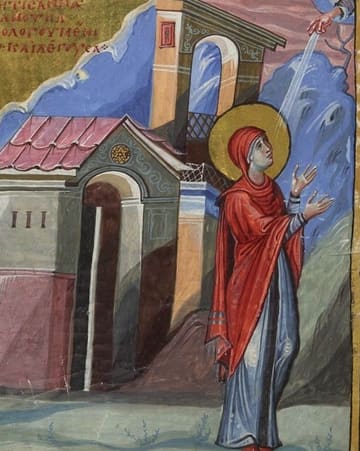
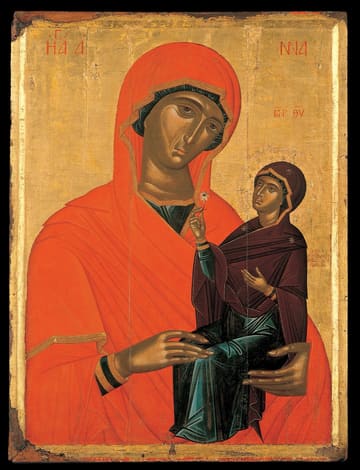
The barren Anna Thou didst make fertile,
Blessed her with a daughter holy, noble,
Her who was to mockery, Thou didst crown with glory,
The dream of the childless woman Thou didst surpass with reality.
The old woman prays, Thou didst accept the prayer,
And the seal of barrenness Thou didst remove from her body,
Her dead body Thou didst water with life,
A maiden Thou didst give her, wondrous in beauty,
And a daughter was born, most holy virgin,
Both Daughter and Mother and Theotokos!
All things canst Thou, Creator, according to Thy plan,
According to Thy plan, eternal, divine.
Reflection
Fear of God drives out from the heart every fear of men. In all the great hierarchs of the Orthodox Church we see wondrously united meekness and fearlessness. Saint Nicholas seized the executioner's sword and pulled, that he might not slay innocent people. Saint Chrysostom denounced the misdeeds of Empress Eudoxia without regard for all the unpleasantness and dangers to life to which he thereby exposed himself. And similar to this many, many others. Emperor Valentinian the Elder, having heard the stern denunciations of Ambrose, said to him: I knew thy fearlessness, therefore I also helped that thou shouldst be chosen bishop; correct our errors as divine law teaches, and heal our injustices. When Valentinian the Younger, at the instigation of his mother Justina, an Arian, ordered that the Cathedral Church in Milan be given over to the heretics, Ambrose shut himself in the church with the faithful people and for three days refused to come out, and sent word to the emperor and empress that if they desired his death, he was ready at any hour to be pierced here in the church either by sword or by spear. Hearing this, the emperor and empress withdrew their order. When a certain riot occurred in Thessalonica, in which, by order of Emperor Theodosius the Great, about 7,000 people were slain, Ambrose became so angry with the emperor that when he visited Milan and wished to enter the church, the saint forbade him to enter. The emperor said to Ambrose: David also sinned, and was not deprived of God's mercy, to which the bishop answered: If thou hast imitated David in sin, imitate him also in repentance. The emperor was ashamed, returned, and bitterly repented for the sin committed.
Contemplation
Contemplate the righteousness of righteous Noah (Gen. 6), namely:
- How all people were wicked and malicious;
- How Noah alone in the midst of universal wickedness remained righteous and lived according to God's will.
Homily
On Noah
Noah was a just man and perfect in his generations, and Noah walked with God
Gen. 6:9
To be righteous among the righteous is a great and praiseworthy deed. But how much greater and more praiseworthy a deed it is to be righteous among the unrighteous. And Noah lived among people filled with injustice and malice, five hundred years he lived among them, and remained righteous before God. And Noah found grace in the eyes of the Lord God. The Highest Judge, who sees all human deeds and evaluates without bias and without error, assessed Noah's labor to maintain himself in God's righteousness in the midst of a generation corrupt and perverse, and rewarded him with His grace. Undoubtedly, Noah endured much torment and bitterness from his malicious neighbors. Undoubtedly, he could not have friends among them. The greatest pleasure of sinners is to drag the righteous man into their mire and to share their sin with him. But Noah did not allow himself to be dragged down or seduced. He preferred to have God as a friend rather than unrighteous people. It was dearer to him to walk with God without people, than with people without God. Fear of God, the Creator and Judge, preserved him from the general corruption. And not only was he righteous, but perfect in his generations. That is, he did not allow himself to be infected in the least by the common evil but held to God's righteousness. The enticements to sin and the mockeries from sinners only distanced him more from them. And when the universal flood came upon the entire human race, God did not leave faithful Noah to perish with the rest, but saved him, and glorified him by making him the progenitor of the new human race. The brilliant example of Noah, brethren, teaches us that even among us each one can please God in the midst of sinners around him, if only he will.
O righteous and long-suffering God, support us on the path of Thy righteousness. To Thee be glory and praise forever. Amen.
From the Prologue from Ochrid, translated by Marcian Sakarya, OCHRID.COM. CC BY-SA 4.0.
The Prologue, every day
Axios! brings the day’s Hymn of Praise, Reflection, Contemplation and Homily to Today, with the saints, the feasts and the saying of the day, on iPhone, iPad and Android.