
February 14
Saints of the day
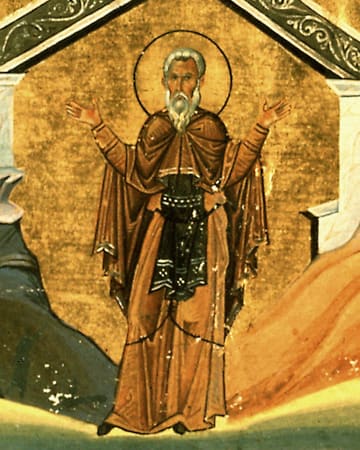
Hymn of Praise
Auxentius, ornament of Orthodoxy,
One night in mute silence
Prayed to God with tears,
And in spirit ascended to heaven
Like a cherub with fiery wings,
While the saint's gaze wandered
Into the host of stars in the heavenly vault;
The elder was amazed, the elder wept,
The hieromonks asked him
To tell them what he beheld,
And why the elder wept?
"My children, hieromonks,
I saw the soul of holy Simeon,
Simeon the great Stylite,
Pillar of faith, pillar of Orthodoxy,
Tonight the Stylite has departed,
His soul ascends to heaven,
Bright flame, brighter than stars,
The soul stopped by us,
Greeted me the sinner sweetly."
From that night many nights passed,
Until news came of the Stylite's death,
All recognized the truth of the vision
That St. Auxentius saw.
Reflection
Why do people leave one place and move to another? Mainly because they hope to be happier in another place. And indeed, from the viewpoint of worldly life and pleasure, places can be different, better and worse. Whoever does not hope for a better life after death, seeks better sensory pasture in this life. But if you listen to the heart of those people who could and knew how to live in the so-called best places on earth, you will perceive dissatisfaction, misery and despair. They did not find what they were seeking. They ate to satiety in every place, and finally, still hungry, they look death in the eye.
But look at the Christian saints! They chose places with the least worldly pasture, places "dry, impassable and waterless," places solitary and terrible, places that least attract attention and which no one fights over. All places on earth they considered equally without value, but they chose these places only so that they might more easily draw near in spirit and mind to their immortal homeland. And if anyone listened to their heart, they would perceive joy and satisfaction.
Contemplation
Contemplate the Lord Jesus as a Father who in the desert weeps for His children, calling them and gathering them, namely:
- The children of the people of Israel (at that time);
- The children of all peoples on earth;
- The children of all times from creation to the end.
Homily
On reversed values in God's kingdom
But many that are first shall be last; and the last shall be first
Matthew 19:30; Luke 13:30
How wise is He who uttered these words! He did not say that all the first will be last and all the last first, but many. There is not a single error in the Gospel and nowhere any exaggeration.
Why did the Lord limit and not say all, but many? Experience teaches us that some of those who were first in honor on earth, remained first in honor also with God. There were emperors who from their throne pleased God, and there were people outside all authority who until death angered God. There were rich men who by charity and faith were saved, and there were poor men who because of malice and unbelief received condemnation. There were famous people who rejected both faith and virtue. And so some who were first here, remained first there also, and some who were last here, remained last there also.
But, alas, many first here became last there. And O joy, O justice of God: many last here, became first there!
The Lord neither singled out nor praised any one estate, any one trade, above all others, but recruited (and to this day recruits) the army of light from all estates, from all trades and occupations. For Him the measure of a man is neither crown nor beggar's bag but faith, faith and virtue.
Wise Lord, remember us also in Thy kingdom. To Thee be glory and praise forever. Amen.
From the Prologue from Ochrid, translated by Marcian Sakarya, OCHRID.COM. CC BY-SA 4.0.
The Prologue, every day
Axios! brings the day’s Hymn of Praise, Reflection, Contemplation and Homily to Today, with the saints, the feasts and the saying of the day, on iPhone, iPad and Android.