
March 1
Saints of the day

Hymn of Praise
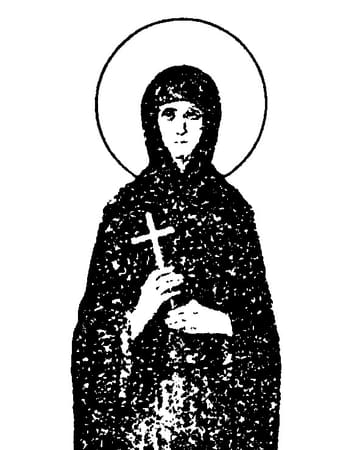
Venerable Martyr Eudocia
Once a woman filled with sin,
But at last a meek and contrite penitent,
Eudocia prayed to God,
Kneeling continually, shedding tears.
This kindled fury in Satan,
And in his rage he cried out toward the heavens:
"O Michael, heavenly commander,
You speak of justice yet do me injustice,
You intend to empty my fold entirely,
To snatch away my very last sheep.
Why do you take this sinner?
Her sins are heavier than mine!
I fell into hades and eternal torments
For some small act of disobedience,
While her sins, like a fetid sea,
Have infected all who drew near her."
Thus malice rails against goodness,
And plots evil against every penitent,
While Michael, guardian of penitents,
Drew near to Eudocia with his angels
And took her under his protection,
And with his breath scattered the demons.
Then from heaven a song rang out:
"The mercy of God is pleased thus,
That every penitent be received,
That every penitent be forgiven.
Repentance, salvation for mankind,
This is God's mercy and God's will"
God's will, to Satan's great displeasure.
Reflection
Faithfulness and submission to the will of God ought to adorn the life of every Christian. God glorifies the faithful and obedient, as is seen also in the life of Saint Agapius. This saint, when still a young man, was seized by pirates, taken to Asia, and sold to a certain Arab. For a full twelve years Agapius served this Arab in silence and obedience; and for a full twelve years he prayed to the Most Holy Theotokos to free him from slavery. One night the Theotokos appeared to him and told him to arise and go to his elder without fear. Agapius arose and came to his elder on the Holy Mountain. When the elder saw Agapius, he was grieved, thinking that he had fled of his own accord from his master. Agapius, faithful and obedient to the will of God, immediately returned to Asia, presented himself to his master, and recounted to him everything that had happened. When the Arab heard everything, he marveled at the virtue of Christians and desired to see Agapius's elder. He therefore took his two sons and came to the Holy Mountain. There he was baptized together with his sons; all three were tonsured and remained until death in ascetic struggle, first under the guidance of Agapius's elder and then under Agapius himself. And so the former harsh masters became obedient disciples of their former slave, the faithful and God-submissive Agapius.
Contemplation
Contemplate the Lord Jesus at the Last Supper, namely:
- How He washes the feet of the disciples, and thereby teaches them especially humility and mutual love;
- How Peter, one of the most faithful, is ashamed and refuses to let the Lord wash his feet;
- How Judas, the unbeliever and traitor, is not ashamed and does not refuse to let the Lord wash his feet;
- How even today the faithful receive God's countless benefactions with emotion and shame, while the unfaithful receive the same without emotion, without shame, and even with murmuring against God.
Homily
On knowing and doing
If ye know these things, blessed are ye if ye do them
John 13:17
The most important thing in this saying of the Lord, dear brethren, is that the Lord does not pronounce blessed the knowing but the doing. He does not say to the apostles: blessed are you when you know these things. So spoke certain pagan teachers who saw salvation in knowledge alone. No, the Lord says: blessed are ye if ye do them. The knowledge of salvation was brought by the Lord Jesus Himself. To that knowledge no one could attain by his own effort. Some of the ancient Greek philosophers said that the human race could neither attain the truth nor be saved until God Himself came to earth. The Lord came among men and revealed the knowledge to men. Whoever receives this knowledge receives also the obligation to act upon it. Oh, how much lighter will the Judgment be for him who never received this knowledge and, consequently, never acted upon it, than for him who received this knowledge and neglected to act on it!
Oh, how much lighter will the Judgment be for ignorant pagans than for learned Christians! The Lord Himself showed Himself not only as one who knows but as one who does. To His perfect knowledge there corresponded also perfect doing. He Himself in person, before the eyes of His disciples, fulfilled all His own commandments. And this commandment He gave them after the accomplished deed of humility and love. Having washed the feet of the disciples, He then commanded them to do likewise one to another.
The Lord did not come among men to soil men, but to wash them. He soiled no one, yet washed everyone who desired to be washed. What shame for many of us who strive to wash only ourselves while striving twice as hard to soil others! O my brethren, it is our own born brothers that we soil! And Christ weeps when He sees how we soil with the mud of slander those whom He washed with His own blood.
O Lord, forgive us. We sin every day against our brethren. And make, O Lord, the brethren whom we have soiled brighter than ourselves in Thy Kingdom. Thou art righteous and seest all things. To Thee be glory and praise forever. Amen.
From the Prologue from Ochrid, translated by Marcian Sakarya, OCHRID.COM. CC BY-SA 4.0.
The Prologue, every day
Axios! brings the day’s Hymn of Praise, Reflection, Contemplation and Homily to Today, with the saints, the feasts and the saying of the day, on iPhone, iPad and Android.