
May 7
Saints of the day
Also commemorated
The Commemoration of the Appearance of the Honorable Cross in Jerusalem
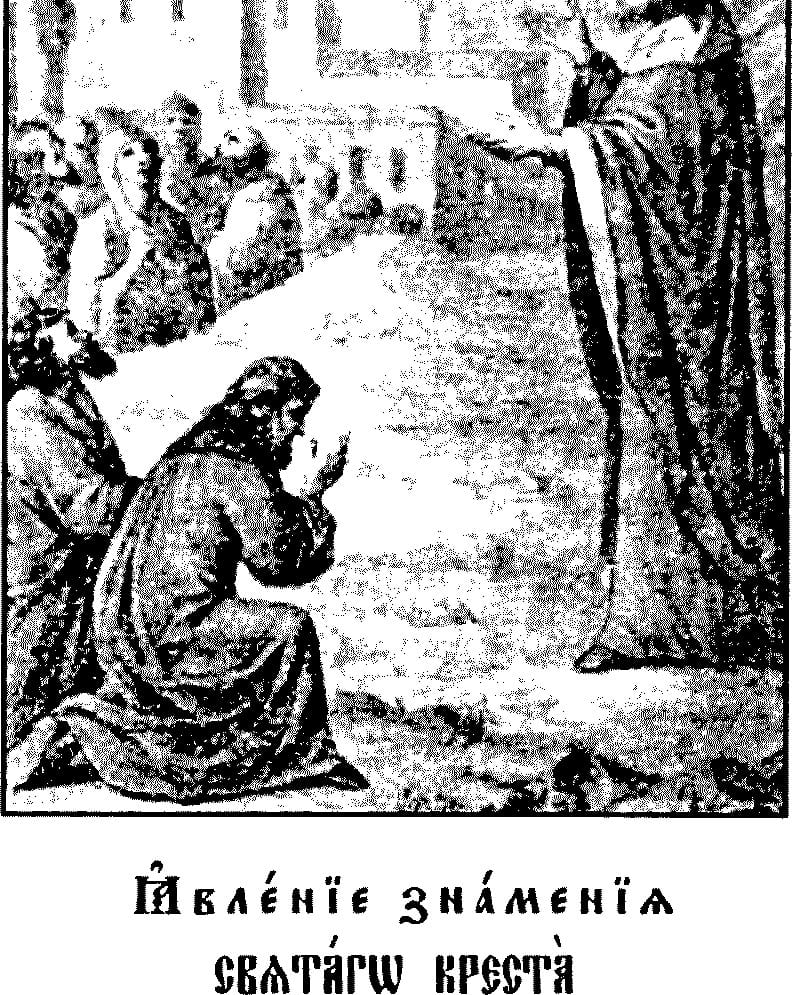
In the time of Emperor Constantius, the son of Saint Constantine, and Patriarch Cyril of Jerusalem, the Honorable Cross appeared in the morning at the ninth hour over Golgotha, extending to above the Mount of Olives. This Cross was brighter than the sun and more beautiful than the most beautiful rainbow. All the people, both believers and unbelievers, left their work and in fear and wonder gazed upon this heavenly sign. Many unbelievers were converted to the faith of Christ, and likewise many Arian heretics abandoned their malicious heresy and returned to Orthodoxy. Concerning this sign, Patriarch Cyril wrote a letter to Emperor Constantius, who himself inclined toward Arianism. This occurred on May 7, 357. Thus it was shown on this occasion as well that the Christian faith lies not in the worldly wisdom of human sensory reason but in the power of God, manifested through innumerable miracles and signs.
Hymn of Praise
Acacius, a soldier of the Most High King,
Acacius prepares himself for death,
He censes his soul with the incense of prayer;
The godless judge asks him:
Why does Christ not deliver the faithful?
Why does He not punish your tormentors,
When you call Him God Almighty?
The martyr gently answers:
The Lord Christ is great in mercy,
In mercy and in long-suffering,
From sinners He awaits repentance,
And from the faithful, patient suffering.
If He punished sinners immediately,
How would He manifest His mercy?
And if the righteous did not suffer,
With what would they display the power of God?
And with what would they shine before the world?
The word was spoken, the head was severed,
Into God's Paradise the soul ascended.
Reflection
"I acknowledge that I was more indebted, and that more has been forgiven me: from judicial and public affairs I was called to the priesthood, and therefore I fear that I may prove ungrateful if I love less than has been forgiven me." These are the words of Saint Ambrose, who was suddenly called by God to change his vocation and from a civil judge become a hierarch of the Church of Christ. By these words the saint shows how the priestly calling is higher than the secular, how one comes to it by the calling of God, and how he who is called owes gratitude to God. The debt of gratitude to God was considered by all the saints to be their chief debt. Without gratitude to God there can be no progress in the spiritual life. Continual gratitude to God is a noble seed from which, if watered by the tears of continual repentance, there grows the most beautiful fruit: love for God.
Contemplation
Contemplate the descent of God the Holy Spirit upon the holy Apostles, namely:
- How the holy Apostles all stood in prayer with one accord,
- How suddenly there came a sound from heaven as of a rushing mighty wind.
Homily
On the Power of the Word of the Lord
Is not My word like fire, saith the Lord, and like a hammer that breaketh the rock in pieces?
Jer. 23:29
Indeed, O Lord, Thy word is truly like fire that warms the righteous and burns the unrighteous. And Thy word is truly like a hammer that softens the stony hardness of the penitent's heart, and crushes to dust the hearts of unrepentant sinners.
Did not our heart burn within us, while He talked with us? (Luke 24:32) the Apostles asked one another after their conversation with the risen Lord. When the heart in a man is upright, it burns from the word of the Lord, and melts with sweetness, and expands with love. But when the heart in a man is crooked and petrified by sin, then it is scorched by the word of the Lord and grows even harder. And the heart of Pharaoh was hardened.
In vain do sinners fortify themselves in their fortresses of stone, in their fortresses of iron, in their fortresses of silver and gold, casting off the armor of God's righteousness. Like a mighty and irresistible hammer is the word of the Lord, when He pronounces judgment upon those stone fortifications in which sinners entrench themselves.
In vain does the unbeliever fortify his house with hard stone, and the statesman his state with the petrified wisdom of this world, not trusting in the living God. The word of the Lord falls like a hammer upon all that is built apart from God, or against God, like a mighty and irresistible hammer.
O brethren, let us not trust in our own constructions of stone, neither of marble nor of gold nor of silver, nor of the godless stone of our own thoughts. All of this is weaker before the power of God than dust before the power of the wind.
O Almighty Lord, help us to receive Thy word and to build upon it our entire life, both in this world and in the world to come. To Thee be glory and praise forever. Amen.
From the Prologue from Ochrid, translated by Marcian Sakarya, OCHRID.COM. CC BY-SA 4.0.
The Prologue, every day
Axios! brings the day’s Hymn of Praise, Reflection, Contemplation and Homily to Today, with the saints, the feasts and the saying of the day, on iPhone, iPad and Android.