
October 11
Saints of the day
Also commemorated
Commemoration of the Seventh Ecumenical Council
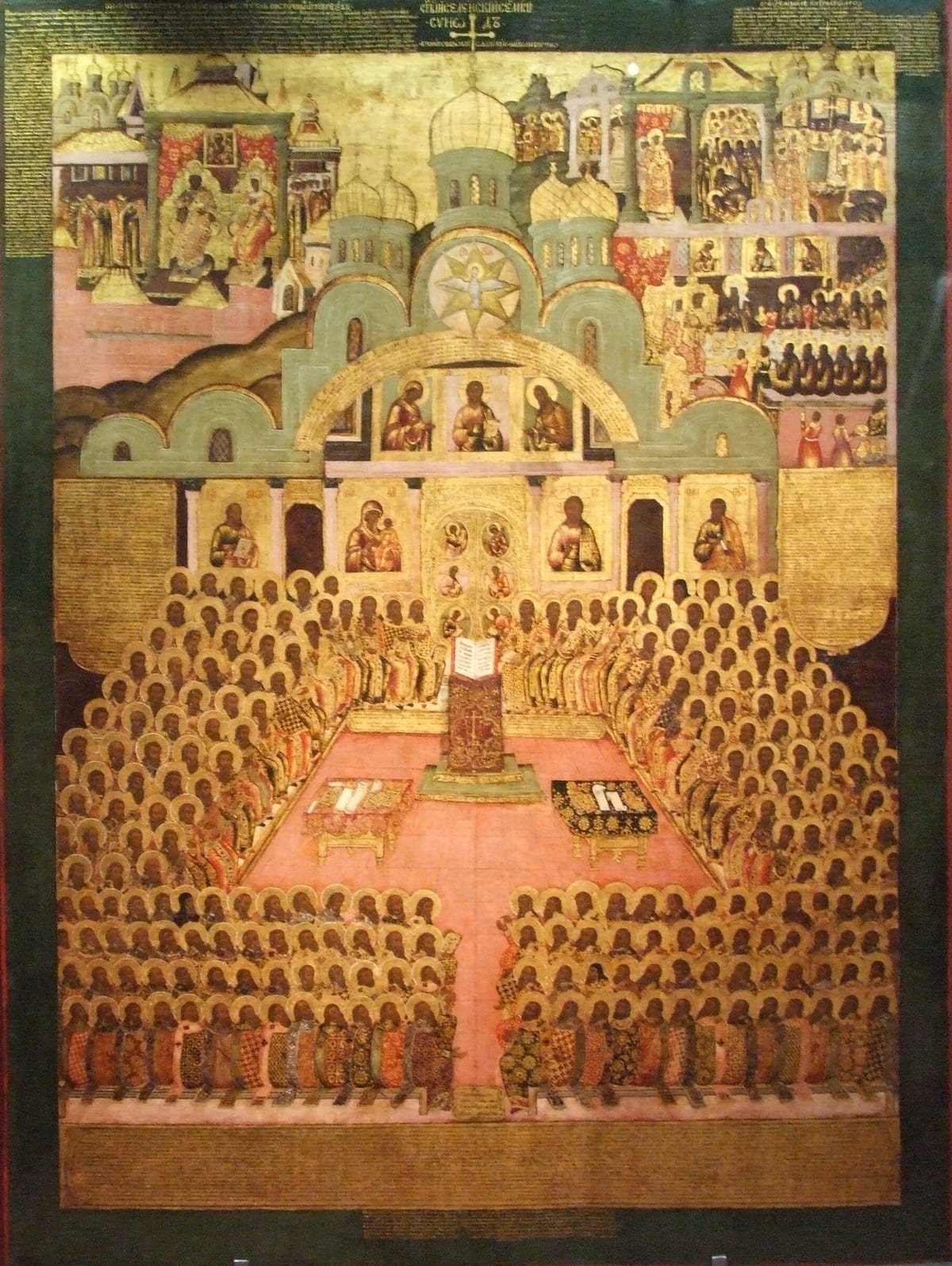
This Council was held in the year 787 in Nicaea, during the reign of the pious Irene and her son Constantine, and during the time of Patriarch Tarasius. This Council definitively established the veneration of icons, having justified it by Holy Scripture, by the testimony of the Holy Fathers, and by reliable examples of miracles manifested through holy icons. Among other cited examples of miracles, Bishop Constantine of Cyprus offered this one: a certain shepherd from the city of Constantia, having driven out his flock to graze one day, saw an icon of the Most Holy Theotokos, all adorned with flowers by the faithful. "Why render such honor to a stone?" said the shepherd (no doubt raised in iconoclasm), and he struck the icon with his iron staff and damaged the right eye on the image of the Mother of God. But no sooner had he left that place than he stumbled and with that same staff put out his own right eye. Returning to the city blind in one eye, he cried out weeping and declared that punishment had befallen him from the Theotokos. This Council also decreed that holy relics of martyrs must unfailingly be placed in the antimins. Three hundred sixty-seven Fathers participated in the Council. By their prayers may the Lord have mercy upon us and save us.
Hymn of Praise
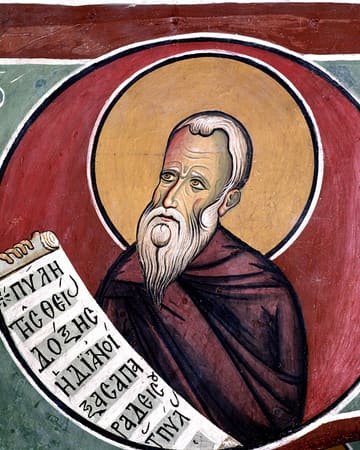
Venerable Theophanes the Branded
Theophane of the Lavra of Sabbas, an excellent ascetic,
A profound theologian and most glorious poet,
A sufferer for Christ, a confessor of the faith,
An adornment of the Church, an Orthodox Father,
He left his cell for the sake of obedience,
From the deep silence he stepped again into the world,
To convince the wicked emperor with the truth
And bear witness to the true truth before the emperor.
A quarter of a century, and more than enough for happiness!
That passed in torment for holy Theophanes,
In the hardest torment, in a cold dungeon,
Bearing the torment inscribed upon his face.
But the saint of God, inspired by the Spirit,
Filled all his time with sweet hymn-singing,
Glorifying the Lord and the Lord's saints
With fervent love, with faith and with hope.
Reflection
Just as God's Providence gives healing and miraculous power to holy water or blessed oil, so also is such power given to icons. Saint Athanasius the Great cites a wonderful example of the miraculous power of holy icons. In the city of Berytus there lived a certain Christian who rented a house. When he moved out of that house, he left behind an icon of the Savior. After him a certain Jew moved into the same house. And in that city there were many Jews, and particularly those embittered against the Christian faith. When, therefore, the icon was found, the Jews carried it out to their meeting hall and began to mock it, just as their forefathers had once mocked the living Savior. And the Jews did to the icon the very same things that their forefathers had done to the Savior, namely: they pierced the hands and feet with nails, they put vinegar to the mouth on the icon, and in every way mocked the image of the Savior. Finally one of them took a spear and struck the divine image beneath the ribs. But, O wonder, from the pierced place there flowed blood and water, just as once from the living body of the crucified Lord. The fear and horror of the Jews cannot be described. Then they brought a vessel to catch the blood; and they brought many sick people (blind, deaf, lame, and possessed) who, as soon as they were anointed with that blood, were all healed. At this miracle the whole city gathered, and all glorified Christ God. And the Jews in that city all came to believe in the Lord Christ, the Living and Life-Giving.
Contemplation
Contemplate the many iniquities of the people of Israel and the many punishments of God, namely:
- How the princes of the people often turned away from God and did what was evil before God;
- How God punished the people in order to correct them;
- How, finally, under the wicked king Jehoiakim, the people of Israel were led away into Babylonian captivity.
Homily
On the voice of the Lord upon the waters
The voice of the Lord is upon the waters
Psalm 29:3
On the Jordan the voice of the Lord was heard, when Saint John baptized the Savior. On the Sea of Galilee, when there was a storm and winds, the voice of Christ was heard, and the storm was stilled and the winds ceased. The voice of the Lord was heard at the wedding in Cana of Galilee, and water was turned into wine. On the Red Sea the voice of the Lord was heard, and the sea parted and opened a way for the people of God. In the wilderness the voice of the Lord was heard, and water flowed from a dry rock. What does this mean: the voice of the Lord is upon the waters? It means: the element of water is a work of God, and through it God works miracles when He wills and as He wills. No less are the other elements also the work of God: fire, air, and earth. And over them God is Lord; and through them God works miracles when He wills and as He wills. In the form of fire God the Holy Spirit appeared at Pentecost. In the Babylonian furnace the flame lost its power by the word of the Lord and did not harm the blessed youths; fire fell from heaven and consumed the sacrifice of Gideon (Judges 6). Elijah brought down fire from heaven. The bush burned and was not consumed (Exodus 3). Fire from heaven fell and consumed the sacrifice to God (1 Kings 18). A pillar of fire went before the Israelites. All this by the word of the Lord. The earth opened and swallowed up the unjust Korah, Dathan, and Abiram (Numbers 16). The earth opened and hid Elizabeth with the infant John from the sword of Herod. The earth quaked when the Lord expired on the Cross, and the graves were opened. Through the air the Lord ascended into heaven. Through the air the holy apostles were transported to Jerusalem from various parts of the world. Through the air an angel instantly transported the prophet Habakkuk to Babylon. And all this by the voice of the Lord, by the command of the Lord. Oh, if only men were as obedient to the voice of the Lord as the mindless elements of nature are obedient to Him! But by "waters" are also truly understood those men who are obedient to the voice of the Lord: the apostles and the saints. Like water they poured out over the whole world with the preaching of Christ God. Like water they quenched the thirst of the world from the fountain of eternal life. And the world was renewed and blossomed. As upon ordinary waters, so also upon them innumerable miracles of God were manifested, for they were submissive to the will of God, obedient to the voice of God, like water, exactly like water.
O Lord Jesus Christ, help us to be obedient to Thy voice. Help us to be ashamed before the dead elements, which obey Thee better than we do. To Thee be glory and praise forever. Amen.
From the Prologue from Ochrid, translated by Marcian Sakarya, OCHRID.COM. CC BY-SA 4.0.
The Prologue, every day
Axios! brings the day’s Hymn of Praise, Reflection, Contemplation and Homily to Today, with the saints, the feasts and the saying of the day, on iPhone, iPad and Android.