
October 13
Saints of the day
Hymn of Praise
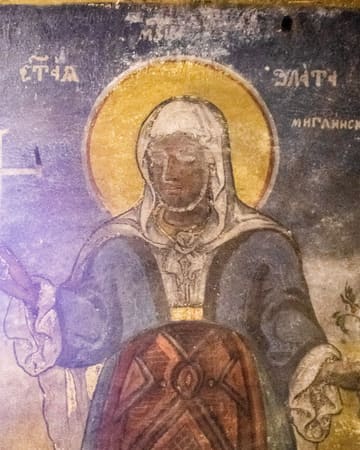
Holy Great Martyr Zlata of Meglen
Holy Zlata, golden-hearted,
The Turks tormented,
For the sake of Christ, the living God,
They wore her down with suffering.
Golden Zlata did not weep,
Nor did she waver,
But with her whole heart she surrendered
To the Lord of heaven.
In vain the tears of parents,
In vain the tears of sisters,
Zlata sought sweetness through suffering,
Sweetness that is true,
Sweetness that Christ has prepared
For the wise virgins,
Sweetness that the Bridegroom gives
To the faithful virgins.
Razed was the cage of the body
Of golden Zlata.
Her soul was set free
From a crumbling prison,
And to Paradise Zlata rose,
Her soul rejoicing,
She took her place among the rulers,
The holy angels.
Once a poor village girl,
Holy Zlata
In Paradise is now glorified
As a queen.
Reflection
Nothing is more pitiable than a man who in the hour of misfortune abandons hope in God and resorts to means of salvation contrary to the law of God. Not only does such a man fail to save and repair his outward situation, but he even loses his soul. Such was the case with Emperor Michael Palaeologus. In order to save his empire, threatened by the Bulgarians and the Serbs, he sought help from the Pope and agreed to the union. What did he gain by this? He did not save the empire, and he committed innumerable crimes, and soon ended his life wretchedly during a military campaign against Prince John Ducas of Epirus. The Orthodox people were so incensed against him that his son Andronicus did not dare bury him publicly, but interred him by night without a funeral service or prayer. Excommunicated by the Orthodox Church and not accepted by the Roman, Michael ended his life outside the Church of God. His wife the empress, after his death, issued this decree: "My Majesty abhors and considers abominable that deed (the union) which recently occurred in the Church and troubled it... And since the holy Church of God has determined not to grant the prescribed commemorations to my deceased husband, lord, and emperor, on account of the aforementioned deed and disturbance, my Majesty, preferring the fear of God and obedience to the holy Church above all things, approves and accepts that determination, and shall never presume to make commemoration of the soul of my lord and husband."
Contemplation
Contemplate the miraculous punishment with which the Apostle Peter punished Ananias (Acts 5), namely:
- How Ananias, and then his wife Sapphira, lied and concealed some of the money;
- How the Apostle Peter exposed them, and they fell down one after the other and died.
Homily
On the burden of sin and deliverance
Blessed are they whose iniquities are forgiven and whose sins are covered
Psalm 32:1
From sin is born fear, and confusion, and weakness, and feebleness, and darkening of the mind. By sin a man provokes men against himself, disturbs his own conscience, gathers demons around himself, and gives them weapons against himself. By sin a man separates himself from God, distances himself from his guardian angel, and walls himself off from the source of every good. A committed sin signifies a declaration of war against God and all good powers. This is more absurd than for a withered autumn leaf to declare war on the wind. But even this most absurd thing happens, namely: man declares war on God! That very declaration means defeat and destruction in advance, unless the man quickly comes to himself, repents, and flees to God for mercy. The terrible position of a sinner was well felt and tested upon himself by the great King David. He felt indescribable fear, and confusion, and feebleness, and loneliness; he felt the arrows of men and the arrows of demons. But seeing his dreadful position, David acknowledged his sin, fell in ashes before God, flooded the earth with tears of repentance and words of pain that burn like fire, and implored the merciful God to forgive him. And when all was forgiven him, he then felt indescribable blessedness. That blessedness of a forgiven soul he cannot show in words: he only proclaims and affirms and assures, on the basis of his experience of both states, that is, both the state of sinfulness and the state of forgiveness from God: blessed are they whose iniquities are forgiven and whose sins are covered! What is this blessedness? Freedom, and courage, and unspeakable joy, and power, and strength, and clarity of thought, and peace of conscience, and hope in God, and a song to God, and love for one's neighbors, and the meaning of life! In a word: light, joy, strength. These are those blessings. These are the blessings that one forgiven of sin feels here on earth; but what blessings await him in heaven, that eye hath not seen, nor ear heard, neither have entered into the heart of man (1 Corinthians 2:9).
O Lord our God, by Thy boundless mercy, forgive us our iniquities and cover our sins! To Thee be glory and praise forever. Amen.
From the Prologue from Ochrid, translated by Marcian Sakarya, OCHRID.COM. CC BY-SA 4.0.
The Prologue, every day
Axios! brings the day’s Hymn of Praise, Reflection, Contemplation and Homily to Today, with the saints, the feasts and the saying of the day, on iPhone, iPad and Android.