
October 18
Saints of the day
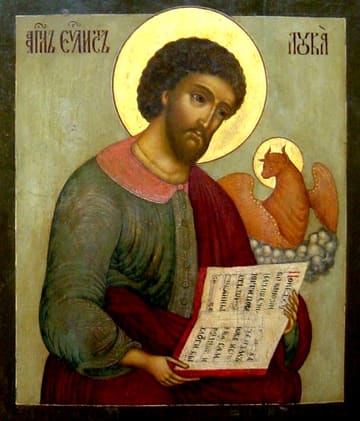
Hymn of Praise
The divine Luke, both wise and learned,
Was willingly martyred for the Lord.
He could have escaped reproach and torment,
But then the world would not have had the great Luke.
Young Luke beheld the Truth of God,
He gave his heart to the Son of God,
Listened to the Teacher, beheld the Wonderworker,
And in Him recognized his immortal Creator.
He saw the Risen One and spoke with Him,
He wrought miracles in His name.
And Christ became his singular joy,
Luke sacrificed to Him mind, treasure and youth.
When Luke grew old, through Christ he was young,
From Christ he received and to the world he gave,
And when he gave the world all he could give,
Then the world, according to Scripture, repaid him with cruelty...
On an old olive tree hangs the elder Luke,
With a smile upon his face, his arms crossed,
From heaven a hand of Christ Himself was stretched forth
And received the soul of His Evangelist.
Now in the radiant Paradise with the other apostles,
Holy Luke prays for the holy Church.
Reflection
Can a sinner atone for his sins in ten days? By the immeasurable mercy of God, he can. In the time of Emperor Maurice there was a certain notorious robber in the vicinity of Constantinople. Both in the environs of the capital and in the capital itself there reigned fear and trembling on account of him. Then Emperor Maurice himself sent him a cross as a sign of his pledge that he would do him no harm if he surrendered. The robber accepted the cross and surrendered. Coming to Constantinople he fell at the emperor's feet and begged for forgiveness. The emperor kept his word, pardoned him and set him free. But immediately thereafter the robber fell gravely ill, and he sensed that death was drawing near. He began to repent bitterly of all his sins and to pray tearfully to God, that God would forgive him as the emperor had also forgiven him. He shed many tears in prayer, so that the kerchief with which he wiped his tears was completely soaked through. And the robber died after ten days of weeping and prayer. That very night when he died, the physician who had been treating him saw in a dream a wondrous vision: when the robber on his bed breathed out his soul, some sort of dark figures gathered around him with many papers on which were written the sins of the deceased. Then two radiant angels also appeared. Between them scales were set, and the dark figures joyfully placed all those papers on the scales, and their side of the scales sank, for the other side was empty. "What shall we place on our side?" the angels conferred. "Let us search for some good in his life!" And in the hands of one angel there was found that kerchief soaked with penitent tears. The angels quickly placed it on their side of the scales, and their side at once outweighed all those papers. Then the dark figures fled, howling sorrowfully, and the angels took the soul and carried it to paradise, glorifying the love of God for mankind.
Contemplation
Contemplate the miracle with the Apostle Philip and the eunuch (Acts 8), namely:
- How an angel directed Philip from Samaria to the road to Gaza;
- How Philip saw the eunuch of the queen, explained to him a prophecy of Isaiah, and baptized him;
- How the angel took Philip, made him invisible to the eunuch, and instantly transported him to the city of Azotus.
Homily
On the sins of the tongue
I said, I will take heed to my ways, that I sin not with my tongue
Psalm 39:1
The sin of the tongue is the most frequent and the swiftest sin. If any man offend not in word, the same is a perfect man, says the Apostle James (James 3:2). When a penitent takes the ways of God, that is, when he begins to live according to the commandments of God, let him strive first not to sin with his tongue. Such a rule the penitent David had set for himself. He especially resolved to be silent before his adversaries: I will keep my mouth with a bridle, while the wicked is before me. Here is a splendid rule for those who are being healed of sin. When he is accused, he does not answer; when he is slandered, he is silent. In truth, what use is it even to speak to an enraged unjust man who does not have God before him? If you speak to him of evil, you will only irritate him more; but if of good, you will make him a mocker of what is holy. Before Pilate, Christ was silent. Answerest thou not me? said Pilate. What shall He answer thee, when thou hast no ears to hear nor reason to understand? Behold, the silence of the righteous before the unrighteous can still have the best influence upon the unrighteous. Left to interpret the silence of the righteous for himself, the unrighteous man may interpret it for the benefit of his own soul, while every answer, white or black, he will interpret to the evil and condemnation of the other and to the justification of himself. Blessed is the one who has learned to govern his tongue. O Lord Jesus Christ, our God, Thou who hast shown us by Thine example how and when one should speak, hast also shown us by Thine example how and when one should be silent. Help us by Thy Holy Spirit, that we sin not with our tongue. To Thee be glory and praise forever. Amen.
From the Prologue from Ochrid, translated by Marcian Sakarya, OCHRID.COM. CC BY-SA 4.0.
The Prologue, every day
Axios! brings the day’s Hymn of Praise, Reflection, Contemplation and Homily to Today, with the saints, the feasts and the saying of the day, on iPhone, iPad and Android.