
October 21
Saints of the day
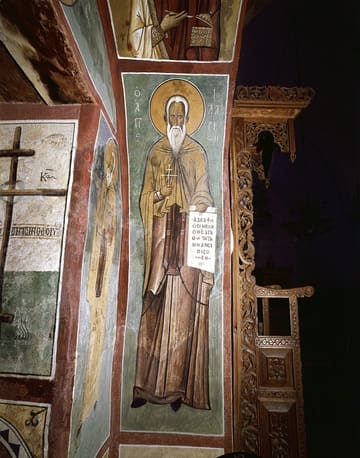
Hymn of Praise
Holy Hilarion, like a radiant comet,
Fleeing from people, traversed half the world,
But in vain does a star hide from sight,
Its light is revealed to all the world.
Hilarion wished to escape glory,
But from glory the saint cannot flee;
Where God did not reveal him, the demons did,
Terrified by the saint who drives them out.
Wondrous Hilarion, wherever he settled,
Showed forth miracles and healed the sick,
Having conquered his own infirmities and passions,
Conqueror of the world, he subdued the demons.
Hidden in a cave, yet proclaimed to all,
Shunning everyone, yet by all glorified.
Thus the Lord glorifies those who glorify Him,
With crowns He crowns the victorious runners.
When the race of earthly life is over,
Then the crowns of eternal life are given.
The elder Hilarion, in spirit ever young,
Now face to face delights in the Lord.
But even now for us he wages war by prayer,
That by His mercy the Lord may have mercy on us too.
Reflection
The all-seeing eye of God watches over all people and in a wondrous manner guides the faithful toward salvation. What at first seems to the faithful as a great loss, in the course of time reveals itself as a great gain. The case of Saint Philotheus and his brother, who for their mother were as if lost, is similar to the case of Saint Xenophon (January 26), and similar to the case of Saint Eustathius Placidas, his wife and his sons. When Saint Philotheus and his brother sat in a Turkish prison in Macedonia, the Most Holy Theotokos appeared to them in the likeness of their mother and said to them: "Arise, my dear children, and follow me!" And suddenly the young men found themselves in a monastery in the city of Neapolis in Asia Minor. When the young men told the abbot what had happened to them, the abbot understood that this was from God, received the young men and tonsured them as monks. A long time passed since that event. Their mother mourned them and resigned herself to their loss. Finally she resolved to go to a women's monastery and devote herself to God. And the Providence of God led her to the vicinity of the monastery in which her sons were. Once, at the patronal feast of that monastery, she came with other nuns to the celebration. In the church she saw her sons but did not recognize them. At that moment one of the brothers called the other by his worldly name. That dear name pierced the mother's heart, and she gazed attentively at their faces. And the mother recognized them, and they their mother. And their joy was great; and they offered heartfelt thanksgiving to God. A believing Christian, even in the greatest loss, should not despair.
Contemplation
Contemplate the miraculous healing of the blind Saul by Ananias (Acts 9), namely:
- How Ananias laid his hands on Saul, invoking the name of the Lord Jesus;
- How something like scales fell from Saul's eyes, and he received his sight, and was baptized, and became Paul.
Homily
On the God-inspired heart and tongue
My heart overfloweth with a good word. My tongue is the pen of a ready writer
Psalm 45:1
Behold the inspiration of the Spirit of God! The prophet wishes to speak of Christ the Lord, and his heart swells with power and wisdom. Therefore he does not say: my heart will speak or utter a good word, but overfloweth, as though he is bringing forth a part of his very own heart. Like a jet of water from an overflowing spring. The surging water presses in its underground confinement, and when it reaches the opening of the spring, it bursts forth in great jets. Such is the heart of the prophet when he wishes to speak of Christ. Such is the power of grace, compressed within the human heart. If it does not manifest itself in mighty words, or if it does not manifest itself in wonderworking deeds, it will shine within the person and work wonders inwardly. And when it issues forth in words, the tongue of the prophet becomes like a reed, like the pen of a ready writer. For here the person does not labor to compose a thought, nor does he labor to clothe the thought in garments of words, but grace itself wells up upon the tongue with ready thoughts and words. Whence such power in a person? From God the Holy Spirit. Why such power? Because the prophet wishes to speak to the King about the King Himself. I will address my works to the King. Here deed and word are identical, as is often the case in Holy Scripture. Where the Spirit speaks, He also acts; and where He acts, He also speaks. Most powerfully does one speak through deeds. The prophet takes from Christ the King and gives to Christ the King. He speaks with the enthusiasm of love for the Savior of the world; he speaks from a heart brimming with the enthusiasm of divine love. From the distance of time he beholds the incarnate Son of God, and his heart leaps for joy. Like a weary traveler in the night when he catches sight of the beautiful dawn in the east! O Lord God, Holy Spirit, do not withhold from us Thy holy and mighty grace, that we may be cleansed of sin and made worthy of the Kingdom of Christ. To Thee be glory and praise forever. Amen.
From the Prologue from Ochrid, translated by Marcian Sakarya, OCHRID.COM. CC BY-SA 4.0.
The Prologue, every day
Axios! brings the day’s Hymn of Praise, Reflection, Contemplation and Homily to Today, with the saints, the feasts and the saying of the day, on iPhone, iPad and Android.