
October 24
Saints of the day
Hymn of Praise
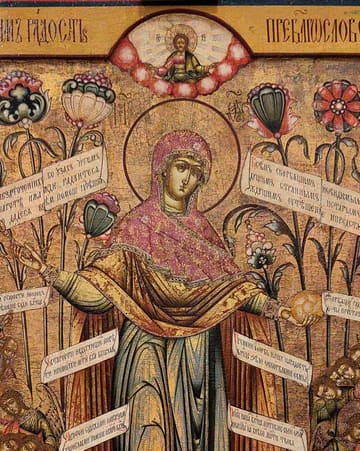
O Most Holy Mother of God,
Joy of all who sorrow,
Grant also to us sinners
Of thy mercy.
Upon the throne of the eternal Kingdom
Thou hast thy Son,
And all our afflictions thou dost see,
All of them, one by one, thou dost know.
Thou hast always prayed
To Christ God for the faithful,
And hast eased exceeding pain
And torment of the sorrowful.
But cease not, O Holy Virgin,
Until the end of time,
To pray for the salvation
Of our race.
God has made thee more glorious
Even than the Seraphim,
O hasten, O help
All who sorrow!
Reflection
When a person in holy orders commits iniquity, a far heavier punishment befalls him than when a common layman, who is less initiated into the mysteries of the will of God, commits the same iniquity. Saint Arethas was a monk in the Caves Monastery and was exceedingly avaricious. In his cell there lay a pile of treasure, from which he gave not a single coin to anyone. But once he fell terribly ill and saw, as if in waking life, how demons were snatching his soul from the angels, crying: "He is ours, he is ours!" and citing as proof Arethas's love of silver and miserliness. Having recovered from his illness, Arethas corrected his life, and from then on he counted all earthly treasure as nothing. And the merciful God forgave him and later gave him great grace. Again, a certain monk from the monastery in which the blessed Emperor Elesbaan reposed had grown accustomed to frequenting a tavern, getting drunk there, and even committing obscenities with women. One day, as he was returning from the tavern, a terribly large serpent attacked him and pursued him relentlessly. In great distress and anguish, the monk cried out: "By the holy and righteous Elesbaan, depart from me!" And the serpent suddenly stopped. And the monk heard, as it were, a human voice from the direction of the serpent: "An angel of God commanded me to devour you on account of the impurity and defilement of yours, for you vowed to serve the Lord in purity, yet now you defile your body and anger the Holy Spirit." And the monk swore that he would never sin again, returned to the monastery, and until his death sinned no more. Thus God both chastised and showed mercy through the prayers of the holy Emperor Elesbaan.
Contemplation
Contemplate the wondrous visitation of the angel of God to Cornelius the centurion (Acts 10), namely:
- How by day and in waking life Cornelius saw the angel of God, who addressed him by name;
- How Cornelius was frightened and answered: What is it, Lord?
- How the angel instructed him to send to Joppa for the Apostle Peter, who would tell him the words of salvation.
Homily
On the open coming of God
God shall come openly and shall not keep silence
Psalm 50:3
The vocation of a commander is different from the vocation of a judge. A commander does not reveal himself to the enemy at once, but leaves it to the enemy to think of him as he will; for the commander's chief concern is to conquer. A judge, however, reveals himself at once to those whom he has to judge. The vocation of a teacher is also different from the vocation of a judge. The teacher's chief concern is to instruct his pupils; therefore he often descends to the level of his pupils and speaks to them as their friend. A judge, however, from beginning to end must be revealed to the accused as a judge, and nothing else. The vocation of a physician is also different from the vocation of a judge: and the difference in these two vocations is as easy to perceive as in the first two cases. God, brethren, revealed Himself to the world in a human body: He revealed Himself as a commander, as a teacher, as a physician. But He has not yet revealed Himself as a judge. In the first case, He kept silence about openly proclaiming His supreme dignity, but left it to enemies, pupils, and the sick to think of Him as they would. Whoever had sound judgment could recognize Him as God hidden in the body: by His words, by His deeds, by His love for mankind, and by the heavenly signs at His birth, at His crucifixion, at His Resurrection and Ascension. But he whose mind was darkened by some malicious passion could not recognize Him or acknowledge Him as God. But when He shall come as Judge, then no one will ask Him any longer, "Art Thou He?" or "Who art Thou?" but all in an instant shall know that it is truly He. Angels shall trumpet before Him; on the heavens His Cross shall shine; before Him fire shall blaze forth, and around Him a great storm shall be seen. Then both the faithful and the faithless, the righteous and the unrighteous, shall look and recognize the Judge. Then only those shall rejoice who recognized Him before as God, in the cave, and on the Cross. They shall truly rejoice, for in the Judge they shall recognize Him with whom they warred, from whom they learned, and by whom they were healed. O most glorious Savior, have mercy on us and set us aright before Thy second coming. To Thee be glory and praise forever. Amen.
From the Prologue from Ochrid, translated by Marcian Sakarya, OCHRID.COM. CC BY-SA 4.0.
The Prologue, every day
Axios! brings the day’s Hymn of Praise, Reflection, Contemplation and Homily to Today, with the saints, the feasts and the saying of the day, on iPhone, iPad and Android.