
October 6
Saints of the day
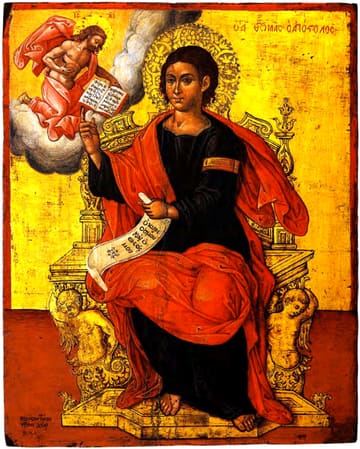
Hymn of Praise
Apostle Thomas by his unbelief
Strengthened the faith: the Lord appeared,
Thomas beheld Him and was filled with joy,
Joyfully Thomas glorified Christ.
India became the vineyard of Thomas;
Skillfully Thomas tended it with the Cross:
To the mighty and the lowly he proclaimed Christ,
Christ's wisdom, Christ's deeds.
O wise children of the land of India,
Your wisdom is a serpent in the grass;
Behold, a wisdom has descended from the heavens,
The wisdom of God is manifest in the flesh.
Thomas speaks and works wonders,
Multitudes of people joined Thomas,
Hearing wisdom, seeing miracles
That Thomas wrought in the name of Christ.
Great torments Thomas endured,
But the gates of idolatrous darkness he broke through,
And like Christ, five cruel wounds
For the sake of truth upon his body he received.
Five cruel wounds, by the number of the senses,
And this is a lesson of mysterious wisdom:
He who does not bridle all his senses
Will not taste of spiritual sweetness.
Reflection
We have a building of God, a house not made with hands, eternal in the heavens, says the far-seeing Apostle Paul (II Corinthians 5:1). All our labors for God on earth have this purpose: to earn by our own effort that house not made with hands, eternal in heaven. A certain Indian king, Gundaphor, decided to build himself a magnificent palace, such as there was none on earth. When his envoy Avan was searching for a skilled master to build the king such a palace, he met, by God's Providence, the Apostle Thomas, who told him that he was a master builder and that no one could build for the king what he desired except him. Thomas then received much gold from the king for the building of that palace. But as soon as he left the king, he distributed all the gold to the poor. After two years the king sent servants to ask Thomas whether the palace was finished, for the palace was to be built somewhere far from the capital. Thomas answered: everything is finished except the roof. And he requested more money from the king, and the king gave it to him. But Thomas again distributed everything to the poor, and went about the kingdom on his own business, that is, preaching the Gospel. The king learned that Thomas had not even begun to build the palace, seized him, and cast him into prison. That night the king's brother died, and the king fell into great sorrow. An angel took the soul of the deceased and led it through Paradise, and showed him a magnificent palace such as the human mind cannot even imagine. The soul of the deceased desired to enter that palace, but the angel told him that he could not, for it was the palace of his brother, built for him by the Apostle Thomas through his almsgiving. And the angel returned the soul to the body again. When the brother came to himself, he said to the king: "Swear to me that you will give me what I ask." And the king swore. Then the brother said: "Give me the palace of yours that is in heaven." The king was amazed and doubted that there could be a palace in heaven. But when his brother described everything to him in detail, the king believed, and immediately brought Thomas out of prison; and when he heard from the apostle's lips the words of salvation and of eternal life, the king and his brother were baptized. And the king strove through new works of mercy, and he too built himself a magnificent palace in heaven.
Contemplation
Contemplate the iniquity of King Amon and the punishment of God (II Chronicles 33), namely:
- How Amon, the son of Manasseh, departed from God and did that which was evil before the Lord;
- How he reigned only two years, and his own servants slew him.
Homily
On the repentance of a king
I am weary with my groaning; every night I flood my bed, I drench my couch with my tears
Psalm 6:6
Day alternates with night, and night with day. So let our daytime repentance alternate with nighttime repentance, and nighttime with daytime. Daytime repentance is shown mainly in good deeds, and nighttime repentance in prayer, sighing, and weeping. Thus we repay the days and nights; that is, we fill them with that which is of the greatest worth before God, and that which will accompany us to the Judgment of God. Look upon King David, and see the example of true repentance. It is not enough to confess one's sin before a priest and immediately consider it forgiven. Behold, David too confessed his sin before the Prophet Nathan, saying: I have sinned against the Lord (II Samuel 12:13). But the great king did not consider this sufficient; rather, he continually sighed in prayer before God and washed his sin every night with tears of repentance. Even lying in bed did not serve him for rest but for the weariness of penitential weeping, weeping with sighs. Do not say: David killed and committed adultery; he had much to repent. But do you not murder people with hatred, and do you not commit adultery with impure thoughts and desires? This life is not for justifying oneself, brother, but for convicting oneself. Blessed only is he whom God shall justify at the Dread Judgment. Repentance is not a matter of one hour or one day. It should be our inner occupation until the end of our life. Every night I flood my bed, says David. By this it is not said that one need not repent by day, but that the outpouring of the soul's repentance is more fitting at night than by day. In the silence of the night both our sins and the Judgment of God appear more clearly before our eyes... And does not the night more clearly remind us of death than does the day? And our bed of the approaching grave? O Lord, righteous and wondrous, we cannot truly repent without Thy help. Help us, O All-Good One, that we may see the wounds of our sins, and smell the stench from them, and weep over ourselves before our relatives weep over our dead carcass; before, O Lord, before our guardian angels weep over the carrion of our souls when it is cast into the unquenchable fire. Help and save us, O Lord our God. To Thee be glory and praise forever. Amen.
From the Prologue from Ochrid, translated by Marcian Sakarya, OCHRID.COM. CC BY-SA 4.0.
The Prologue, every day
Axios! brings the day’s Hymn of Praise, Reflection, Contemplation and Homily to Today, with the saints, the feasts and the saying of the day, on iPhone, iPad and Android.