
September 2
Saints of the day
Also commemorated
Commemoration of the Miracle of the Theotokos of Kaluga
Hymn of Praise
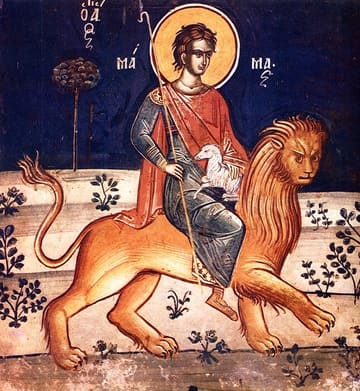
Pious Mammas, born in prison,
From his very first day kinsman of Jesus;
His father and mother, martyrs of God,
Gave birth to their only child in a dark prison cell.
And orphaned Mammas for his fifteen years
Was alone in the prison of the world,
His only consolation and his only light
Shone upon him from the face of the Son of God;
Contented with this and enriched by it,
Mammas glorified his Christ God,
Glorified Him by word, glorified Him by deed,
With a prayerful soul and an innocent body.
The friendship of God was dearer to him
Than the lying world that torments and deceives;
Befriended with God and most pure Christ,
He also befriended the pure world of nature,
With the desert and the forest, with the wild beasts,
With the mountain goats, with the fierce lions.
And the Lord bestowed upon His friend
Wondrous gifts from the Holy Spirit,
So that Mammas put his persecutors to shame
And converted many tormentors to Christ.
The emperor and his empire were against the boy,
But the mighty right hand of God upheld him,
So he endured his torments and glorified the Savior;
The emperor and his empire perished without trace or voice,
But Mammas even now reigns with Christ,
And with the angels of God in heaven he rejoices.
Reflection
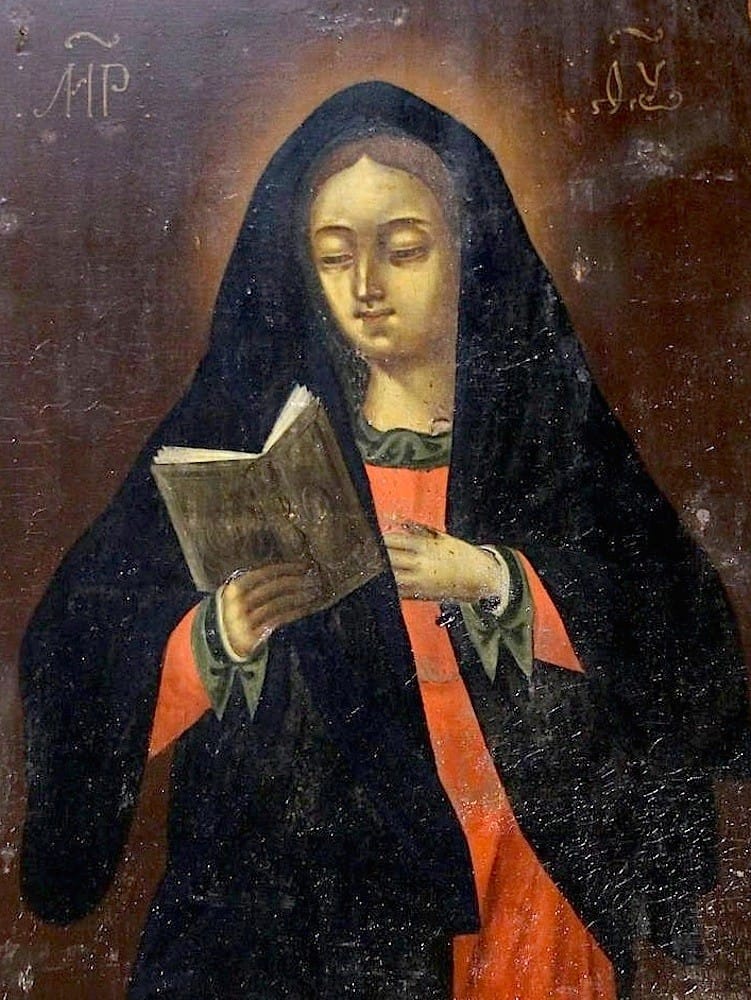
The Orthodox Church knows from experience countless examples where Almighty God manifests His power through small and lifeless things, especially through those that serve as signs of the incarnation, life and suffering of our Lord Jesus Christ, such as the cross, icons of the Theotokos and the saints, holy water, oil, chrism, and others. Thus a miracle occurred from the icon of the Most Holy Theotokos in 1748 in the home of the nobleman Khitrov, near the city of Kaluga, in Russia. Two maidservants of the nobleman, turning over old things in the attic one day, found a rolled-up canvas on which was depicted a beautiful image of a woman. Holiness and piety were expressed in that image. One of these maidservants was modest and serious, while the other was vain and talkative. The first one, gazing at the image on the canvas, called it "the abbess." But Eudocia (for so the other, vain and talkative one was called) did not agree, and mocked her modest companion. And to give greater force to her insolent words, she spat upon the image. At that very moment Eudocia fell to the ground, her whole body convulsing, and she became blind and mute, and began foaming at the mouth. That night the Theotokos appeared to the parents of the unfortunate girl, told them what had happened to their daughter, and told them also to summon a priest, that he should pray before the found image and sprinkle the girl with holy water, and she would be healed. When this was done, Eudocia was healed, and from that time she changed her disposition and became more serious.
Thus it became known that this was the wonderworking image of the Most Holy Theotokos. The icon was transferred to a church in Kaluga, where it is found to this day and works wonders.
Contemplation
Contemplate the punishment of God upon David for adultery and murder (II Samuel 12), namely:
- How God through the Prophet Nathan told David that, because he had taken another man's wife, his own wives would be taken by other men;
- How his son would die;
- How the sword would not depart from his house. All of which came to pass.
Homily
On the Word of God, the Creator of the world
He was in the beginning with God. All things were made by Him
John 1:2-4
The Evangelist speaks of the wondrous Word of God, brethren, of the rational, meaningful Speech, of the eternal Wisdom of God, of the co-eternal Son of God. That wondrous Word was co-essential with the Father and the Holy Spirit, yet hypostatically distinct from both the Father and the Spirit, for It was begotten of the unbegotten Father. It was, and is, and shall be. When was It with God? In the beginning, says the Evangelist. What does this word mean: in the beginning? It means the same as "first," or "at first." At first, therefore, the Word of God was with God, always co-essential with the Father and hypostatically as Son, but not yet incarnate. Afterward that Word of God became incarnate, and in the body appeared to the human race. While It was as the unincarnate Word with God, all things were made by It. Heaven and earth, and the entire heavenly world and the entire earthly world, all came into being through It, through that Word of God, while It was unincarnate with God. Without the Word of God nothing was made that was made. It was the life and the light, and the light shineth in darkness, and the darkness comprehended it not. Above all, death and sin represent darkness. That darkness did not comprehend the Son of God. But the entire created world is also darkness in comparison with God; yet in that darkness the Word of God shines, the rational Wisdom of God, eloquent and magnificent. Every creature would be darkness if there did not shine from it the mysterious light of the Son of God, by whom all things were made that were made. He was in the beginning with God. And afterward, what happened with Him? And the Word became flesh. Up to this point is the history of the creation of the world; from here begins the history of the salvation of the human race. But by becoming flesh, the Word of God did not depart from God the Father and the Holy Spirit, for the divine Trinity is indivisible; rather, It merely clothed Itself with a human body and soul, so that in the shade of the body It might draw near to men (a Sun above suns) and save mankind. O my brethren, how tender and inexpressibly wondrous is the mystery of the incarnation of God. If we embrace that mystery with the heart, we shall more easily approach it with the mind.
O Lord Savior, gracious One, glory of the Father and joy of the Holy Spirit, have mercy on us and save us. To Thee be glory and praise forever. Amen.
From the Prologue from Ochrid, translated by Marcian Sakarya, OCHRID.COM. CC BY-SA 4.0.
The Prologue, every day
Axios! brings the day’s Hymn of Praise, Reflection, Contemplation and Homily to Today, with the saints, the feasts and the saying of the day, on iPhone, iPad and Android.