
September 21
Saints of the day
Also commemorated
Synaxis of the Saints of the Kiev Caves
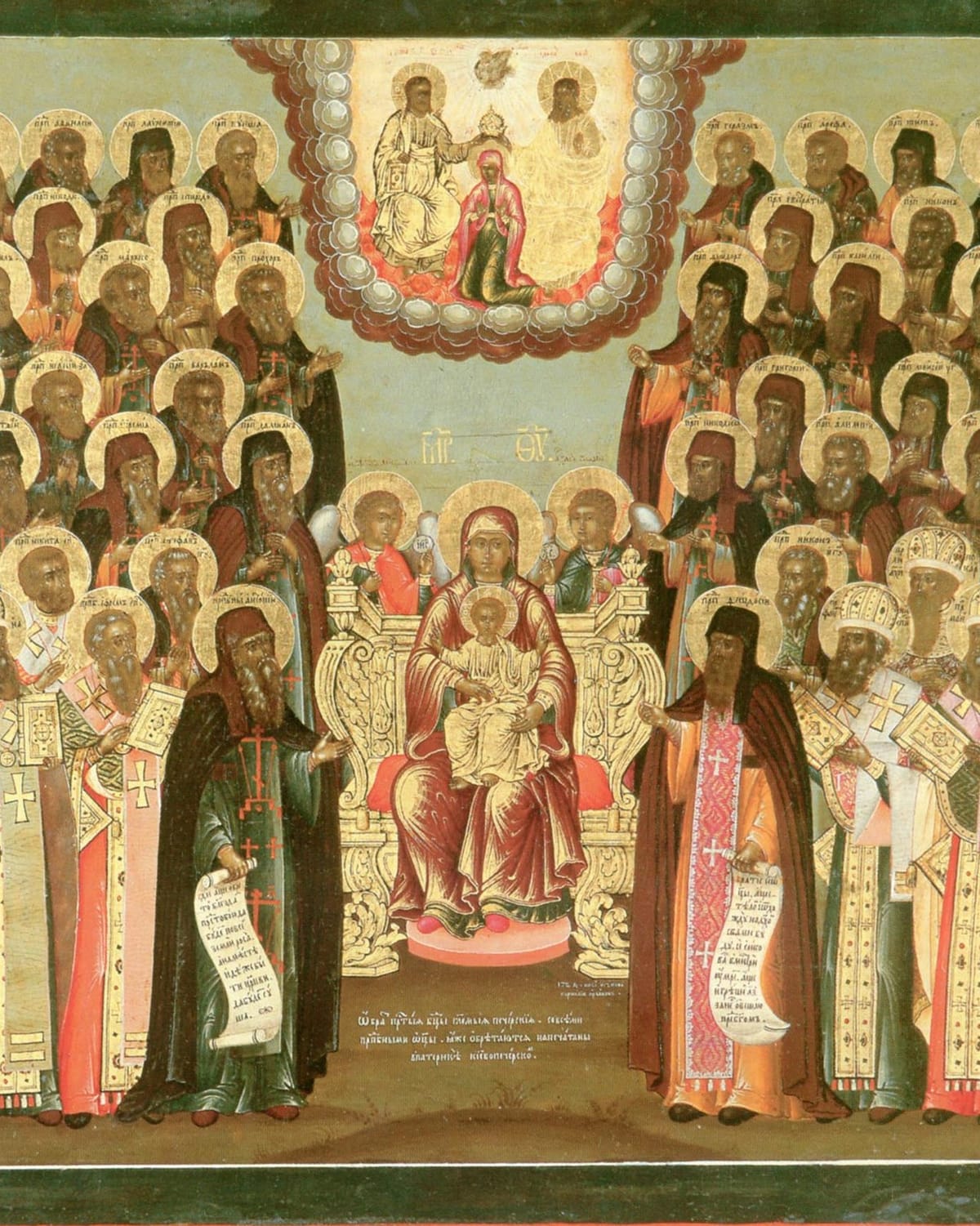
The blessed work of asceticism which the laborious and great servant of God Anthony began grew through the centuries like a fruitful olive tree. The many saints who shone like stars in these Caves of Anthony are each celebrated individually on their own day; but on this date they are commemorated all together in synaxis and invoked to the aid of the faithful.
Hymn of Praise
Holy Quadratus, like the morning star,
Poured forth the light of the Holy Gospel,
Poured forth its rays through the thick darkness,
And grace upon desolate hearts.
Quadratus shattered the confusions of the human mind,
And illumined the forebodings of the human heart,
Illumined them with the light of Christ,
Enlightened the world with the wisdom of Christ.
To the Most High God he raised the unbelieving,
And for Christ received cruel wounds,
To Hadrian, persecutor of the Cross,
Quadratus wrote his wondrous Apology
With the eloquence of Hellenic skill
And the simplicity of Christian truth.
Quadratus succeeded in persuading the emperor
And in shielding the Holy Church from evil.
O Quadratus, disciple of Christ,
Wise defender of the Holy Church,
Servant of God in word and deed,
Now you are crowned with unfading glory;
All Christians fervently pray to you:
Help us, O holy Apostle!
Help us to overcome our afflictions
And to endure sufferings for Christ!
Reflection
If we have but begun with firm resolve to live by the law of God, we need not fear any violence of unreasonable men, for to him who has truly begun to live by the law of God, all that happens from the hands of men happens for his benefit and to the glory of God. Especially we need not fear forced removal from a place we have come to love to a place we do not care for. Instead of empty fear and shallow lamentation, let us rather examine the intentions of God for us. What harm did the malice of his brothers do to Joseph? Did not his unwilling departure to Egypt bring him glory, save his brothers from famine, and create the conditions for all the wondrous works of God through Moses in Egypt and in the wilderness? Pagans and heretics often drove Orthodox Christians into barbarian regions. What did they accomplish by this? Did they destroy Orthodoxy? No, they strengthened it all the more firmly in the souls of the persecuted and spread it among the barbarian peoples. The wicked heretic Lucius banished from Egypt both the glorious Macarii with a number of Tabennesiote monks to a certain barbarian island, where all the inhabitants were idolaters. But these holy men by their teachings and the example of their lives soon managed to baptize the entire island. That island was afterward called the Island of Repentance.
Contemplation
Contemplate God's miraculous salvation of Jerusalem on account of the righteousness of Jehoshaphat (II Chronicles 20), namely:
- How a multitude of Moabites and Ammonites marched against Jerusalem;
- How King Jehoshaphat prayed to God, and it was revealed to him through a prophet: this is not your war but God's;
- How the Moabites and Ammonites slaughtered one another among themselves and all perished to the last man.
Homily
On the divinity of the Son and His essential equality with the Father
He that hath seen Me hath seen the Father
John 14:9
Lord, show us the Father, and it sufficeth us, said Philip. To these words the Lord Jesus answered him: Have I been so long time with you, and yet hast thou not known Me, Philip? He that hath seen Me hath seen the Father. Thus the Lord answered His disciple. Philip desired to see God with bodily eyes. For three years he had looked upon Christ, and he had not known Him as God. Why? Because at that time, before the descent of the Holy Spirit, Philip looked with the body upon the body; that is, with bodily eyes he looked upon and saw the Lord Christ as a man. He had not yet seen the Divinity in the incarnate Son of God, and yet he asks to see God the Father! He that hath seen Me hath seen the Father. By this the Lord does not mean to say that He is God the Father; no, but that He and the Father are of one essence. Insofar as God could in general show Himself to men, He showed Himself through God the Son, who appeared to men as a man. God the Father was not incarnate; God the Holy Spirit was not incarnate; only God the Son was incarnate. How, then, could He show His Father to the bodily eyes of mortal man? It was precisely for this reason that the Son became incarnate: to reveal to men through Himself both Himself, and the Father, and the Holy Spirit, the one Divinity in essence, threefold in hypostasis. He that hath seen Me hath seen the Father. The Lord here speaks of His divine nature. In this He is wholly equal and consubstantial with the Father. And had Philip been able at that time to see the divine nature of Christ, he would not have made that request: show us the Father. Of course, he could not have seen the divine nature, which is spiritual and invisible, but he could have seen, and indeed clearly seen, the great works of Christ as the manifestation of His divine nature. And today, brethren, certain people say: show us God, and we will believe! Say to them: behold, we show you the Lord Christ; believe! Nineteen centuries have I been with you, O people, and you still have not come to know Me? Nineteen centuries filled with His glory, miracles, power, grace, mercy, saints, and martyrs! And still the feeble-minded ask: where is God? O Christ the Lord, our God, open the spiritual eyes of those who do not yet see, that they may behold the majesty of Thy glory. To Thee be glory and praise forever. Amen.
From the Prologue from Ochrid, translated by Marcian Sakarya, OCHRID.COM. CC BY-SA 4.0.
The Prologue, every day
Axios! brings the day’s Hymn of Praise, Reflection, Contemplation and Homily to Today, with the saints, the feasts and the saying of the day, on iPhone, iPad and Android.