
September 25
Saints of the day
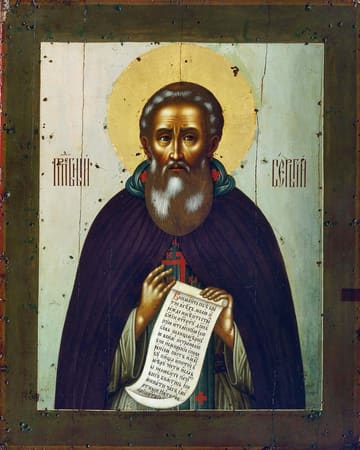
Hymn of Praise
An example of meekness and prayerfulness,
Holy Sergius, from his youth
Loved God and divine beauty,
Implanted in himself stillness and goodness;
With unceasing prayer he filled the wilderness,
Turned the forest into a shrine of God.
Worldly vanity did not disturb him,
Never at anyone was he angered.
All quiet, quiet, and meek with everyone,
Only not meek with the wicked enemy,
With the enemy of God, the father of every lie,
Who seeks to devour the souls of men.
Brave Sergius waged a fierce battle,
Laborious and mighty, to the final victory.
And the elder died, but the saint remained,
Becoming a pillar of fire for the Russian people;
Every blessing he asks of God
And brings down from heaven to his nation.
Holy Sergius, cease not to shine,
Cease not to pray to the Most High God
For the good of the Church, for the good of Russia,
To the glory of Christ, O holy Sergius!
Reflection
The saint does not shine by his outward appearance; all his wealth is within, in the soul. A certain peasant came from afar to the monastery to see Saint Sergius. When he asked the monks for the abbot, they told him that he was at work in the garden. The peasant went to the garden and saw there a man in shabby and patched clothing digging like any other laborer. The peasant returned to the monastery dissatisfied, thinking to himself that the monks were mocking him, and said again, more clearly this time, that he wished to see the renowned holy Father Sergius. In the meantime Sergius himself returned to the monastery and received the peasant, serving him at table himself. The saint gazed into the heart of his guest and knew how low an opinion the man had of him. And he comforted him, promising that if he waited a little, he would see Sergius. Just then a certain prince arrived at the monastery with his boyars. Both the prince and the boyars bowed low before Saint Sergius and sought his blessing. Then the monks removed the peasant from the chamber to make room for the new guests. And that peasant in amazement looked from afar and peered from a distance to see the one he had refused to see up close. And he reproached himself for his ignorance and was greatly ashamed. When the prince departed, the peasant quickly approached the saint, fell at his feet, and began to beg forgiveness. And the great saint comforted him and said: "Do not be sorrowful, my son, you alone rightly thought of me, considering me as nothing, while all the others erred in considering me something great."
Contemplation
Contemplate the righteousness and sin of King Joash, and the reward and punishment of God (II Chronicles 24), namely:
- How Joash at first obeyed the high priest Jehoiada and did all that was right before the Lord;
- How God blessed Joash with a long and peaceful reign;
- How Joash changed, and slew the righteous son of Jehoiada, and committed other evils;
- How a small Syrian army defeated Joash and plundered the land, and Joash, gravely ill, was slain by his servants in his bed.
Homily
On the common riches of the Father and the Son
All things that the Father hath are Mine
John 16:15
This is one of the last words of Christ the Lord before His very Passion. The weightiest word, for it proclaims to the world the Divinity of Christ the Savior, and in connection with the following words: therefore said I, that He shall take of Mine, and shall show it unto you, it also proclaims the equality of the Holy Spirit with the Father and the Son. That which the Spirit shall take of Mine cannot be other than or contrary to what the Father has, for all things that the Father hath are Mine. Why does the Lord not say: the Spirit will take what is Mine, but rather of Mine? Because the Spirit will not bring all things to men, but only something of all, as much as men can receive and as much as they need. One part of God's gifts is given to the faithful on earth, while another part will be given to them in the Kingdom of Heaven. And this heavenly part is what the clairvoyant Apostle describes: Eye hath not seen, nor ear heard, neither have entered into the heart of man, the things which God hath prepared for them that love Him. And all this, and incomparably more, belongs to the riches of Christ. His riches are not only this world but also the next, and something incomparably greater and more precious than both worlds. His is eternity, His is immortality, His is perfect power, His is perfect wisdom, His is perfect love, His is perfect goodness and mercy and justice and truth. And what more is there of good that our mind can think and our tongue express? His is every perfection that surpasses all that men can even conceive. All this the Father has, all this the Son has, all this the Holy Spirit has. All things that the Father hath are Mine. With these words the indescribable Rich One, the unattainable Son of the King, proclaimed to His disciples His riches, boundless and inconceivable, on that dark night when He was to go forth barefoot before the Jewish elders, to be scourged and spat upon. O Lord our God, Most Holy and Most Rich Trinity, have mercy on us sinners and save us. To Thee be glory and praise forever. Amen.
From the Prologue from Ochrid, translated by Marcian Sakarya, OCHRID.COM. CC BY-SA 4.0.
The Prologue, every day
Axios! brings the day’s Hymn of Praise, Reflection, Contemplation and Homily to Today, with the saints, the feasts and the saying of the day, on iPhone, iPad and Android.