
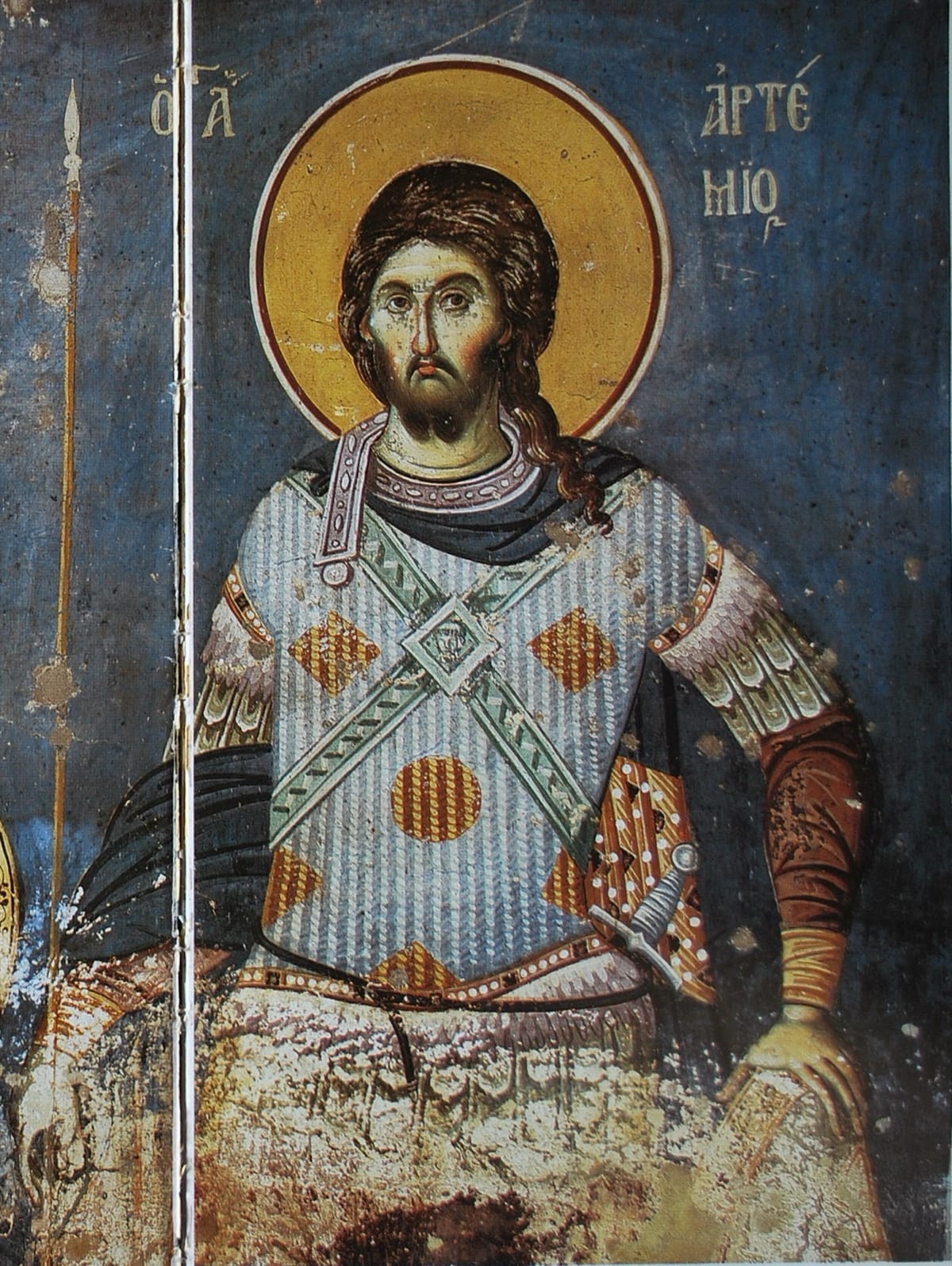
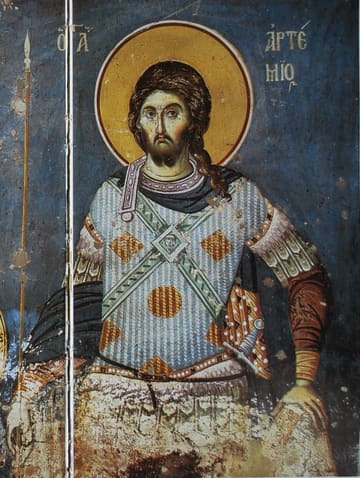
St. Artemius the Great Martyr
St. Artemius is one of the Great Martyrs of the Church: a high officer of the Roman Empire who was put to death under Julian the Apostate, by tradition at Antioch in 362, for his faith in Christ.
For centuries the sick of Constantinople sought healing at his tomb, and the Church keeps his memory on October 20.
Writers of his own and the following century give the frame of his life. The records of the Church of Alexandria name him as dux, the commander of the army in Egypt, in 360, under Constantius II, the son of St. Constantine the Great. In that year, serving an emperor who favored the Arians, he took part in the search for the exiled St. Athanasius.
When Julian became sole emperor at the end of 361, Artemius was condemned to death. The pagan historian Ammianus Marcellinus says that the Alexandrians pressed grave charges against their former commander, and the Church historian Theodoret writes that Julian seized his property and had him beheaded because as commander he had destroyed most of the idols.
The fuller story is told in his Passion, written by the monk John of Rhodes, who drew on the history of Philostorgius, and later retold by St. Symeon Metaphrastes. According to it, Artemius was a man of senatorial rank who came to faith through the sign of the Cross that appeared to Constantine before the Battle of the Milvian Bridge in 312. Constantius sent him to bring the relics of the Apostle Andrew from Patras and of the Evangelist Luke from Thebes to the church of the Holy Apostles in Constantinople, and then gave him the command of Egypt.
When Julian came to Antioch to prepare his war against Persia, Artemius found him torturing two priests, Eugenius and Macarius, and rebuked him to his face. He was beaten and thrown into prison, where Christ appeared to him and strengthened him; at last he was crushed beneath a great stone and beheaded, having foretold the emperor's ruin. Julian fell in Persia in 363.
A deaconess named Ariste, the Passion relates, took up his body and sent it to Constantinople. It rested in the church of St. John the Forerunner in the Oxeia quarter, where a seventh-century collection of his miracles records many healings, above all of men and boys suffering from hernias, and he is still invoked in such illnesses. According to the Kyiv Caves Patericon, portions of his relics were brought from Constantinople to the Kyiv Caves Monastery in 1073. In Patras local tradition honors him as the founder of the Gerokomeio Monastery of the Theotokos, and the Greek police have honored him as their patron since 1987.
Sources
- Festal Index of St. Athanasius, year 32 (359-360)
- Ammianus Marcellinus, History XXII.11.2-3
- Theodoret, Church History III.14 (NPNF)
- John of Rhodes, Passion of St. Artemius
- Greek Menaion and Synaxarion, October 20
- Pravoslavnaya Entsiklopediya, 'Artemy'
No recorded sayings. Read the Life to meet this saint.
Troparion · Tone 4
Your martyr, O Lord, by his contest won from You, our God, the crown of incorruption; for, holding Your strength, he threw the tyrants down and shattered too the powerless audacity of demons. At his entreaties, O Christ God, save our souls.
Translated for Axios! from the Greek Menaion, October 20
Kontakion · Tone 2
The pious and crown-bearing Martyr, who raised trophies of victory over the enemies, let us now come together and worthily praise in hymns: Artemius, greatest among the martyrs and most bountiful giver of wonders; for he intercedes with the Lord for us all.
Translated for Axios! from the Greek Menaion, October 20
Saints around October 20
Get the full library
770+ saints, in your pocket
Their Lives, sayings and prayers, A to Z and by feast, with search. The Church calendar, the holy icons, and the saying of the day on your Home Screen. All in Axios! for iPhone, iPad and Android.