
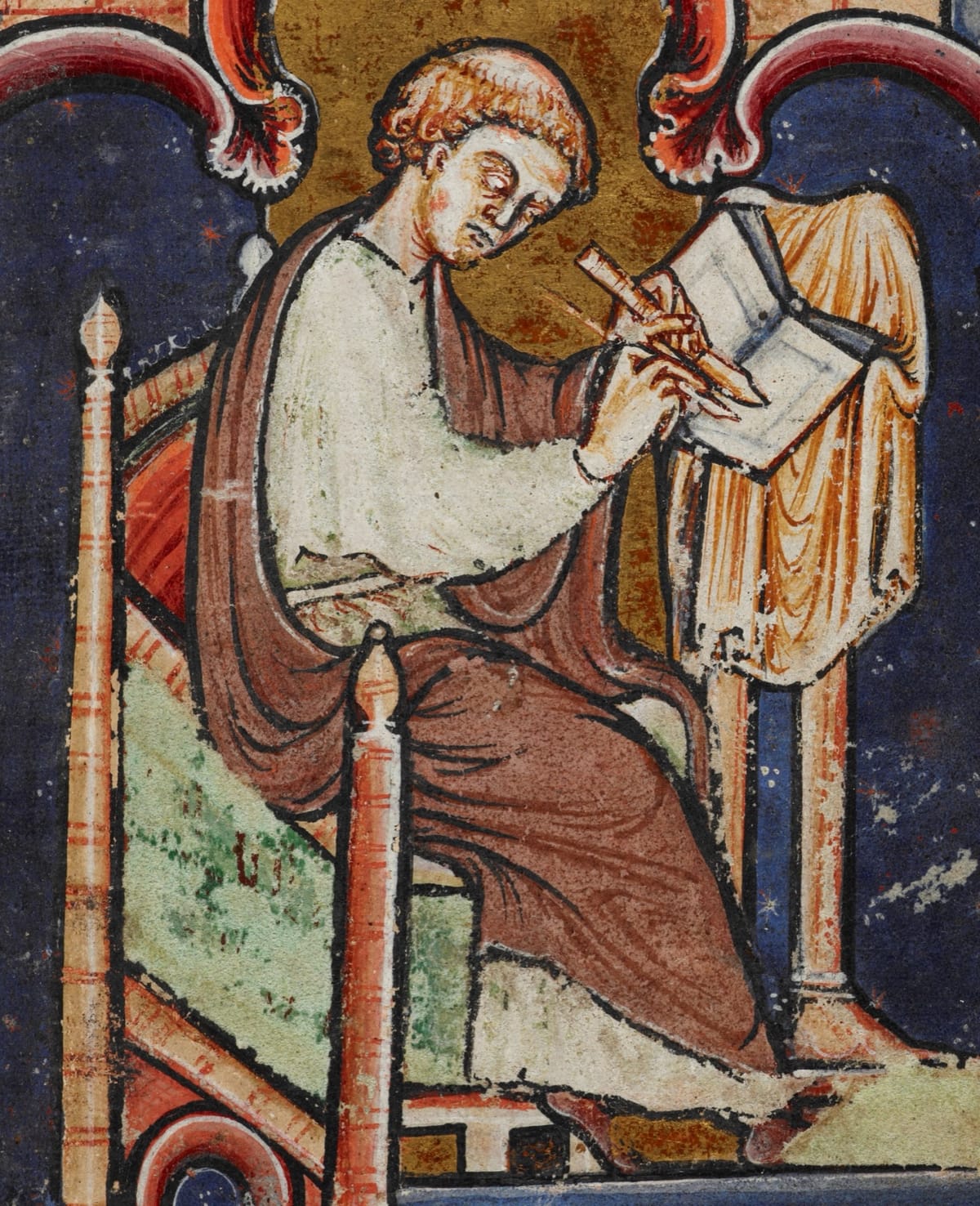
St. Bede the Venerable
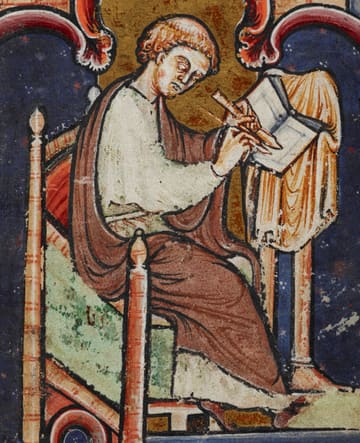
St. Bede the Venerable, monk and priest of the twin monastery of Wearmouth and Jarrow in Northumbria, is the great teacher of the early English Church and the father of English history.
He hardly ever left his monastery, yet his life of prayer, study and teaching gave his people their first history and the memory of the saints who brought them to Christ.
He was born about 673 on land belonging to the monastery, and at seven his family entrusted him to its founder, St. Benedict Biscop, and then to Abbot Ceolfrith at the new house of St. Paul in Jarrow. An early Life of Ceolfrith tells that when plague struck Jarrow, only the abbot and one boy were left to sing the antiphons; that boy is thought to have been Bede. He was ordained deacon in his nineteenth year and priest in his thirtieth, both by St. John of Beverley.
He wrote some forty works: commentaries on the Scriptures drawn from the Fathers, homilies, Lives of saints, books on grammar and nature, and The Reckoning of Time (725), which spread the counting of years from the Incarnation. His Ecclesiastical History of the English People, finished in 731, tells how the English received the faith, from the coming of the mission of St. Gregory the Dialogist in 597 to his own day, naming his witnesses. He also wrote two Lives of St. Cuthbert of Lindisfarne. St. Boniface, laboring in Germany, begged for his books, calling him a light of the Church.
In 735, some two weeks before Pascha, he fell ill. His disciple Cuthbert wrote that he still taught each day, sang the psalms, gave thanks day and night, and was putting the Gospel of St. John into English. On the Wednesday before the Ascension he shared his few small treasures among the priests, asked their prayers, and said that his soul longed to see Christ his King in His beauty. That evening his young scribe Wilberht told him the last sentence was written.
"You have spoken truly: it is finished," Bede answered. Seated on the floor of his cell, facing the place where he used to pray, he sang "Glory to the Father, and to the Son, and to the Holy Spirit" and breathed his last. It was May 25, 735, the eve of the Ascension.
The title "Venerable" was joined to his name within two generations. About 1022 his relics were carried from Jarrow to Durham and laid with St. Cuthbert's; since 1370 they have rested in the Galilee Chapel of Durham Cathedral. The Orthodox Church in America, the Russian Church Outside Russia in Britain and the Antiochian Western Rite keep his memory on May 27.
Sources
- St. Bede, Ecclesiastical History of the English People, Preface and V.24
- Cuthbert of Jarrow, Letter on the Death of Bede (735), in C. Plummer, Baedae Opera Historica (1896)
- Anonymous Life of Ceolfrith, ch. 14
- OCA, Lives of the Saints: Venerable Bede, the Church Historian (May 27)
- Durham Cathedral, 'Bede's Tomb'
- Catholic Encyclopedia (1907), 'The Venerable Bede'
From that time I have spent my whole life dwelling in this monastery, giving all my effort to meditating on the Scriptures; and amid the observance of the monastic rule and the daily care of singing in church, I have always found it sweet to learn, or to teach, or to write.
Ecclesiastical History of the English People V.24 (translated for Axios! from the Latin)
If history tells of good men and good deeds, the attentive hearer is spurred to imitate the good; if it records the evil deeds of the wicked, the devout and pious hearer or reader, shunning what is harmful and perverse, is kindled the more eagerly to do what he knows to be good and worthy of God.
Ecclesiastical History of the English People, Preface, to King Ceolwulf (translated for Axios! from the Latin)
I humbly beg the reader, if he finds anything in what I have written set down otherwise than the truth, not to hold it against me: as the true law of history requires, I have simply tried to put in writing, for the instruction of those who come after, what I gathered from common report.
Ecclesiastical History of the English People, Preface (translated for Axios! from the Latin)
I humbly entreat all of our nation who read or hear this history, wherever it reaches them, to remember often to intercede with the mercy on high for my weaknesses of mind and body.
Ecclesiastical History of the English People, Preface (translated for Axios! from the Latin)
It is time, if it so pleases my Maker, to be set free now from the flesh and come to Him who formed me out of nothing when I was not. I have lived a long time, and my merciful Judge has provided well for my life. The time of my release is near, for my soul longs to see Christ my King in His beauty.
His words on the day of his death, in Cuthbert's Letter on the Death of Bede (translated for Axios! from the Latin)
I do not want my boys to read what is false, and to labor at it without profit after my death.
His words on the extracts he was making from the books of St. Isidore of Seville in his last days, in Cuthbert's Letter on the Death of Bede (translated for Axios! from the Latin)
Before the journey that all must make, no one is wiser in thought than he has need to be, in pondering, before his going hence, what good or evil will be judged to his soul after his day of death.
Bede's Death Song, which Cuthbert's Letter on the Death of Bede says he sang in English as he lay dying (translated for Axios! from the Old English)
Troparion · Tone 8
In you, O Father, God's image was preserved to perfection; for you took the cross upon yourself and followed Christ, and in your conduct you taught that one should think little of the flesh, for it is fleeting, and take care of the soul, a thing that does not die. And so, O venerable Bede, your spirit exults together with the angels.
Translated for Axios! from the Greek General Menaion (the common troparion of a venerable father)
Kontakion · Tone 2
Armed in godly fashion with the soul's purity and wielding ceaseless prayer as a lance, you mightily cut through the battle lines of the demons, O Bede, wonderworker, our father, interceding without ceasing for us all.
Translated for Axios! from the Greek Menaion (the common kontakion of a venerable father)
Prayer of St. Bede the Venerable
I pray You, good Jesus: as You have graciously granted me to drink in sweetly the words of Your knowledge, so grant me also in Your kindness to come one day to You, the fountain of all wisdom, and to appear forever before Your face.
Ecclesiastical History of the English People V.24, the closing prayer (translated for Axios! from the Latin)
Saints around May 27
Get the full library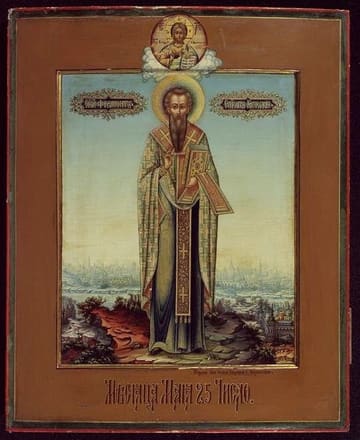

770+ saints, in your pocket
Their Lives, sayings and prayers, A to Z and by feast, with search. The Church calendar, the holy icons, and the saying of the day on your Home Screen. All in Axios! for iPhone, iPad and Android.