
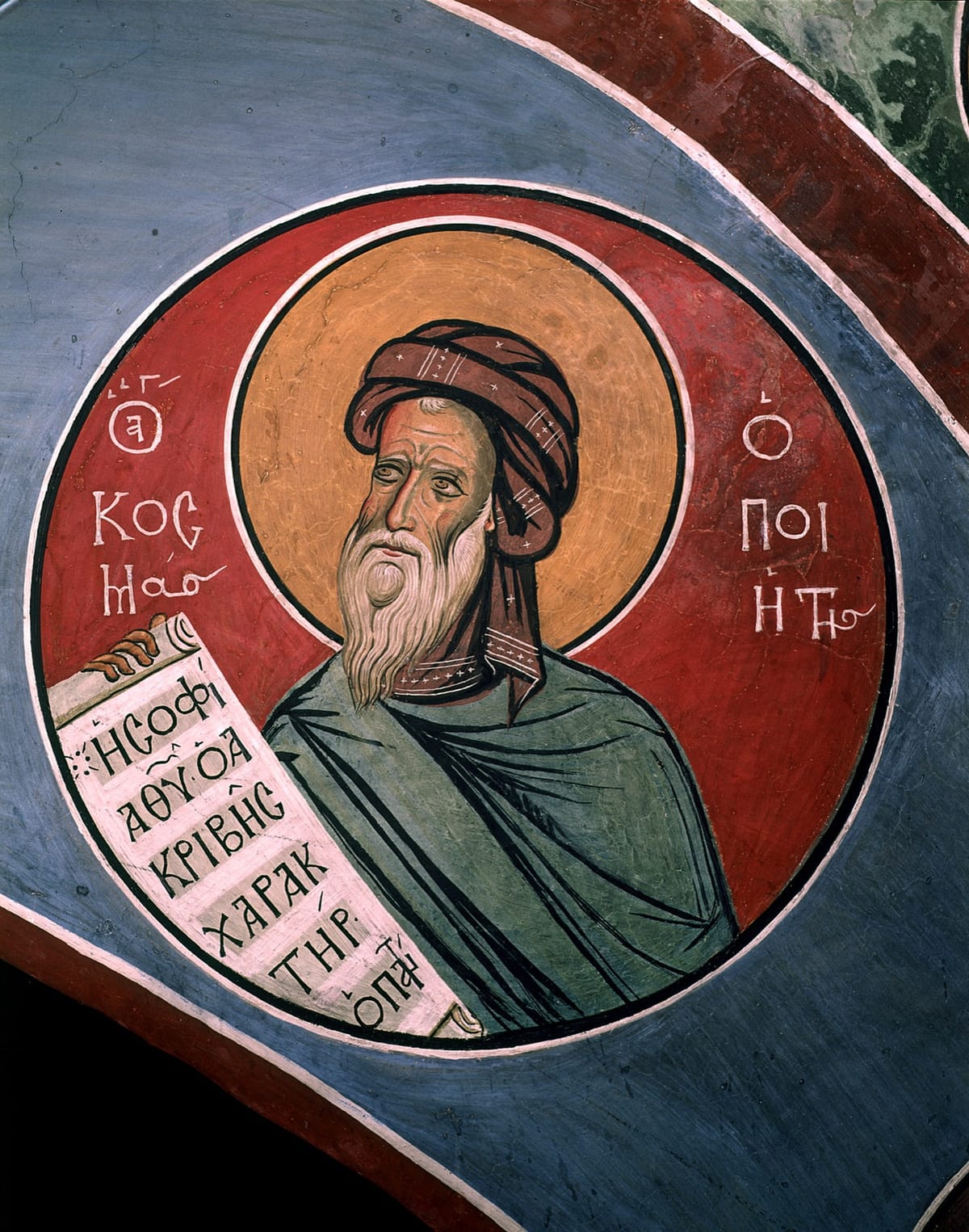
St. Cosmas the Hymnographer
Also commemorated
- October 14Greek usage
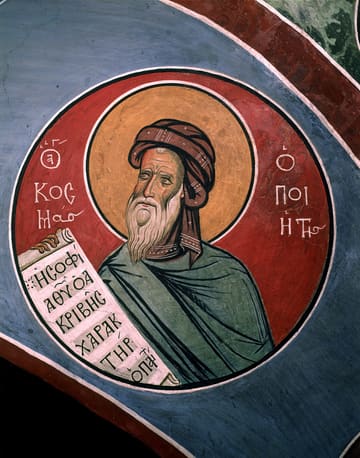
St. Cosmas the Hymnographer, bishop of Maiuma, is one of the great masters of the canon, the hymn of nine odes sung at Matins.
With his foster brother St. John of Damascus he gave the Church many of the songs of its great feasts. His canons for the Nativity, whose opening words, "Christ is born, give glory," he took from St. Gregory the Theologian, and for Theophany, the Meeting of the Lord, the Transfiguration, the Dormition, the Exaltation of the Cross, Palm Sunday, Holy Week and Pentecost are still sung every year.
The Synaxarion of Constantinople and several of his Lives say that he came from Jerusalem, and in the acrostics of his canons he calls himself "of the Holy City"; one Life says he was born in Damascus. Born around 675 and orphaned as a child, he was taken into the home of Sergius, a Christian official of the caliph's treasury in Damascus, and raised with Sergius's son John. According to the Lives, Sergius ransomed a learned monk from captivity, and this teacher trained both boys in every branch of learning, music included.
As young men the two brothers left Damascus for Jerusalem and became monks at the Lavra of St. Sabbas. Later the Patriarch of Jerusalem made Cosmas bishop of Maiuma, the port of Gaza, against his will; the traditional date is 743, though some scholars place it earlier. Some Lives say that he too stood up for the holy icons when the iconoclasts attacked them. He reposed in old age, by several Lives about a year after St. John, and was buried at the Lavra of St. Sabbas, where a 12th-century pilgrim saw the tombs of the two "ancient poets."
The Byzantines prized his canons for their learning and beauty, and in the 12th century Theodore Prodromos and Gregory Pardos wrote commentaries on them. Some forty of his canons are known, besides stichera and short canons of three or four odes for the days of Holy Week. His verses are full of Scripture and of the mystery of the Incarnation, and their acrostics are small poems of their own, such as "Trusting in the Cross, I pour forth a hymn." Tradition, recorded by Nikephoros Kallistos, also credits him with "More honorable than the cherubim," the hymn to the Theotokos sung at almost every service.
The Greek Church keeps his feast on October 14 and the Slavic Churches on October 12. Each year the faithful sing his hymns for the feasts much as he first sang them, in praise of the Word made flesh.
Sources
- Greek Menaion and Synaxarion, October 14
- Church Slavonic Menaion, October 12
- Pravoslavnaya Entsiklopediya, vol. 38, 'Kosma Mayumsky'
- St. Dimitri of Rostov, Lives of the Saints, October 12
- OCA, Lives of the Saints: Saint Cosmas the Hymnographer, Bishop of Maiuma
I see a strange and wondrous mystery: the cave is heaven, the Virgin a cherubic throne, the manger a place where Christ God, whom nothing can contain, was laid. Him we praise in song and magnify.
Canon of the Nativity of Christ, ode 9, heirmos (translated for Axios! from the Greek)
Trusting in the Cross, I pour forth a hymn.
Canon of the Exaltation of the Cross, acrostic (translated for Axios! from the Greek)
O Theotokos, you are mystically a Paradise that without tilling made Christ spring up; by Him the life-bearing tree of the Cross was planted on earth. Now, as it is lifted high, we worship Him and magnify you.
Canon of the Exaltation of the Cross, ode 9, heirmos (translated for Axios! from the Greek)
On the mountain height Christ sent forth a boundless radiance from His form.
Canon of the Transfiguration, acrostic (translated for Axios! from the Greek)
In you, O pure Virgin, the bounds of nature are overcome: your childbearing is virginal, and death is the pledge of life. Virgin after giving birth and alive after death, O Theotokos, may you ever save your inheritance.
Canon of the Dormition of the Theotokos, ode 9, heirmos (translated for Axios! from the Greek)
Neither tomb nor death could hold the Theotokos, unsleeping in her prayers and an unfailing hope in her protection; for as the Mother of Life she was taken over to life by Him who dwelt in her ever-virgin womb.
Kontakion on the Dormition of the Theotokos, prooimion (translated for Axios! from the Greek)
Troparion · Tone 8
O guide of Orthodoxy, teacher of piety and reverence, luminary of the world, God-inspired adornment of hierarchs: O wise Cosmas, by your teachings you have enlightened all, O lyre of the Spirit. Intercede with Christ our God that our souls may be saved.
Translated for Axios! from the Greek Menaion, October 14
Kontakion · Tone 8
Adorned with virtues, O God-inspired Cosmas, you became the adornment of Christ's Church and adorned her with your songs, O blessed one. Intercede with the Lord to deliver from every scheme of the enemy who wars against us those who cry to you: Rejoice, O thrice-blessed father.
Translated for Axios! from the Greek kontakion of October 14 (in the Church Slavonic Menaion, October 12)
Saints around October 12
Get the full library
770+ saints, in your pocket
Their Lives, sayings and prayers, A to Z and by feast, with search. The Church calendar, the holy icons, and the saying of the day on your Home Screen. All in Axios! for iPhone, iPad and Android.