
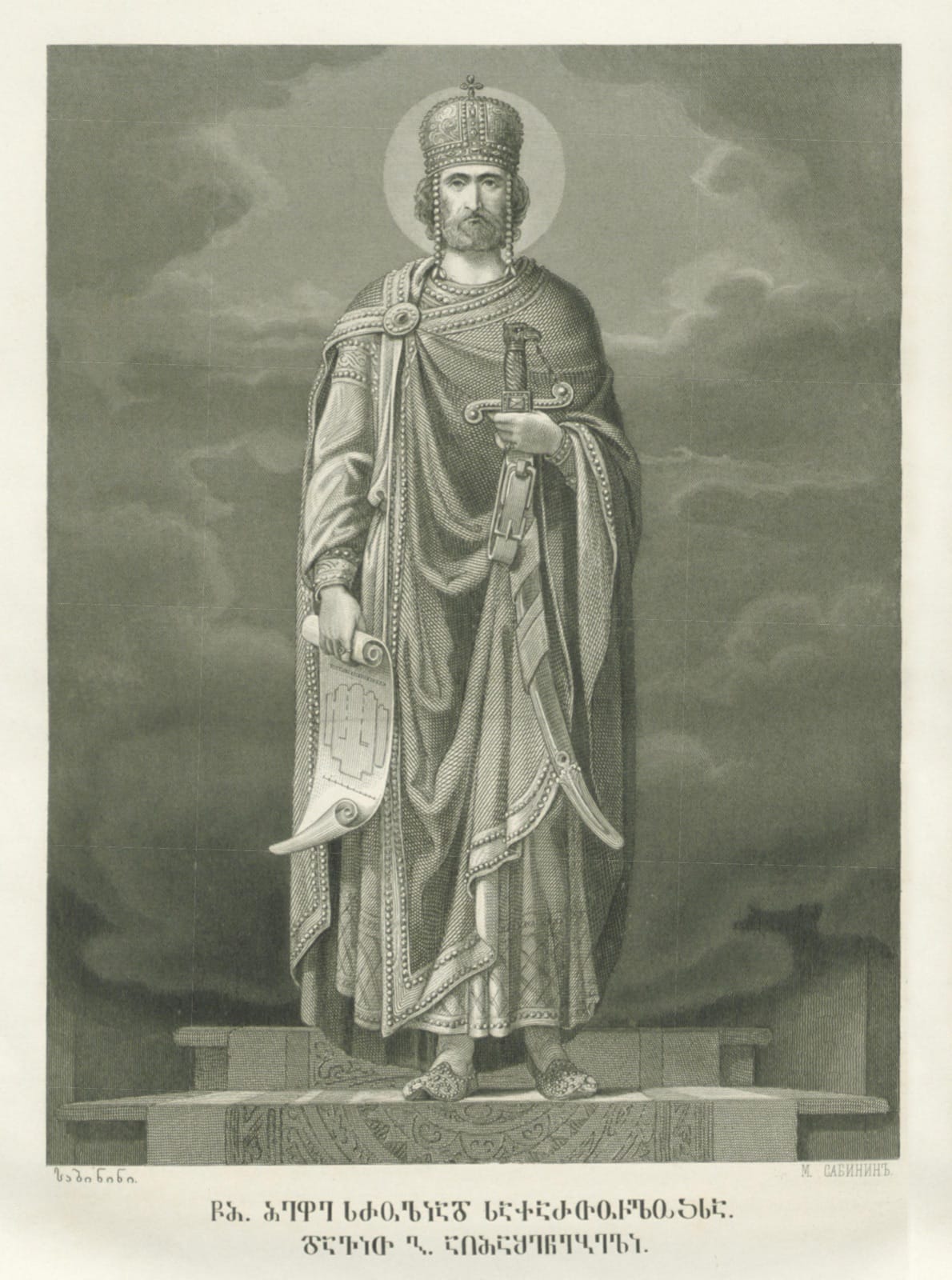
St. David the Builder
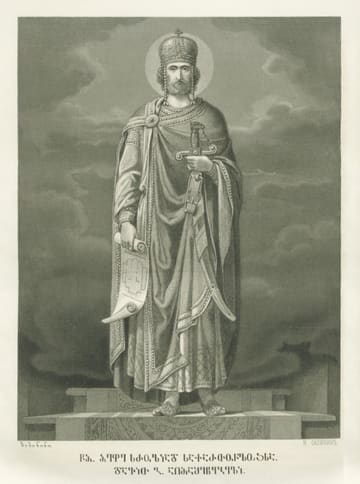
St. David the Builder, King David IV of Georgia, is venerated by the Georgian Church as a right-believing king. Coming to the throne of a land ravaged by the Seljuk Turks, he freed and united Georgia, renewed its Church, founded the monastery and academy of Gelati, and left a canon of repentance that the Church still reads on his feast.
Born about 1073, the son of King George II, he was crowned in 1089, at sixteen, when his father laid down the crown. Georgia then paid tribute to the Seljuks; churches and monasteries lay plundered, many people had fled to the mountains and forests, and the great nobles defied both king and Church. David broke the power of the strongest lords, and in 1099, while the Turks were engaged with the crusaders, he ceased to pay tribute. Step by step he won back the lands of the east, taking Kakheti and Hereti in 1104 and fortress after fortress in the years that followed.
About 1105 he called the Council of Ruisi-Urbnisi, which removed unworthy bishops and set down canons for the life of the Church, and he made his tutor, Bishop George of Chkondidi, the first official of the realm. In 1106 he founded the monastery of the Theotokos at Gelati near Kutaisi, with an academy to which he invited learned monks such as St. Arsenius of Ikalto and the philosopher John Petritsi. He renewed the monastery of St. Shio of Mgvime and gave generously to monasteries in Byzantium, on Mount Athos, in Syria, Cyprus and Palestine, and at Sinai.
On August 12, 1121, at Didgori, his army routed a far larger Seljuk coalition, and in 1122 he took Tbilisi, held by Muslim rulers for four centuries, made it his capital, and granted privileges to its Muslims and Jews. His biographer remembers his care for the sick and the poor, and that he read the Epistles of the apostles many times each year, carrying his books with him even on campaign.
Shortly before his death he composed his Hymns of Repentance, in which a humbled king pours out his soul before God and the Theotokos. He reposed on January 24, 1130, and at his wish was buried beneath a stone at the entrance of the gate church of Gelati, inscribed with the psalm, "This is my rest forever." At the end of the 13th century the Georgian Church glorified him as a right-believing king, an exception to its custom of canonizing only martyrs and monastics; a service was written for him, and his relics were placed beneath the altar of the cathedral of Gelati. The Church keeps his memory on January 26.
Sources
- Pravoslavnaya Entsiklopediya, 'David IV Stroitel' (after the Life of the King of Kings David by his 12th-century historian)
- OCA, Lives of the Saints: Blessed David IV, King of Georgia (January 26)
No recorded sayings. Read the Life to meet this saint.
Troparion · Tone 2
Celebrating the commemoration of Your righteous one David, O Lord, we implore You through him: Save our souls.
Translated for Axios! from the Greek Menaion (the troparion of the righteous, as sung for St. Job, May 6)
Saints around January 26
Get the full library
770+ saints, in your pocket
Their Lives, sayings and prayers, A to Z and by feast, with search. The Church calendar, the holy icons, and the saying of the day on your Home Screen. All in Axios! for iPhone, iPad and Android.