
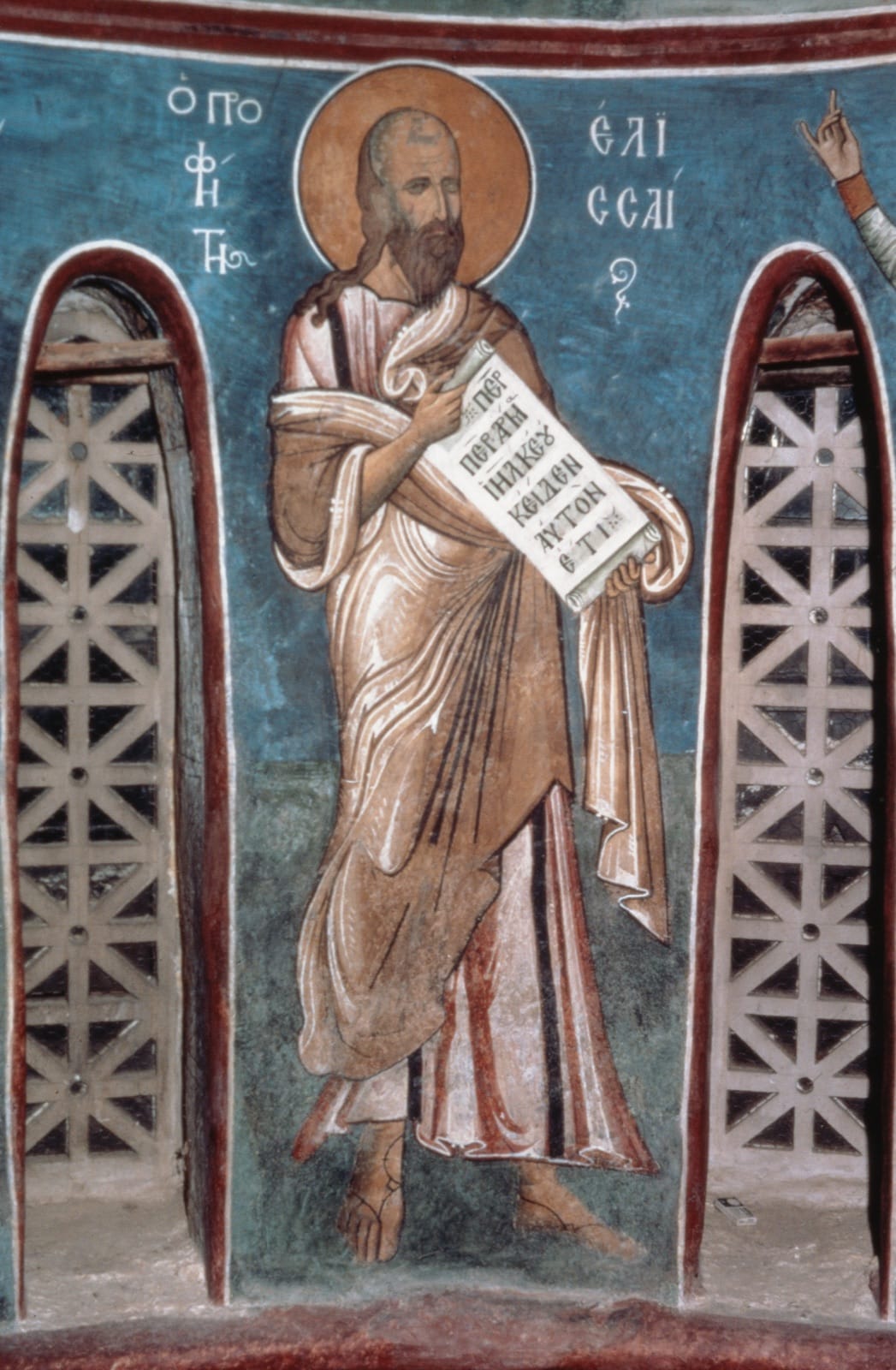
St. Elisha the Prophet
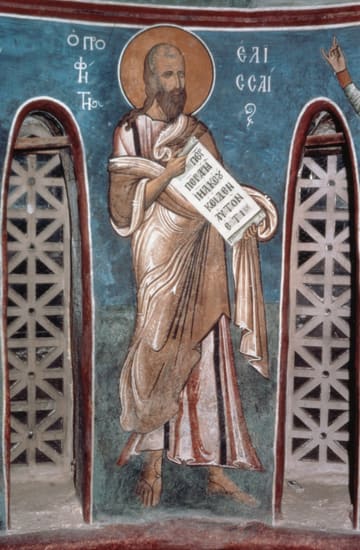
St. Elisha, the disciple and successor of St. Elijah, received a double portion of his master's spirit and became one of the great wonderworkers of the Old Testament.
For some sixty years he served the God of Israel among kings and common people alike, and the Church honors him as a prophet whose very bones gave life, a witness from Scripture itself to the grace that rests on the relics of the saints.
The son of Shaphat of Abel-meholah, Elisha was plowing with twelve yoke of oxen when Elijah passed by and threw his mantle over him. He slaughtered the oxen, fed the people with their meat, and followed the prophet as his servant. When the time came for Elijah to be taken up, Elisha refused to leave him and asked for a double portion of his spirit. He saw his master carried away by a whirlwind as a chariot of fire parted them, cried out, "My father, my father, the chariots of Israel and its horsemen!", took up the fallen mantle, and struck the Jordan, which divided before him.
Many signs followed. He healed the spring of Jericho with salt, multiplied a poor widow's oil so that she could pay her debts, and promised a son to the hospitable woman of Shunem, then raised the boy from death. He made a poisoned pot of stew wholesome and fed a hundred men with twenty loaves, with food left over.
He sent the Syrian commander Naaman to wash seven times in the Jordan, and Naaman's leprosy left him; Elisha refused all payment, and Christ Himself recalled this healing (Luke 4:27). When an army surrounded Dothan, he prayed that his frightened servant's eyes be opened, and the young man saw the mountain full of horses and chariots of fire. He then led the blinded raiders to Samaria and had them fed and sent home in peace.
Elisha died in old age in the days of King Joash, who wept over him with the words Elisha had once cried after Elijah. When a dead man was hurriedly laid in his tomb and touched his bones, the man revived and stood on his feet. Sirach praises him as one whom no ruler could overawe.
His tomb at Sebaste in Samaria, beside those of the Prophet Obadiah and St. John the Forerunner, was honored by early pilgrims. Under Julian the Apostate, about 362, pagans desecrated the shrine and burned the relics there; according to the Church's tradition, part of them was saved and taken to Alexandria. The Church celebrates him on June 14.
Sources
- 1 Kings 19:16-21; 2 Kings 2-13 (4 Kingdoms LXX); Sirach 48:12-14; Luke 4:27
- Synaxarion and Menaion, June 14
- St. Jerome, Letter 108.13 (NPNF II/6), the tombs at Sebaste
- Theodoret, Ecclesiastical History III.3 (NPNF II/3)
- OCA, Lives of the Saints: Prophet Elisha
As the Lord lives, and as your soul lives, I will not leave you.
2 Kings 2:2 (WEBBE)
Please let a double portion of your spirit be on me.
2 Kings 2:9 (WEBBE)
My father, my father, the chariots of Israel and its horsemen!
2 Kings 2:12 (WEBBE)
Where is the Lord, the God of Elijah?
2 Kings 2:14 (WEBBE)
As the Lord lives, before whom I stand, I will receive none.
2 Kings 5:16 (WEBBE)
Don't be afraid, for those who are with us are more than those who are with them.
2 Kings 6:16 (WEBBE)
Lord, please open his eyes, that he may see.
2 Kings 6:17 (WEBBE)
Troparion · Tone 4
The angel clothed in flesh, the groundwork of the Prophets, the second Forerunner of Christ's coming, glorious Elijah, who sent down grace from above upon Elisha, puts diseases to flight and makes lepers clean; and so for those who honor him he gushes forth healings.
Translated for Axios! from the Greek Menaion, June 14
Kontakion · Tone 8
Having received a double grace from the Spirit, you were shown to be a wondrous prophet to all the ends of the earth, delivering from dangers those who sing your praise and granting the grace of your wonders to those who hasten to it with faith and cry to you: Rejoice, O divinely inspired Prophet.
Translated for Axios! from the Greek Menaion, June 14
Saints around June 14
Get the full library
770+ saints, in your pocket
Their Lives, sayings and prayers, A to Z and by feast, with search. The Church calendar, the holy icons, and the saying of the day on your Home Screen. All in Axios! for iPhone, iPad and Android.