
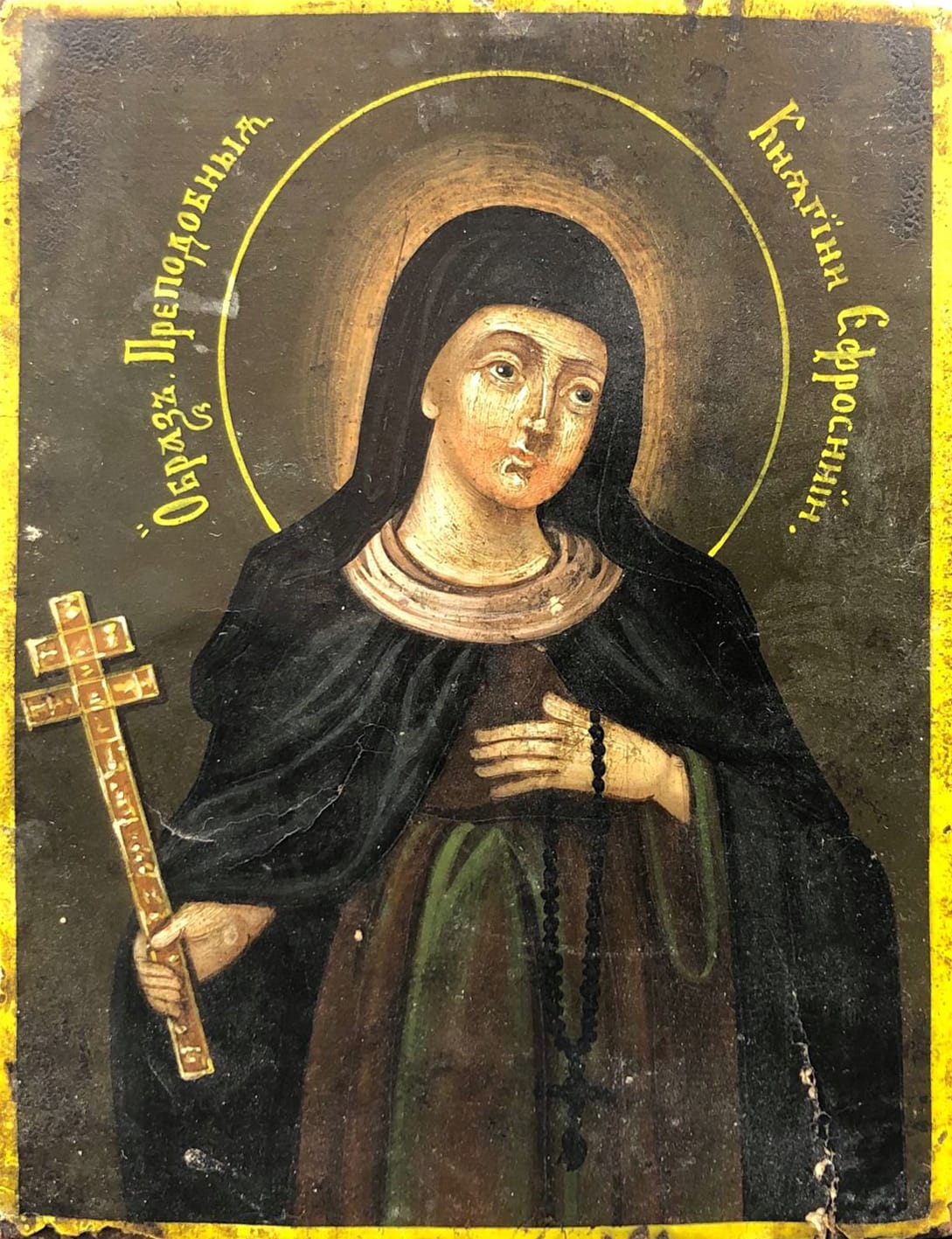
St. Euphrosyne of Polotsk
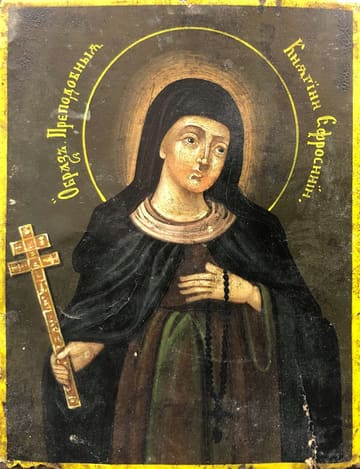
St. Euphrosyne of Polotsk, a princess who became a nun, a copyist of books and the founder of two monasteries, is one of the best-loved women saints of medieval Rus' and the heavenly patroness of Belarus.
Her church of the Savior, built in her lifetime, still stands in Polotsk.
She was born Predslava about 1104, the daughter of Prince Svyatoslav (George) Vseslavich and granddaughter of Prince Vseslav of Polotsk. Learned and beautiful, she was sought by many suitors, but her Life tells that at twelve she resolved to leave the glory of the world. About 1116 her aunt, the abbess of a Polotsk convent, had her tonsured with the name of St. Euphrosyne of Alexandria. With the blessing of Bishop Elijah she lived in a cell by the Cathedral of St. Sophia, copying books from its library and giving what she earned to the poor.
About 1128 the bishop gave her the church of the Savior at Seltso, outside the city, where she founded a convent. Its stone church of the Savior, raised by the builder John, still stands, and she later built a church of the Theotokos with a monastery for men. She obtained from Emperor Manuel I Komnenos and Patriarch Luke Chrysoberges the Ephesus icon of the Theotokos, held to be the work of St. Luke, and in 1161 the master Lazar Bogsha made for her convent a precious cross holding relics brought from Byzantium. The cross was lost in the twentieth century and recreated in 1997.
Near the end of her life she entrusted her monasteries to her sister Eudokia and set out on pilgrimage with her brother David and her cousin Eupraxia. The emperor received them with honor, and she prayed in Hagia Sophia in Constantinople. In Jerusalem, then held by the Crusaders, she stayed at the Russian monastery of the Theotokos, venerated the Holy Sepulchre and gave it rich gifts. There she fell ill and reposed on May 23, most likely in 1173, and she was buried in the Monastery of St. Theodosius the Cenobiarch.
From the seventeenth century her relics were venerated in the Far Caves of the Kyiv Caves Monastery, and in 1910 they were solemnly brought home to Polotsk. Seized in 1922 and shown in Soviet museums, they were returned to her convent in 1943 and rest today in its Cathedral of the Holy Cross. The Church keeps her memory on May 23, and in Belarus also on May 24 for the translation of her relics.
Sources
- Life of St. Euphrosyne of Polotsk (pre-Mongol in origin, extant in 16th-century redactions; BLDR, vol. 12)
- Pravoslavnaya Entsiklopediya, vol. 17, 'Evfrosiniya (Predslava Svyatoslavna), Polotskaya'
- Church Slavonic Menaion, May 23
- OCA, Lives of the Saints: Venerable Euphrosyne, Abbess of Polotsk
No recorded sayings. Read the Life to meet this saint.
Troparion · Tone 4
At twelve years of age, imitating Christ at twelve teaching the word of God in the temple, you followed Him, O Euphrosyne. Leaving temporal glory and an earthly bridegroom and despising all worldly things, you betrothed yourself to Christ, fairer than all. Taking up the Cross, walking the path of the angelic life and guiding many to Him, you hastened in the fragrance of myrrh into the heavenly bridal chamber. There pray to Him whom you loved for those who piously honor your memory.
Translated for Axios! from the Church Slavonic Menaion, May 23
Kontakion · Tone 8
To her who was chosen by God from her very birth and called to His service, who served the Lord in holiness in the angelic order and lived a venerable life, who now praises the Lord with the heavenly powers and intercedes before the Lord for us sinners, let us cry with joy and love: Rejoice, O Euphrosyne, all-honored bride of Christ.
Translated for Axios! from the Church Slavonic Menaion, May 23
Saints around May 23
Get the full library
770+ saints, in your pocket
Their Lives, sayings and prayers, A to Z and by feast, with search. The Church calendar, the holy icons, and the saying of the day on your Home Screen. All in Axios! for iPhone, iPad and Android.