
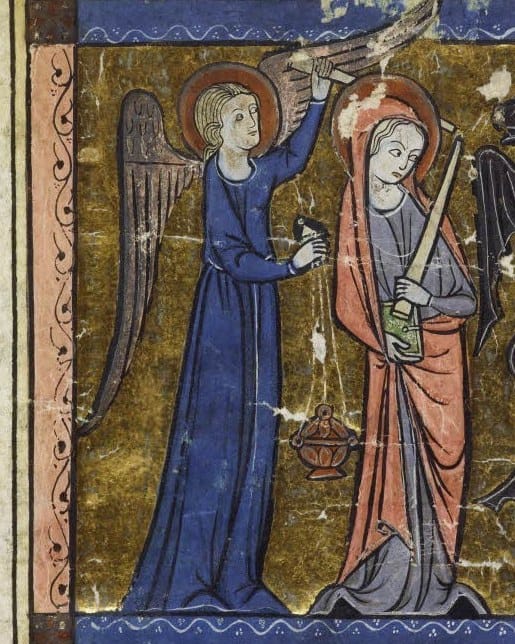
St. Genevieve of Paris
St. Genevieve of Paris, a consecrated virgin of 5th-century Gaul, is the patroness of Paris, the woman of prayer whose faith and charity sustained the city through the invasion of the Huns and a long Frankish blockade.
Her name stands on January 3 in the oldest Western martyrologies.
Most of what is known of her comes from her Life, which claims to have been written eighteen years after her death; most scholars accept an early 6th-century date. It tells that she was born about 420 at Nanterre, near Paris, to Severus and Gerontia. When St. Germanus of Auxerre passed through Nanterre in 429 on his way to Britain, he singled out the girl in the crowd, foretold her holiness and gave her a bronze coin marked with the cross to wear in place of jewels. At about fifteen she received the veil of a consecrated virgin, and after her parents died she moved to Paris, where she lived in prayer and strict fasting and was mocked by many as a deceiver.
In 451, when Attila's Huns were laying Gaul waste and the people of Paris prepared to flee, she gathered the women to keep vigil with fasting and prayer, as Judith and Esther had done, and urged the men not to carry their goods away, for Christ would protect the city. Some wanted to stone or drown her as a false prophet, but the Huns turned toward Orléans and Paris was spared. Later, when the Franks blockaded the city, she led boats up the Seine and brought back grain for the hungry, and she won from King Childeric the release of prisoners. She urged the clergy to build a church over the tomb of St. Denis, the martyred first bishop of Paris, and was honored by King Clovis and Queen Clotilde.
She reposed on January 3, 512, early in the 6th century, though some reckonings place her death about 502. Gregory of Tours records that she was buried in the church of the Holy Apostles built by Clovis and Clotilde, which in time took her name. For centuries Paris carried her relics in procession in times of plague and flood. In 1793 the revolutionaries burned most of them, but her tomb and some relics are still venerated in the church of St.-Étienne-du-Mont.
In 1952, after a report by St. John of Shanghai and San Francisco, then archbishop in Western Europe, the Russian Church Outside Russia entered her name in its calendar, and in 2017 the Moscow Patriarchate added her to its own on January 3 (January 16 on the civil calendar). The Orthodox Church in America also keeps her memory on January 3.
Sources
- Life of St. Genevieve (Vita Genovefae), ed. B. Krusch, MGH Scriptores rerum Merovingicarum III (1896)
- St. Gregory of Tours, History of the Franks IV.1, and Glory of the Confessors 89
- OCA, Lives of the Saints: Venerable Genevieve of Paris (January 3)
- A. Vasiliev, 'Life of St. Genevieve of Paris', Journal of the Moscow Patriarchate 1957, no. 1 (azbyka.ru)
- Diocese of Paris, 'Sainte Genevieve'
- Catholic Encyclopedia (1909), 'St. Genevieve'
No recorded sayings. Read the Life to meet this saint.
Troparion · Tone 8
In you, O Mother, God's image was preserved to perfection; for you took the cross upon yourself and followed Christ, and in your conduct you taught that one should think little of the flesh, for it is fleeting, and take care of the soul, a thing that does not die. And so, O venerable Genevieve, your spirit exults together with the angels.
Translated for Axios! from the Greek General Menaion (the common troparion of a venerable mother)
Kontakion · Tone 2
For love of the Lord, O venerable one, you hated the desire for ease, enlightening your spirit by fasting, for you mightily overcame the beasts. But by your prayers overthrow the tumult of the adversaries.
Translated for Axios! from the Church Slavonic General Menaion (the common kontakion of a venerable mother)
Saints around January 3
Get the full library



770+ saints, in your pocket
Their Lives, sayings and prayers, A to Z and by feast, with search. The Church calendar, the holy icons, and the saying of the day on your Home Screen. All in Axios! for iPhone, iPad and Android.