
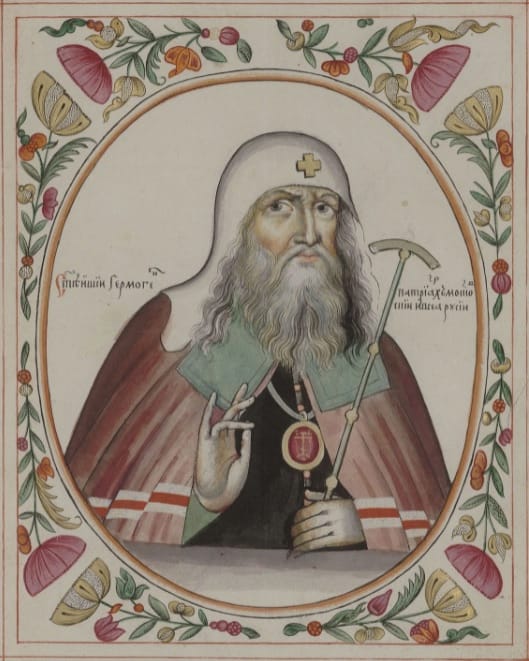
St. Hermogenes of Moscow
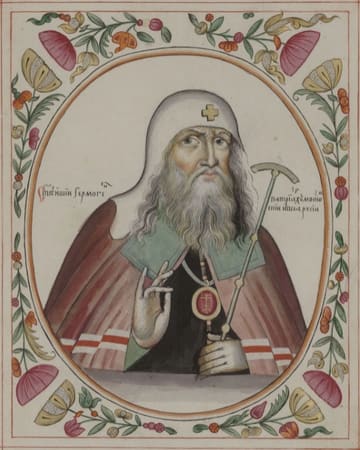
St. Hermogenes, Patriarch of Moscow and All Russia from 1606 to 1612, is honored as a hieromartyr of the Time of Troubles.
When Polish troops held the Kremlin and leading boyars bowed to the Polish king, the aged patriarch refused to bless foreign rule, called the Russian people to defend the Orthodox faith, and died a prisoner in the Chudov Monastery in February 1612.
Little is certain about his origins. Born about 1530, he first appears as a parish priest at the church of St. Nicholas in Kazan, and on July 8, 1579, he took part in the finding of the wonderworking Kazan Icon of the Theotokos, carrying it to church with the archbishop's blessing; he later wrote the account of its appearance and miracles. Tonsured in 1587, he became archimandrite of the Transfiguration Monastery in Kazan, and on May 13, 1589, Metropolitan of Kazan and Astrakhan. In that newly conquered land of Tatars, Chuvash and Mari he instructed the newly baptized, took part in uncovering the relics of St. Gurias and St. Barsanuphius in 1595 and wrote their Life, and won the commemoration of the Kazan martyrs.
Under the first False Dmitry he stood almost alone among the bishops in demanding that the pretender's Polish bride become Orthodox before the wedding, and he was sent away from Moscow. When the pretender fell, he was enthroned as patriarch on July 3, 1606. Through years of civil war he upheld the lawful tsar, Vasily Shuisky, and he refused to recognize the tsar's forced tonsure in 1610.
When the boyars offered the throne to the Polish prince Wladyslaw, Hermogenes insisted that he first become Orthodox; when King Sigismund wanted the crown for himself, the patriarch refused under threats to sign the boyars' letter of submission. His letters to the towns from the end of 1610 helped to raise the militias that would free the country.
In March 1611 he was deposed and confined in the Chudov Monastery in the Kremlin. In August he still managed to send a last letter to Nizhny Novgorod, where the Second Militia of Kuzma Minin and Prince Dmitry Pozharsky was soon to gather, urging the troops to keep purity of soul and brotherhood. According to the New Chronicler, his captors then starved him to death.
He died on February 17, 1612, months before Moscow was freed. In 1652 his body, found incorrupt, was moved to the Dormition Cathedral of the Kremlin, where his relics rest today, and in 1913 he was glorified. The Church keeps his memory on February 17, his glorification on May 12, and the Synaxis of the Moscow hierarchs on October 5.
Sources
- New Chronicler (Novy Letopisets), on the years 1606-1612
- St. Hermogenes, letters and writings, in Tvoreniya svyateishego Germogena (Moscow, 1912)
- Pravoslavnaya Entsiklopediya, vol. 18, 'Ermogen'
- Church Slavonic service for the glorification of St. Hermogenes (1913)
- OCA, Lives of the Saints, February 17: Hieromartyr Hermogenes, Patriarch of Moscow, Wonderworker of All Russia
Even a good thing is not good when it is not done well.
St. Hermogenes, Epistle to All the People, Above All to Priests and Deacons, on the Correction of Church Singing (translated for Axios! from the Old Russian)
The church is a quiet and saving refuge, a harbor free of storms; yet you trouble and stir it, and raise a storm against yourselves.
St. Hermogenes, Epistle to All the People, Above All to Priests and Deacons, on the Correction of Church Singing (translated for Axios! from the Old Russian)
Sing every hymn in harmony with the holy fathers, with one voice and not in two or three at once, and sing the rest according to the rule, so that you may hope to receive mercy from God and be delivered from the great troubles of our time.
St. Hermogenes, Epistle to All the People, Above All to Priests and Deacons, on the Correction of Church Singing (translated for Axios! from the Old Russian)
Let them put an end to looting and drunkenness, keep purity of soul and brotherhood, and as they vowed to lay down their lives for the house of the Most Pure Theotokos, for the wonderworkers and for the faith, so let them do.
St. Hermogenes, last letter to Nizhny Novgorod (August 1611), on the militia (translated for Axios! from the Old Russian)
To you all, our blessing and absolution in this age and in the age to come, because you stand unshaken for the faith; and I am bound to pray to God for you.
St. Hermogenes, last letter to Nizhny Novgorod (August 1611) (translated for Axios! from the Old Russian)
Troparion of St. Hermogenes of Moscow, for his glorification (Tone 4)
The day of radiant festival has come: the city of Moscow rejoices, and with it Orthodox Russia exults in songs and spiritual hymns; for today the holy festival of the appearing of the precious and healing relics of the hierarch and wonderworker Hermogenes has shone forth like the never-setting sun with radiant beams, driving away the darkness of temptations and troubles from those who cry with faith: Save us, as our protector, O great Hermogenes!
Translated for Axios! from the Church Slavonic service for his glorification (1913), May 12
Kontakion · Tone 4
Having lived in piety among the hierarchs and passed along the road of martyrdom, you quenched the sacrifices to idols and became the champion of your flock, O God-wise one. Therefore, honoring you, we cry to you in mystery: From troubles deliver us always by your prayers, O our father Hermogenes.
Translated for Axios! from the Church Slavonic General Menaion (the common kontakion of a hieromartyr)
Saints around February 17
Get the full library
770+ saints, in your pocket
Their Lives, sayings and prayers, A to Z and by feast, with search. The Church calendar, the holy icons, and the saying of the day on your Home Screen. All in Axios! for iPhone, iPad and Android.