
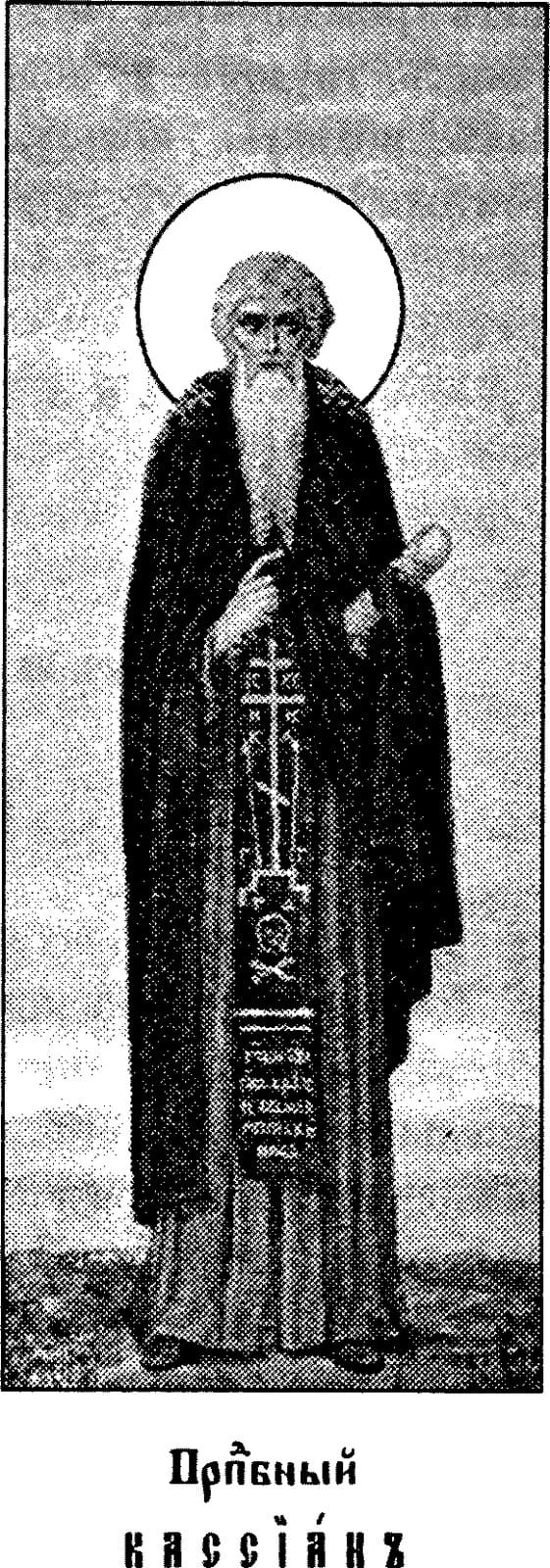
St. John Cassian
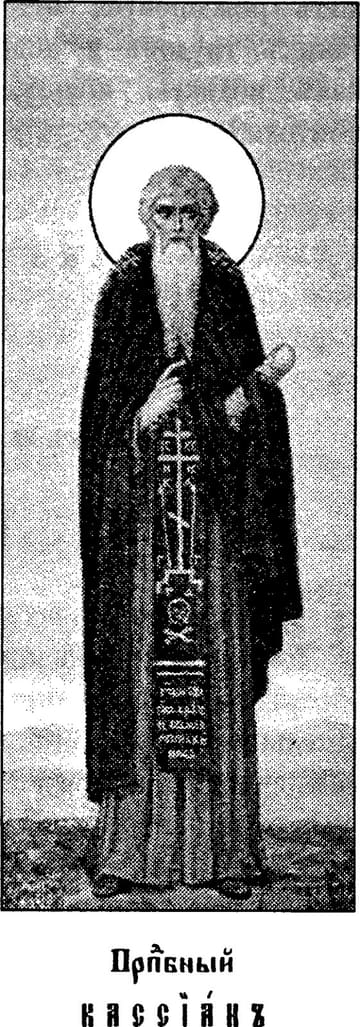
St. John Cassian, called the Roman in the East, probably because he wrote in Latin, carried the wisdom of the desert fathers of Egypt to the Christian West.
A disciple of the Egyptian elders and a deacon of St. John Chrysostom, he founded monasteries at Marseille and wrote the Institutes and the Conferences, books that shaped Western monasticism and are read in the East in the Philokalia. The Church keeps his memory on February 29, and in years without that day his service is sung on February 28.
He was born about 360 in Rome. He came from a well-to-do Christian family and received a classical education. Drawn by the fame of St. John Chrysostom, he left Rome for Constantinople to learn from him, and Chrysostom ordained him deacon and entrusted him with the treasury of the cathedral.
He then traveled east with his friend Germanus, and the two became monks in a monastery at Bethlehem, near the cave of the Nativity, before going on to Egypt, the homeland of monasticism. In the Nile Delta and in the desert of Scete they sat at the feet of elders such as Abba Moses, Paphnutius, Serenus and Isaac, and their conversations became the Conferences. In time Cassian made his way back to the West, where he formed a lasting friendship with the future Pope St. Leo the Great.
About 415 he settled at Marseille. Beside the tomb of the martyr Victor he founded a monastery for men, later the Abbey of St. Victor, and he also founded one for women. At the request of the monks of southern Gaul he wrote the Institutes, on the monastic life and the battle against the eight principal passions, and then the Conferences; about 430, at Leo's request, he wrote On the Incarnation against Nestorius. His teaching that God's grace and human freedom work together drew criticism from Prosper of Aquitaine and other followers of Augustine, but the East has always received him as a teacher of the spiritual life.
He reposed at Marseille about 435 and was buried in the crypt of St. Victor, where his head and right hand were later enshrined. His Greek service, which names him Confessor, dates from the 14th century. In Romania his veneration has flourished anew.
Sources
- St. John Cassian, Institutes, Conferences and On the Incarnation of the Lord (NPNF, Second Series, vol. 11, trans. E. C. S. Gibson)
- Greek Menaion and Church Slavonic Menaion, February 29
- Pravoslavnaya Entsiklopediya, 'Ioann Kassian Rimlyanin'
- OCA, Lives of the Saints: Venerable John Cassian the Roman
A reasonable supply of food partaken of daily with moderation is better than a severe and long fast at intervals. Excessive fasting has been known not only to undermine the constancy of the mind, but also to weaken the power of prayers through sheer weariness of body.
Institutes V.9 (NPNF, trans. Gibson, adapted)
Bodily weakness is no hindrance to purity of heart, if only so much food is taken as the bodily weakness requires, and not what pleasure asks for.
Institutes V.7 (NPNF, trans. Gibson)
However great a city may be protected by the height of its walls and the strength of its closed gates, yet it is laid waste by the giving up of one postern, however small.
Institutes V.11 (NPNF, trans. Gibson, adapted)
God, the Creator and Healer of all, knowing that pride is the cause and fountain head of evils, has been careful to heal opposites with opposites, that those things which were ruined by pride might be restored by humility.
Institutes XII.8 (NPNF, trans. Gibson, adapted)
None can attain the end of perfection and purity, except through true humility, which he displays in the first instance to the brethren, and shows also to God in his inmost heart.
Institutes XII.23 (NPNF, trans. Gibson, adapted)
Read his writings. Hold fast his instruction. Embrace his faith and merits. For though to attain this is a hard and magnificent thing, yet even to follow is beautiful and sublime.
On the Incarnation of the Lord, against Nestorius VII.31, of his teacher St. John Chrysostom (NPNF, trans. Gibson, adapted)
Troparion · Tone 8
In you, O Father, God's image was preserved to perfection; for you took the cross upon yourself and followed Christ, and in your conduct you taught that one should think little of the flesh, for it is fleeting, and take care of the soul, a thing that does not die. And so, O venerable John, your spirit exults together with the angels.
Translated for Axios! from the Greek Menaion, February 29 (the venerable fathers' apolytikion, which the Menaion appoints for him)
Kontakion · Tone 4
Made holy, you were offered to God, and, made radiant by every form of good, O Cassian, you flashed forth like the sun, ever enlightening with the light of your divine teachings the hearts of all who honor you. But entreat Christ earnestly for those who praise you warmly and with longing.
Translated for Axios! from the Greek Menaion, February 29 (the kathisma of his service, which the Church Slavonic Menaion sings as his kontakion)
Saints around February 29
Get the full library
770+ saints, in your pocket
Their Lives, sayings and prayers, A to Z and by feast, with search. The Church calendar, the holy icons, and the saying of the day on your Home Screen. All in Axios! for iPhone, iPad and Android.