
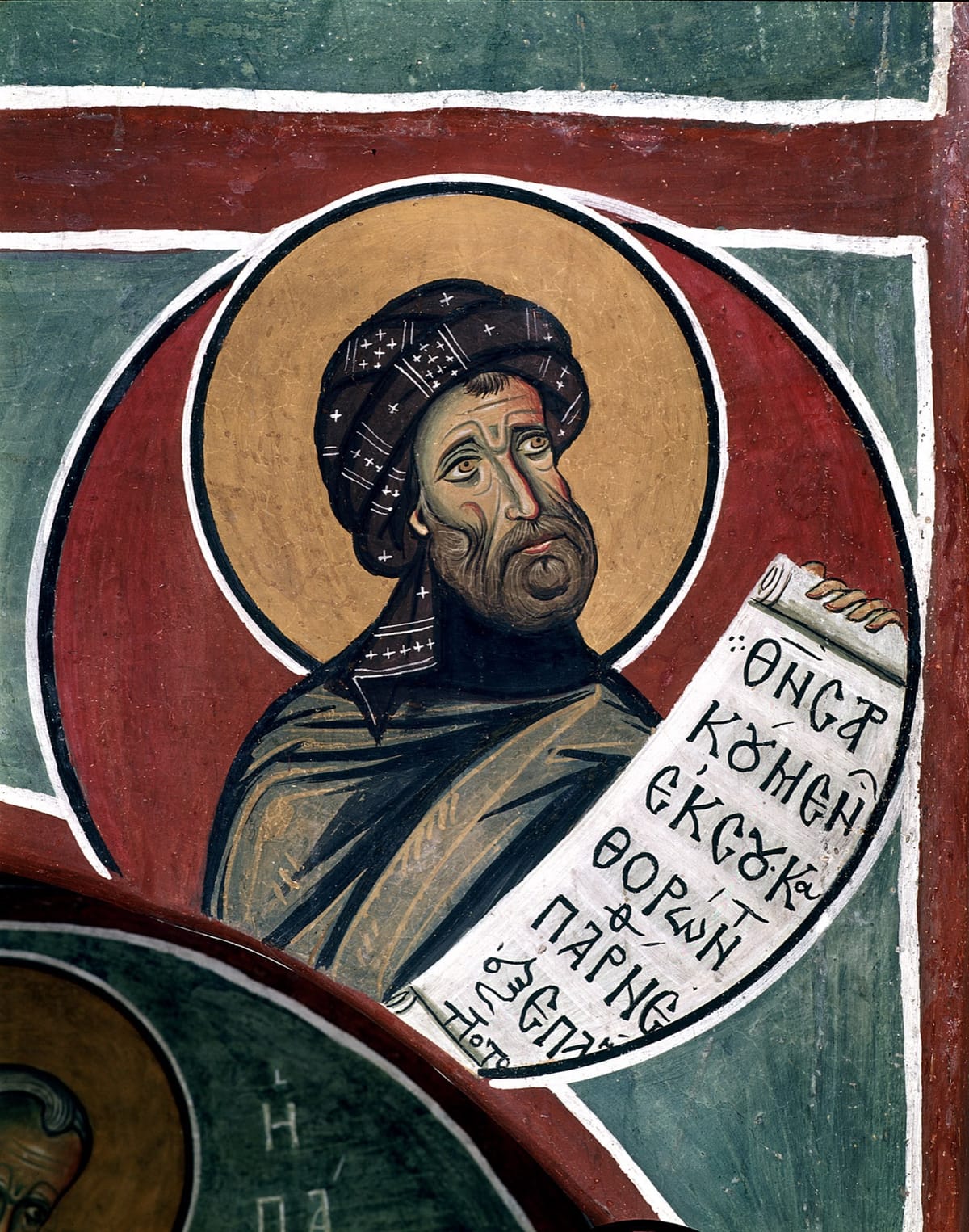
St. Joseph the Hymnographer
Also commemorated
- April 3Greek usage
St. Joseph the Hymnographer (died 883) is the most prolific poet of the Orthodox Church. Hundreds of the canons of Matins in the Menaion, the Octoechos and the Triodion are his, many signed with his name in the acrostic of the ninth ode, and his words are heard in the services almost daily, above all in the canon of the Akathist Hymn.
The Synaxarion of Constantinople says that he was born in Sicily to Plotinus and Agatha. When the Arabs overran the island he fled with his mother and brothers to the Peloponnese, and at fifteen he became a monk in Thessaloniki, where he was later ordained a priest. He became the disciple of St. Gregory the Decapolite and went with him to Constantinople. When Emperor Leo the Armenian renewed the war on the icons, the Orthodox sent him to Rome to seek help, but Arab pirates seized his ship and held him prisoner on Crete, where he encouraged his fellow captives.
There, the Synaxarion tells, a holy man who said he had come from Myra, St. Nicholas, appeared to him with a scroll, and Joseph sang the words written on it: "Hasten, O Compassionate One, and as the Merciful make speed to help us, for You can do whatever You will." Soon Emperor Leo was slain, and Joseph was freed. In Constantinople he founded a monastery dedicated to the Apostle Bartholomew, whose relics he had received, and to St. Gregory. The Apostle, his Lives relate, appeared to him by night at the altar, laid the Gospel on his breast and blessed him, and from then on he wrote hymns with remarkable ease.
For rebuking the Caesar Bardas, Joseph was exiled to Cherson in the Crimea around 858, and there too he wrote canons. After his return he became keeper of the sacred vessels of Hagia Sophia under St. Ignatius, and St. Photius, who succeeded Ignatius, honored him as a man of God. Scholars count some four hundred canons of his in the Menaion alone, among them the canon of St. Martin the Confessor, written in a clear, simple style on model stanzas borrowed from St. John of Damascus and St. Cosmas.
At a great age, foreseeing his death, he returned the inventory of the church treasury to Photius and reposed seven days later, on the Wednesday of Holy Week in 883. The Synaxarion adds that St. Theodore the Recruit was late in answering a man's prayer because he had been escorting Joseph's soul to heaven. The Greek Church keeps his feast on April 3 and the Slavic Churches on April 4; part of his relics is venerated in Athens, at the church of St. Constantine in Kolonos.
Sources
- Synaxarion of Constantinople, April 3 (ed. H. Delehaye, 1902)
- Greek Menaion, April 3; Church Slavonic Menaion, April 4
- Pravoslavnaya Entsiklopediya, vol. 26, 'Iosif Pesnopisets'
- OCA, Lives of the Saints: Venerable Joseph the Hymnographer
- Great Synaxaristes (synaxarion.gr), 'Ὁ Ὅσιος Ἰωσὴφ ὁ Ὑμνογράφος'
O vessel of joy, to you alone it is fitting to rejoice.
Canon of the Akathist to the Theotokos, acrostic (translated for Axios! from the Greek)
No tongue, however eloquent, has the strength to sing your praise, O Lady, for you were raised above the seraphim when you bore Christ the King. Entreat Him now to deliver from every harm those who venerate you with faith.
Canon of the Akathist to the Theotokos, ode 7, troparion 3 (translated for Axios! from the Greek)
Let us stand with reverence in the house of our God and cry aloud: Rejoice, Lady of the world; rejoice, Mary, Lady of us all; rejoice, you alone blameless and fair among women; rejoice, pillar of fire, leading mankind into the life above.
Canon of the Akathist to the Theotokos, ode 9, troparion 3 (translated for Axios! from the Greek)
To praise the labors of Martin is great glory.
Canon of St. Martin the Confessor, acrostic (translated for Axios! from the Greek)
You taught, O blessed one, that Christ, the One of the holy Trinity and God beyond all being, has two natures, two wills and twofold energies, and you cast out all who do not worship Him so, O most sacred Martin.
Canon of St. Martin the Confessor, ode 1, troparion 2 (translated for Axios! from the Greek)
Like a radiant sun rising from the West toward the East, O blessed one, you lit the whole earth with your rays and drove away the deepest darkness of the heretics.
Canon of St. Martin the Confessor, ode 9, troparion 2 (translated for Axios! from the Greek)
Troparion · Tone 8
In you, O Father, God's image was preserved to perfection; for you took the cross upon yourself and followed Christ, and in your conduct you taught that one should think little of the flesh, for it is fleeting, and take care of the soul, a thing that does not die. And so, O venerable Joseph, your spirit exults together with the angels.
Translated for Axios! from the Greek General Menaion (the common troparion of a venerable father)
Kontakion · Tone 4
You are an inexhaustible fountain of repentance, a giver of unending comfort and a deep sea of compunction, O Joseph. Grant us tears of divine repentance, that weeping here we may find comfort from God, as we ask for your help, O holy one.
Translated for Axios! from the Church Slavonic Menaion, April 4
Saints around April 4
Get the full library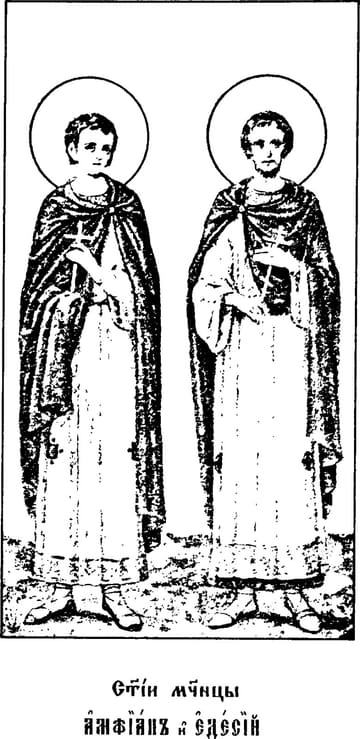
770+ saints, in your pocket
Their Lives, sayings and prayers, A to Z and by feast, with search. The Church calendar, the holy icons, and the saying of the day on your Home Screen. All in Axios! for iPhone, iPad and Android.