
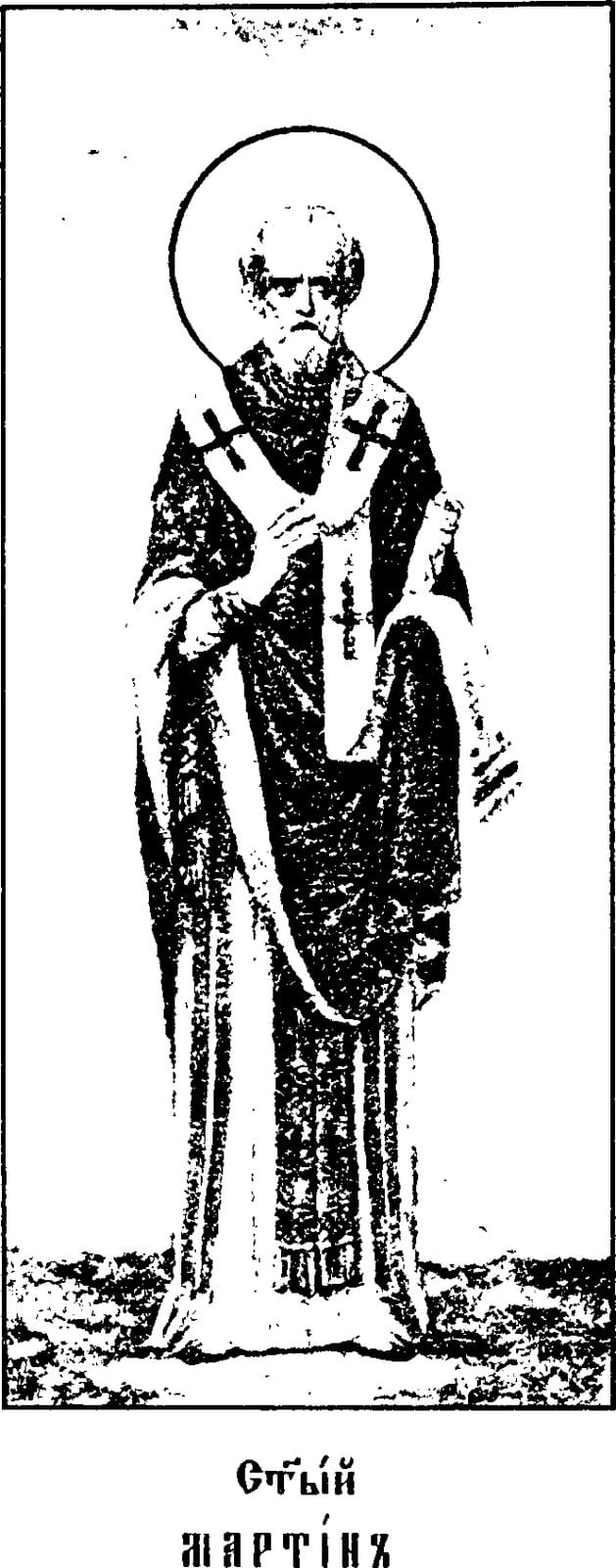
St. Martin the Confessor
Also commemorated
- April 13Greek usage
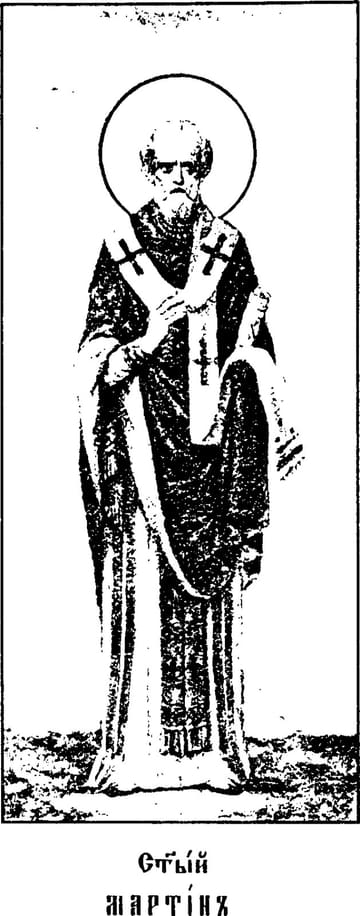
St. Martin the Confessor, Pope of Rome from 649 to 655, gave his life for the truth that Christ has two wills, divine and human.
He presided over the Lateran Council that condemned Monothelitism, and for this the emperor had him arrested, tried as a traitor and exiled to the Crimea, where he died of hunger and hardship.
He was born in Todi in central Italy and served as the papal envoy in Constantinople under Pope Theodore I. To win back the opponents of Chalcedon, the emperors had promoted the teaching that Christ has one energy and then one will, and the Typos of Constans II (648) forbade discussing it. Elected pope in 649, Martin was consecrated without waiting for the emperor's approval. In October of that year, with the help of St. Maximus the Confessor and Greek monks from the East, he held the Lateran Council in Rome, where over a hundred bishops confessed in Christ two natural wills and two natural energies and condemned the Ekthesis, the Typos and the patriarchs who had taught the error.
The emperor ordered his arrest. After the exarch Olympius failed to carry it out, the exarch Theodore Calliopas seized the ailing pope in the Lateran basilica in June 653, while his clergy cried, "With him we live, with him we die!" Taken secretly by sea, Martin was held for a time on the island of Naxos and reached Constantinople in September 653.
After three months alone in prison he was tried before the senate in December on the charge of supporting Olympius's rebellion, and his attempts to speak about the faith were cut short. He was stripped of his vestments before the crowd, chained, dragged through the city and condemned to death; at the plea of the dying Patriarch Paul the sentence was changed to exile.
In 653 he was sent to Cherson in the Crimea. His last letters tell of a land so poor that bread was named but never seen, and of his sorrow at being forgotten by his own people; yet he prayed that God would keep the Roman Church and its new shepherd steadfast in the Orthodox faith, and he committed his weakened body to the Lord. He reposed on September 16, 655, and was buried in the church of the Theotokos of Blachernae outside the walls of Cherson, where miracles were reported at his tomb. Twenty-five years later the Sixth Ecumenical Council confirmed the faith for which he and St. Maximus had suffered.
The Greek Church keeps his feast on April 13, together with the bishops exiled with him, and the Slavic Churches on April 14. His canon is the work of St. Joseph the Hymnographer.
Sources
- St. Martin I, Letters 15-17, from Constantinople and Cherson (PL 87)
- Pravoslavnaya Entsiklopediya, vol. 44, 'Martin I'
- Greek Menaion and Synaxarion, April 13
- St. Dimitri of Rostov, Lives of the Saints, April 14
- OCA, Lives of the Saints: Saint Martin the Confessor, Pope of Rome
I believe in the power of God, who sees all things, that when I have been taken from this present life, those who persecute me will be called to account for all this, so that, led at least in this way to repentance, they may turn from their iniquity.
Letter 15, to Theodore (PL 87, 202) (translated for Axios! from the Latin)
I was astonished, yet I glorified my God even in this, for He orders our tribulations as He knows best; above all since there is such famine and want in this land that bread is only named here, but never seen at all.
Letter 16, from Cherson (PL 87, 202-203) (translated for Axios! from the Latin)
I have wondered, and I still wonder, at the thoughtlessness and want of compassion of all who once belonged to me, my friends and kinsmen, who have so utterly forgotten my misfortune that, as I find, they do not even wish to know whether I am still on the earth or not.
Letter 17, from Cherson (PL 87, 203) (translated for Axios! from the Latin)
Yet may God, who wills that all be saved and come to the knowledge of the truth, through the intercessions of St. Peter establish their hearts in the Orthodox faith... and keep them unshaken, above all the shepherd who is now shown to preside over them.
Letter 17, from Cherson (PL 87, 204) (translated for Axios! from the Latin)
As for this lowly body of mine, the Lord Himself will take care of it, guiding it as it pleases Him, whether in unceasing tribulations or in some small relief. For the Lord is near; why then should I be anxious? I hope in His mercies that He will not delay to bring my course to its end.
Letter 17, from Cherson (PL 87, 204) (translated for Axios! from the Latin)
Troparion · Tone 4
O God of our fathers, You who ever act toward us in Your meekness, do not remove Your mercy from us, but through their prayers direct our life in peace.
Translated for Axios! from the Greek Menaion, April 13
Kontakion · Tone 2
O divine thunder, trumpet of the Spirit, planter of the faithful and axe of heresies, O Hierarch Martin, greatest servant of the Trinity: ever dwelling with the angels, do not cease from interceding for us all.
Translated for Axios! from the Greek Menaion (the common kontakion of a hierarch)
Saints around April 14
Get the full library
770+ saints, in your pocket
Their Lives, sayings and prayers, A to Z and by feast, with search. The Church calendar, the holy icons, and the saying of the day on your Home Screen. All in Axios! for iPhone, iPad and Android.