
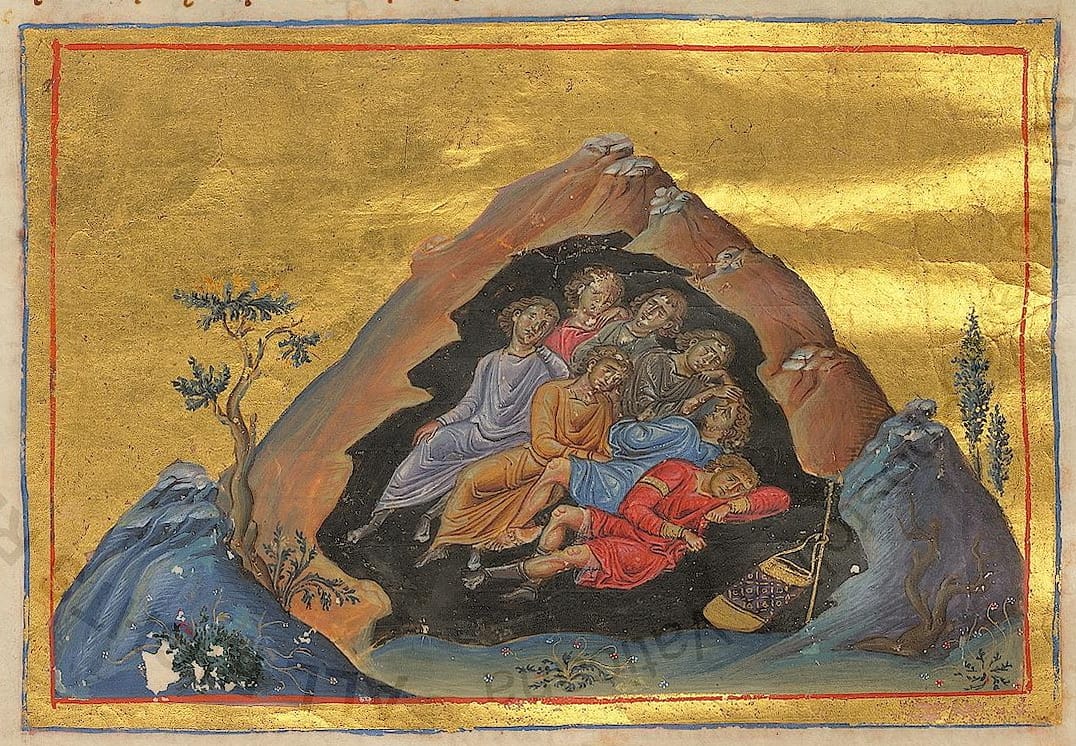
The Seven Youths of Ephesus
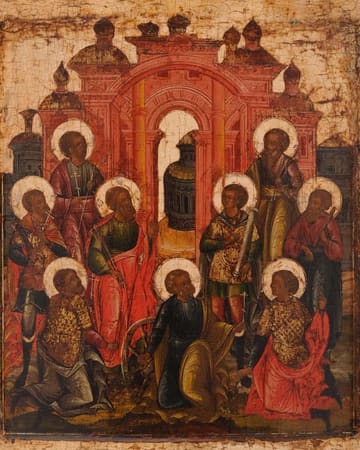
The Seven Youths of Ephesus, often called the Seven Sleepers, are among the best loved figures of the Church's tradition.
According to their Life, they were young Christians of Ephesus who hid in a cave during the persecution of Decius and fell asleep in death there; more than two centuries later, under the Christian emperor Theodosius II, they awoke for a short time as a sign of the resurrection of the dead. The Church keeps their memory on August 4 and again on October 22.
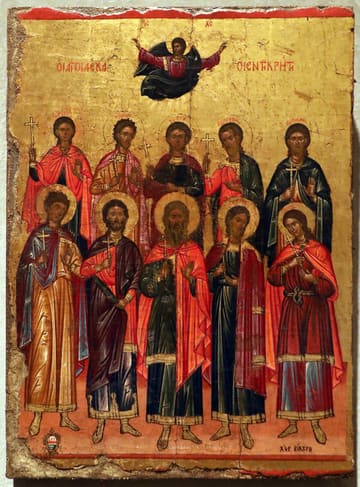
Their Life tells the story this way. When Decius came to Ephesus about 250 and ordered the citizens to sacrifice to the gods, seven young men of good families confessed Christ: Maximilian, Iamblichus, Martinian, John, Dionysius, Exacustodian (also called Constantine) and Antoninus. The emperor gave them time to reconsider.
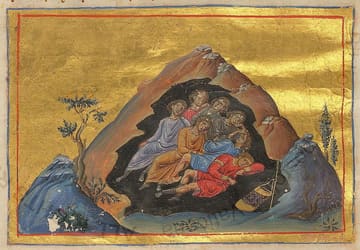
They gave their goods to the poor and withdrew to a cave in a hill outside the city to pray and await martyrdom, while Iamblichus, the youngest, slipped into the city in disguise to buy bread. When Decius learned where they were, he had the mouth of the cave walled up, and inside they fell asleep in the Lord.
Under Theodosius II (408-450), when some at Ephesus denied the resurrection of the body, the owner of the hill had the cave opened, and the youths awoke as if after a single night. Iamblichus went to the market and paid with coins of Decius. Questioned by the city's authorities, he led the bishop to the cave, where the others were found alive. The emperor himself came to see them, and when they had told him that God had raised them to confirm the hope of the resurrection, they lay down again and slept in death until the last day.
The story is first told in writings of the late 5th and 6th centuries, among them a Syriac homily by Jacob of Serugh (died 521), and it soon spread in Greek, Syriac, Latin and many other languages. Its many versions differ in the names and the number of years. Many historians regard it as a pious narrative; others think a real episode of the 440s lies behind it.
The Church receives it as a sign of the resurrection and sings of youths who died and remained incorrupt. At Ephesus a cave church on the slope of Mount Pion, excavated by Austrian archaeologists in the 1920s, was long shown to pilgrims as their tomb, and the Russian abbot Daniel saw their relics there in the 12th century. The books explain the two feasts differently, as the day they first fell asleep, the day they awoke, or the day they slept again.
Sources
- Greek Menaion and Synaxarion, August 4 and October 22
- Slavonic Menaion, August 4
- OCA, Lives of the Saints: 7 Holy Youths (Seven Sleepers) of Ephesus
- Mystagogy Resource Center, 'The Historicity of the Seven Sleepers of Ephesus'
- Catholic Encyclopedia (1909), 'The Seven Sleepers of Ephesus'
No recorded sayings. Read the Life to meet this saint.
Troparion · Tone 4
Your martyrs, O Lord, by their contest won from You, our God, the crowns of incorruption; for, holding Your strength, they threw the tyrants down and shattered too the powerless audacity of demons. At their entreaties, O Christ God, save our souls.
Translated for Axios! from the Greek Menaion, August 4
Kontakion · Tone 4
Having disdained the things of the world as corruptible and received the incorruptible gifts, they died and yet remained free from corruption; therefore they rise up after many years, burying all the unbelief of the hostile. Extolling them with praise today, O faithful, let us sing hymns to Christ.
Translated for Axios! from the Greek Menaion, August 4
Saints around August 4
Get the full library
770+ saints, in your pocket
Their Lives, sayings and prayers, A to Z and by feast, with search. The Church calendar, the holy icons, and the saying of the day on your Home Screen. All in Axios! for iPhone, iPad and Android.