
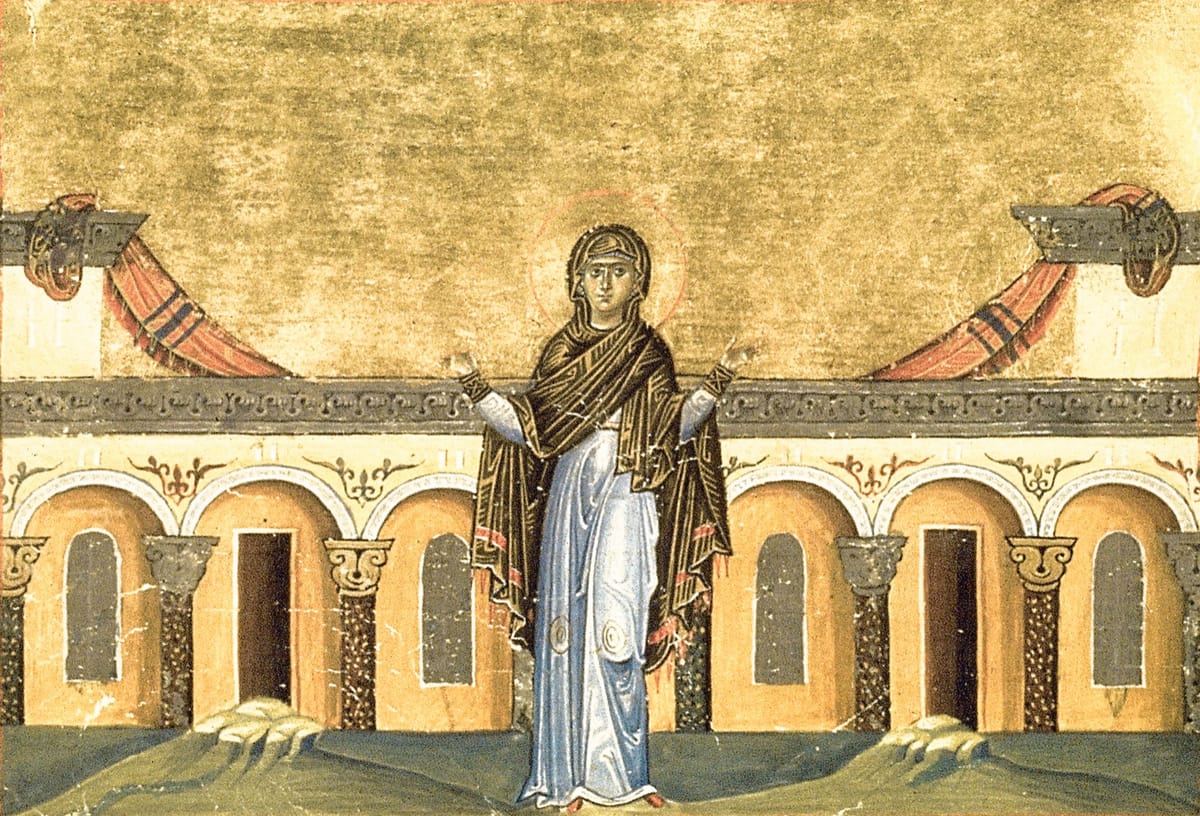
St. Syncletica of Alexandria
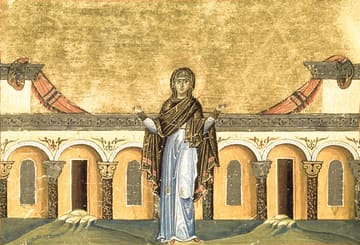
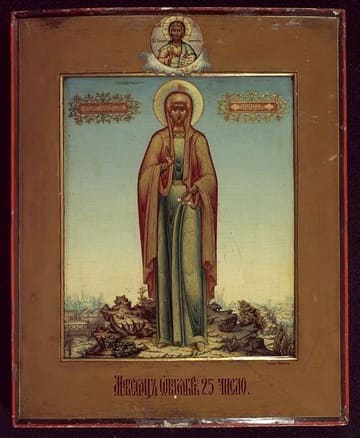
St. Syncletica of Alexandria is the best known of the Desert Mothers, the women who took up the ascetic life of Egypt in the age of St. Anthony the Great.
Her teaching, preserved in her Life and in the Sayings of the Desert Fathers, made her a spiritual mother to generations of nuns and monks, and the Church honors her as a venerable mother.
Her Life, an early work long attributed to St. Athanasius of Alexandria but written by an unknown author, says that her family came from Macedonia and settled in Alexandria, drawn by the faith of its Christians. She was of noble birth, wealthy and beautiful, yet she refused every suitor. She had a sister of one mind with her, who was blind, and two brothers: one died in childhood, and the other at twenty-five, on the eve of his wedding. While still in her parents' house she fasted and disciplined her body, hiding her struggle from others.
When her parents died, she sold her inheritance and gave it to the poor, had a priest cut her hair, and went with her blind sister to live in the tomb of a relative outside the city. There she gave herself to prayer and fasting, and women gathered around her. At first she kept silent, but at their pleading she began to teach, and her Life records her long discourses on humility, watchfulness, voluntary poverty and the discerning of thoughts. She taught that ascetic effort must keep its measure, that obedience in community is worth more than feats of fasting, and that the enemy must be met with prayer and patience.
In her last years she was struck by a long and terrible illness, first in her lungs, then by a cancer that began in a tooth and ate away her jaw, until her companions could hardly bear the stench. For three and a half years she endured it like Job, refusing remedies, until a physician persuaded her to let the wound be dressed for the sisters' sake. Near the end she saw angels and the light of paradise, foretold that she would depart in three days, and reposed at the hour she had named, at about eighty. The OCA places her death about 350.
Eighteen of her sayings stand under her name in the alphabetical collection of the Sayings of the Desert Fathers, among the very few words of the desert mothers to survive. Her memory is kept on January 5.
Sources
- Pseudo-Athanasius, Life and Conduct of St. Syncletica (PG 28.1487-1558)
- Apophthegmata Patrum, alphabetical collection, Syncletica 1-18 (PG 65.421-428)
- Synaxarion, January 5 (Greek Menaion)
- OCA, Lives of the Saints: Venerable Syncletica of Alexandria
In the beginning there is struggle and great toil for those who come to God, and afterward joy beyond words. Those who want to light a fire are first choked by the smoke and weep, and so they obtain what they seek ... so we too must kindle the divine fire in ourselves with tears and toil.
Apophthegmata Patrum, Syncletica 1 (translated for Axios! from the Greek)
As the strongest medicines drive out venomous creatures, so prayer joined to fasting drives out an evil thought.
Apophthegmata Patrum, Syncletica 3 (translated for Axios! from the Greek)
Owning nothing is a perfect good for those who are able. Those who endure it have affliction in the flesh but rest in the soul. As sturdy garments are washed clean by being trodden and wrung hard, so a strong soul is made stronger still by voluntary poverty.
Apophthegmata Patrum, Syncletica 5 (translated for Axios! from the Greek)
If you live in a community, do not change your place, for it will harm you greatly. As a bird that leaves its eggs makes them addled and barren, so the monk or virgin grows cold and dead in faith by going from place to place.
Apophthegmata Patrum, Syncletica 6 (translated for Axios! from the Greek)
Imitate the publican, so that you are not condemned with the Pharisee; and choose the meekness of Moses, so that you may turn your heart, which is a rock, into springs of water.
Apophthegmata Patrum, Syncletica 11 (translated for Axios! from the Greek)
Why do you hate the person who has grieved you? It is not he who has wronged you, but the devil. Hate the sickness, and not the one who is sick.
Apophthegmata Patrum, Syncletica 13, end (translated for Axios! from the Greek)
When we live in a community, let us prefer obedience to ascetic feats, for asceticism teaches pride, but obedience humility.
Apophthegmata Patrum, Syncletica 16 (translated for Axios! from the Greek)
Why do you cut me off from this good contest? Why do you look at what appears, not knowing what is hidden? Why do you busy yourselves with what is happening, and do not see the One who does it?
Her words to the sisters in her last illness, Life of St. Syncletica 111 (translated for Axios! from the Greek)
Troparion · Tone 8
In you, O Mother, God's image was preserved to perfection; for you took the cross upon yourself and followed Christ, and in your conduct you taught that one should think little of the flesh, for it is fleeting, and take care of the soul, a thing that does not die. And so, O venerable Syncletica, your spirit exults together with the angels.
Translated for Axios! from the Greek General Menaion (the common troparion of a venerable mother)
Kontakion · Tone 2
For love of the Lord, O venerable one, you hated the desire for ease, enlightening your spirit by fasting, for you mightily overcame the beasts. But by your prayers overthrow the tumult of the adversaries.
Translated for Axios! from the Church Slavonic General Menaion (the common kontakion of a venerable mother)
Saints around January 5
Get the full library

770+ saints, in your pocket
Their Lives, sayings and prayers, A to Z and by feast, with search. The Church calendar, the holy icons, and the saying of the day on your Home Screen. All in Axios! for iPhone, iPad and Android.