
August 16
Saints of the day
Also commemorated
The Image of our Lord Jesus Christ Not Made by Hands
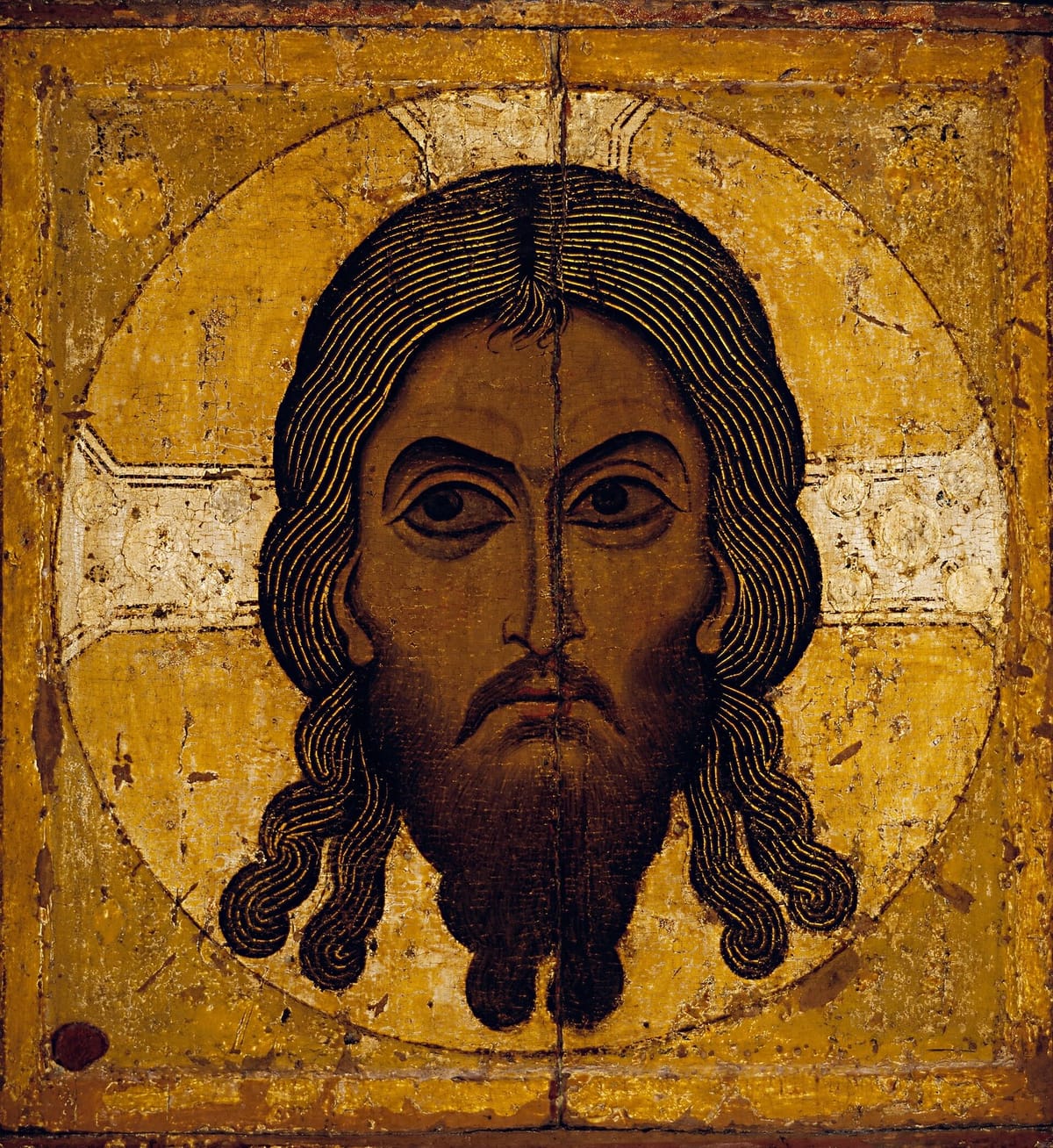
In those times when our Lord was preaching the Gospel and healing every sickness and every infirmity among men, there lived in the city of Edessa, on the bank of the river Euphrates, a certain prince named Abgar, who was entirely leprous. He heard of Christ, the Healer of every affliction and disease, and sent a certain painter named Ananias to Palestine with a letter to Christ, in which Abgar besought the Lord to come to Edessa and heal him of leprosy. In case the Lord could not come, the prince ordered Ananias to paint His likeness and bring it, believing that that image would restore his health. The Lord replied that He could not come, since the time of His Passion was drawing near. He took a cloth, wiped His face, and on the cloth His most pure countenance was perfectly imprinted. The Lord gave this cloth to Ananias with a message that the prince would be healed by it, though not entirely, for which reason He would later send him an envoy who would wipe away the remainder of his disease. Having received the cloth, Prince Abgar kissed it, and the leprosy fell from his whole body, though a little of it remained on his face. Later the Apostle Thaddeus, while preaching the Gospel, came to Abgar, healed him secretly and baptized him. Then the prince smashed the idols which stood before the gates of the city, and over the gates he placed that cloth with the image of Christ, glued to a board, framed in gold, and adorned with pearls. The prince also inscribed beneath the icon on the gate: "Christ God, no one shall be put to shame who hopes in Thee." Later, one of Abgar's great-grandsons restored idolatry. And the bishop of that city came by night and walled up that icon above the gate. Centuries passed from that time. In the time of Emperor Justinian, the Persian king Chosroes attacked Edessa, and the city was in great distress. It happened then that the Bishop of Edessa, Eulabius, had a vision of the Most Holy Theotokos, who revealed to him the secret of the walled-up and forgotten icon. The icon was found, and by its power the Persian army was defeated.
Hymn of Praise
O gracious God, who dost reveal mysteries,
Wondrous mysteries, never before imagined,
Thou didst once declare beside a lake
That many pagan peoples
From east to west in all directions
Would sit at table with Abraham,
While the faithless sons of Israel
Would be cast out into the uttermost darkness
Because of their hardened hearts.
The mystery was spoken, and the mystery came to pass:
Jews gazed into Thy face,
Yet behind Thy back they prepared Thy death.
But Prince Abgar from distant lands,
Leprous in body, stricken in soul
By the false faith of the pagans,
Heard of Thee from mouth to mouth,
Heard of Thy words and miracles,
Heard of Thee and believed in Thee,
Beheld the image of Thy most pure face,
And with tears he kissed Thy image.
He was made whole in body and in soul,
And his soul entered into Paradise,
With Abraham forever to rejoice.
Reflection
The Orthodox Church surpasses all other Christian groups in the richness of its Tradition. Protestants wish to hold only to Holy Scripture. But not even Holy Scripture can be interpreted without Tradition. The Apostle Paul himself commands: brethren, stand fast and hold the traditions which ye have been taught, whether by word or our epistle (II Thessalonians 2:15). The tradition concerning Prince Abgar is undoubtedly an apostolic tradition, even though the apostles do not mention it in their writings. The Apostle Thaddeus wrote nothing at all, so that according to the Protestant opinion he neither said anything nor handed anything down to the faithful. By what then was he an apostle of Christ? The tradition about Prince Abgar is mentioned by Saint John of Damascus in his defense of the veneration of icons. How wondrous and touching is the letter of Abgar to Christ. After he had first written that he had heard of His miraculous power to heal the sick, and after he had besought Him to come and heal him, Abgar further writes: "I hear also this, that the Jews hate Thee and are preparing some evil against Thee. I have a city, not large but beautiful and abundant in every good thing. Come to me and live with me in my city, which is sufficient for both of us for every need." Thus wrote a pagan prince, while the princes of Jerusalem were preparing death for the Lord and Lover of mankind.
Contemplation
Contemplate the miraculous help of God to Jonathan, the son of Saul (I Samuel 13-14), namely:
- How the Philistines rose up against the Israelites, and the army of the Philistines was like sand on the seashore;
- How Jonathan with his armor-bearer attacked the Philistines, trusting in God, and how he confounded and defeated them;
- How we too must recognize the truth of Jonathan's words: The Lord is not hindered to save by many or by few.
Homily
On the divine Branch from the root of Jesse
And there shall come forth a rod out of the stem of Jesse, and a Branch shall grow out of his roots
Isaiah 11:1
Before such clear prophecies about Christ the Lord, why did the Jews not believe in Him as the Messiah? Because of their senseless pride, and because of their senseless crimes against holy and righteous men. Who is this rod from the stem of Jesse other than the Lord Christ? Jesse was the father of King David, and from the tribe of David the Messiah was expected. From the tribe of David He appeared, and from Bethlehem, the city of David. The rod from the stem of Jesse signifies the bodily descent of the Lord from the Virgin Mary, a descendant of Jesse and David, while the Branch from his root, from Jesse's root, signifies the righteousness manifested in Him, a righteousness that had been trampled upon by many kings of the house of David. Trampled righteousness is like a dried-out stump. But from the root of such a stump a green shoot sometimes springs forth. Such a self-sprung shoot shall be the Lord Jesus. Through His Mother He shall be of the tribe of David, but through His divine Conception He shall be of the Holy Spirit. In eternity from the Father without a mother; in time from the Mother without a father. In eternity the idea of the Incarnation stood beneath the veil of Divinity; in time, His Divinity stood beneath the veil of humanity. Pilate gazed in vain at this rod from the stem of Jesse and exclaimed: Behold, the man! as if someone were to see a wire conducting electrical power among many ordinary wires and exclaim: Behold, a wire! Neither does the one know the electrical power in the wire, nor did the other know God in man.
O Lord Jesus, God-man and Lover of mankind, make us lovers of God, and save us. To Thee be glory and praise forever. Amen.
From the Prologue from Ochrid, translated by Marcian Sakarya, OCHRID.COM. CC BY-SA 4.0.
The Prologue, every day
Axios! brings the day’s Hymn of Praise, Reflection, Contemplation and Homily to Today, with the saints, the feasts and the saying of the day, on iPhone, iPad and Android.