
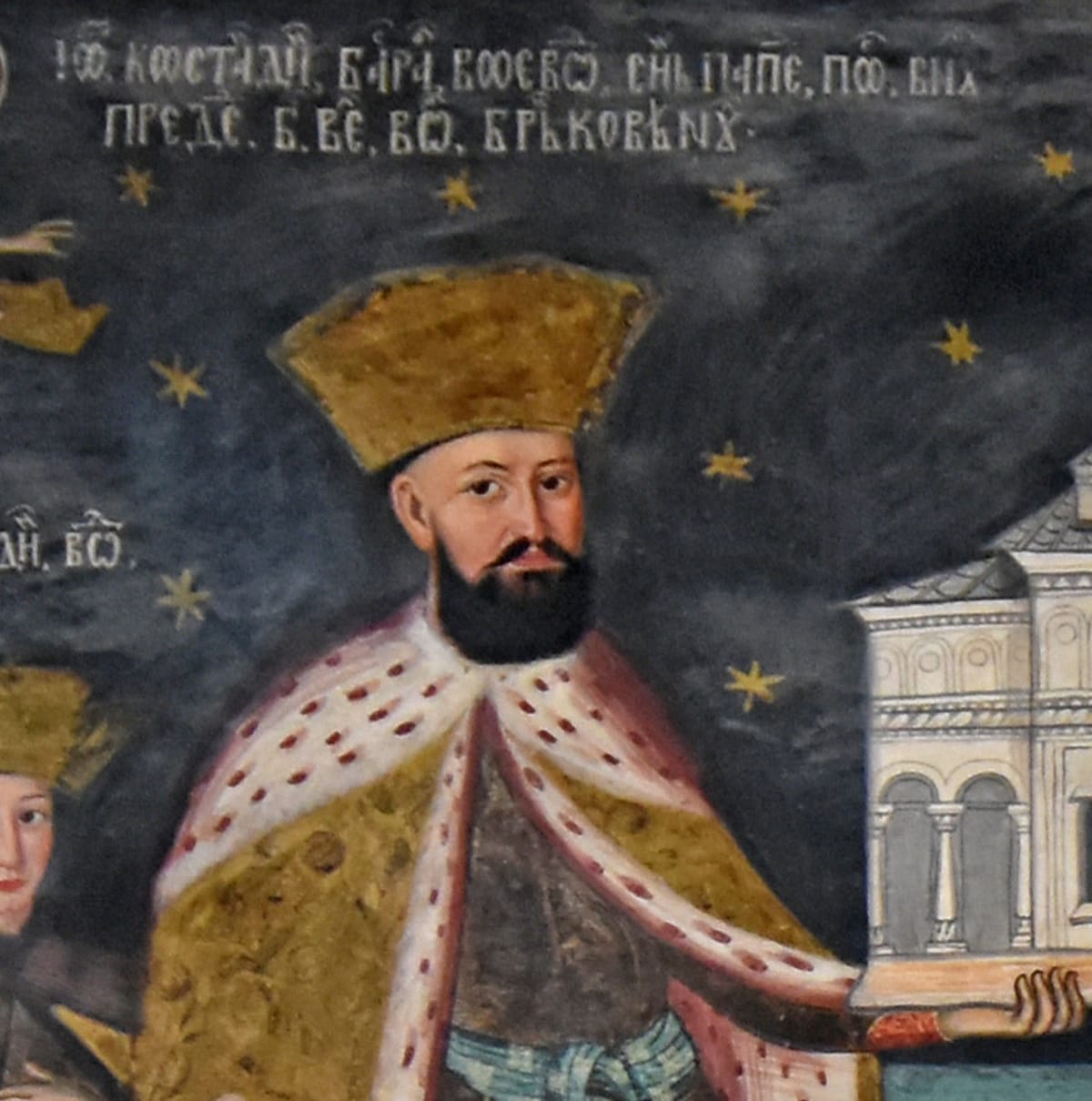
St. Constantine Brancoveanu and His Sons
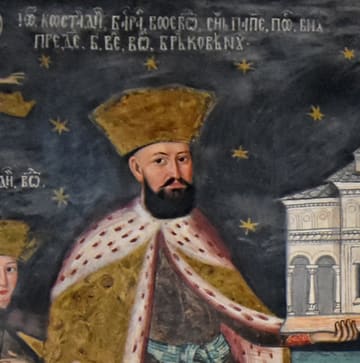
St. Constantine Brancoveanu, Prince of Wallachia, is honored by the Romanian Church as a martyr together with his four sons, Constantine, Stefan, Radu and Matei, and his counselor Ianache Vacarescu.
For a quarter of a century he ruled his land, built churches and printed books for the whole Orthodox East; in 1714 he and his sons were beheaded in Constantinople on the feast of the Dormition of the Theotokos.
He was born in 1654 at Brancoveni into an old boyar family, a nephew of Prince Serban Cantacuzino. Orphaned of his father in infancy, he was raised by his learned uncle, the stolnic Constantine Cantacuzino, and learned Greek, Latin and Slavonic. After serving at the princely court he was chosen Prince of Wallachia in 1688, and for twenty-six years he steered his country between the Ottoman Empire, the Habsburgs and Russia.
He was a great builder and patron of the Church. He founded the monastery of Hurezi and raised churches in Bucharest, among them St. George the New, in Transylvania, in Constantinople and on Mount Athos, and the Brancovenesc style of architecture bears his name. With St. Anthim the Iberian among his helpers, he had more than sixty books printed in Romanian, Slavonic, Greek and Arabic, for his own people and for the Orthodox of the East; he aided the ancient patriarchates and renewed the princely academy in Bucharest.
In 1711, when Peter the Great and Prince Dimitrie Cantemir of Moldavia rose against the Ottomans, Brancoveanu stayed aloof, but the Porte accused him of treason. Deposed in the spring of 1714, he was taken with his family to Constantinople, imprisoned in the Yedikule fortress and tortured to reveal his wealth. On August 15, 1714, before the sultan, the counselor Ianache, the four sons and finally the prince were beheaded.
Anton Maria Del Chiaro, his former secretary, records that when the executioner came, the prince prayed and urged his sons to save their souls and wash away their sins with their blood, and the Church remembers that they would not deny Christ to save their lives. Christians recovered the bodies from the sea and buried them on the island of Halki; in 1720 his widow, Princess Maria, secretly brought the prince's remains to Bucharest and laid them at St. George the New. The Romanian Church glorified the martyrs on June 20, 1992, and keeps their feast on August 16, the day after the Dormition.
Sources
- Anton Maria Del Chiaro, Istoria delle moderne rivoluzioni della Valachia (Venice, 1718; ed. N. Iorga, 1914), ch. XI
- Pravoslavnaya Entsiklopediya, 'Konstantin Brynkovyanu'
My sons, be of good courage. We have lost all that we had in this world; let us at least save our souls and wash away our sins with our blood.
His words to his sons before their execution, Anton Maria Del Chiaro, Istoria delle moderne rivoluzioni della Valachia (Venice, 1718), ch. XI (translated for Axios! from the Italian)
Troparion · Tone 4
Your martyrs, O Lord, by their contest won from You, our God, the crowns of incorruption; for, holding Your strength, they threw the tyrants down and shattered too the powerless audacity of demons. At their entreaties, O Christ God, save our souls.
Translated for Axios! from the Greek General Menaion (the common troparion of several martyrs)
Kontakion · Tone 2
Revealed as radiant lamps, O divine martyrs, you light up all creation with the brightness of miracles, loosing sicknesses and always chasing away the deep darkness, as you pray to Christ God without ceasing for us all.
Translated for Axios! from the Church Slavonic General Menaion (the common kontakion of several martyrs)
Saints around August 16
Get the full library
770+ saints, in your pocket
Their Lives, sayings and prayers, A to Z and by feast, with search. The Church calendar, the holy icons, and the saying of the day on your Home Screen. All in Axios! for iPhone, iPad and Android.