
December 3
Saints of the day
Hymn of Praise
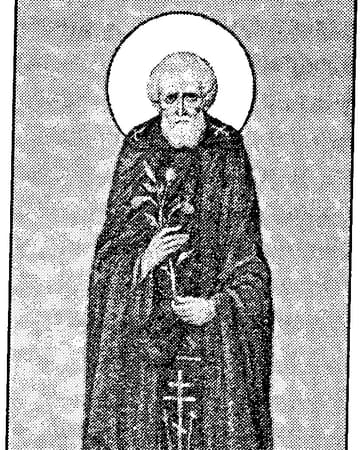
John the Silent, God's laborer,
Walks through the desert, solitary hermit,
When someone cries: barbarians are coming,
Behold, how they raise dust on the road!
Near they are, near, arise, arise!
"Let them be near, but God is nearer!"
John said to him, and went nowhere,
And when trouble was about to befall him,
A lion appeared, sent by God,
And began to roar fiercely at the enemies;
The horde fled. John moved not,
With the harsh desert he competed.
With it he competed in silence
And in dryness and solitude.
"Easter is coming, how shall we meet it?
What shall we, father, eat for the feast?"
The disciple asked, John said to him:
"God gives food to every creature."
When Christ's feast dawned rosy,
An angel like a man appeared before the saint,
Brought bread, wine and honey.
The disciple when he beheld the wonder
Over his own little faith he wept.
He glorified God and God's saint.
Reflection
God hears the prayers of the righteous and fulfills them sometimes immediately and literally, and sometimes later, at an opportune time, with regard to the benefit of the Church. In other words: in fulfilling the prayers of the righteous, God has in view either the salvation of one person or the good of the whole Church. Saint John the Silent prayed to God to reveal to him how the soul at death separates from the body. And while still in prayer he went out of himself and had this vision: before the church in Bethlehem a good man died, and angels took his soul from the body and with sweet singing raised it to heaven. Coming to himself from the ecstasy, John immediately set out on the road from the monastery of Saint Sabas the Sanctified to Bethlehem. And when he came to Bethlehem, he saw before the church the dead body of the man exactly as he had seen it in the vision.
And when the great Saint Sabas the Sanctified died, John grieved much and wept. Sabas appeared to him in a vision and said: Grieve not, Father John, for though I have parted from thee in body, yet I am with thee in spirit. Then John entreated him: Pray to the Lord, father, that He take me also with thee. To this Sabas answered: This cannot be now, for there will come to the monastery a great temptation; and God wills that thou be in the body for the consolation and strengthening of the Orthodox against heretics. At first John knew not of what heretics the holy father spoke to him, but learned later, when the heresy of Origen began to shake the Church of God.
Contemplation
Contemplate the sinful fall of Adam and Eve, namely:
- How, having seen themselves naked, they covered their nakedness with fig leaves;
- How even now all unrepentant sinners, when they lose some virtue, feel themselves naked and cover their nakedness with some lie or pretense.
Homily
On the two worlds
In the beginning God created the heaven and the earth
Gen. 1:1
What God wills, brethren, that He reveals to men, and what He wills not, remains unrevealed. The God-seer Moses could say nothing more about heaven except only that God created heaven in the beginning; and having said that, he continues to describe exhaustively the creation of the earth. Why does he not speak so exhaustively about the creation of heaven? Because God did not wish to reveal more to him. And God did not wish to reveal more to him because the people of his time were not yet mature nor capable of understanding supersensory, heavenly things. Only when many centuries had passed and when the New Covenant of God with men had come, God revealed much more about the heavenly world to His faithful and chosen saints. Christians were the first to begin seeing the open heaven. Saint John the Theologian testifies: I looked, and, behold, a door was opened in heaven (Rev. 4:1). And Stephen the Protomartyr testified: Behold, I see the heavens opened (Acts 7:56). The Apostle Paul, who was caught up to the third heaven and heard unspeakable words (2 Cor. 12:2), speaks of angelic choirs, of thrones, dominions, principalities, powers, and says: All things were created by him, and for him (Col. 1:16). His disciple, Saint Dionysius, describes the heavenly hierarchy as exhaustively as Moses describes the earthly world at its creation. Thus willed the immeasurable wisdom of God: what God did not wish to reveal to Moses, He revealed to the apostles and their followers. What is not told to children is told to mature people. According to spiritual maturity and to the revelation of mysteries.
Behold a beautiful instruction for all of us. Let us be diligent in seeking truth, yet more diligent in purifying our hearts, patient in waiting and unshakable in faith, that God will give us all in His own time, in such manner and in such measure as and how much is necessary for our salvation.
O Lord most wise and loving of mankind, who without haste and without delay teachest us and leadest us to salvation, to Thee the good be glory and praise. To Thee be glory and praise forever. Amen.
From the Prologue from Ochrid, translated by Marcian Sakarya, OCHRID.COM. CC BY-SA 4.0.
The Prologue, every day
Axios! brings the day’s Hymn of Praise, Reflection, Contemplation and Homily to Today, with the saints, the feasts and the saying of the day, on iPhone, iPad and Android.