
December 4
Saints of the day
Hymn of Praise
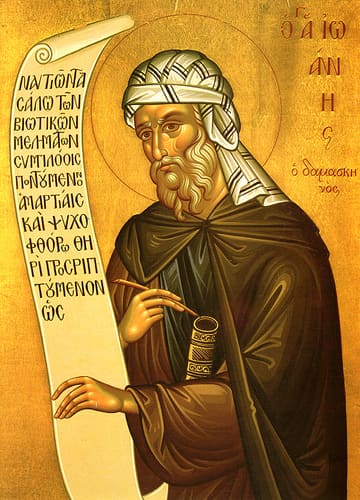
O wondrous trumpet of the Orthodox Faith.
O glorious monk of a glorious monastery,
John the hymnographer, champion of the Faith,
Holy sufferer for the holy icons,
Glorified art thou now, glorifier of God.
Immortal, thou trumpeter of eternal life.
For the sake of the living Christ thou didst abandon the world,
By humility didst glorify thyself all the more.
Thou didst take upon thyself ascetic bonds,
Heavenly mysteries didst thou see through tears:
Miracles didst thou work by prayer and faith,
Conversation didst thou have with the Mother of God.
Who could better expound the Faith?
Who with sweeter hymn glorify God?
No one as thou, harp of eternal truth,
No one as thou, glorious father John of Damascus.
O lift up even now thy pure lips,
And pray for us to Christ the Life-giver,
That His mercy may follow us unto death
That we may glorify Him through thee.
Reflection
Obedience with humility is the foundation of spiritual life, the foundation of salvation, the foundation also of the entire structure of the Church of God. The great John of Damascus, great in all that is good, left as a monk a deep mark in the history of the Church by his extraordinary example of obedience and humility. His elder, his spiritual father, testing him one day, handed him woven baskets and ordered him to carry them all the way to Damascus and sell them there. The elder set a very high price for the baskets, thinking that John would not be able to sell them for that price but would have to bring them back. John, therefore, had to do: first, go on a long journey; second, go as a poor monk to the city where he had once been the most powerful man after the emperor; third, ask for the baskets a ridiculously high price; and fourth, if he did not sell the baskets, make in vain the enormous journey there and back. In this way the elder wanted to test both the obedience and the humility and the patience of his glorious disciple. John bowed to the elder in silence, and without any objection took the baskets and set out on the road. Arriving in Damascus, he stood in the marketplace and waited for a buyer. When he told interested passersby the price of his goods, they laughed at him and mocked him as a madman. All day he stood and all day he was exposed to ridicule and mockery. But God, who sees all, did not forsake His patient servant. A certain citizen passed by and looked closely at John. And though John was in poor monastic garb, and in face dried up and pale from fasting, that citizen recognized in him the former nobleman and prime minister of the emperor, under whom he had been in service. John recognized him also, but both one and the other entered into agreement as strangers. Although John stated an excessive price for the baskets, the citizen bought and paid without a word, remembering the good that John of Damascus had once done for him. Like a victor Saint John returned to the monastery rejoicing and brought joy to his elder.
Contemplation
Contemplate the sinful fall of Adam and Eve, namely:
- How Adam and Eve, having sinned, hid themselves from God;
- How, hearing the voice of God, they fled and hid themselves among the trees, as even now every sin distances from God;
- How the sinner, hearing the voice of God, through conscience hides himself under irrational nature.
Homily
On how all that is from God is good
And God saw that it was good
Gen. 1:4, 10, 12, 18, 21, 25
From a good Creator, brethren, only good works could proceed. Let them close, therefore, their mouths all those who say that from God has proceeded both good and evil. After each of His works God Himself affirms that it is good. Six times He repeats that what He has made is good; and finally a seventh time, when He had considered everything as a whole, He pronounced His assessment that all which He had made was very good (v. 31). Altogether, then, seven times He repeats that all which came to be by His holy will is good. Is it not a great wonder how some people could come forth with the godless assertion that from God has proceeded equally both good and evil? God, as if He knew that upon Him would be cast (or better to say, through the ages cast) such slanders, gave in advance, for all times and all generations, His defense, and repeated it seven times. Evil is from sin, and in God there is no sin. God, therefore, cannot do evil. He is called Almighty because He is mighty to do every good. Wicked and perverse are those interpreters of God who assert that God is called Almighty because He can do both good and evil. God is the fountain of good, troubled by nothing, and from Him cannot proceed anything that is contrary to good. And it is clear to every normal person that evil is contrary to good. Know, brethren, that of duality in God, in the eternal fountain of good, speak those in whom themselves is found duality of good and evil. But all those who love good, and walk the path of good, and strive toward good, have clear revelation within themselves that God is good, and only good.
O our God, our Creator, Thou art the Maker of all good, and all Thy works are very good. To Thee be glory and praise forever. Amen.
From the Prologue from Ochrid, translated by Marcian Sakarya, OCHRID.COM. CC BY-SA 4.0.
The Prologue, every day
Axios! brings the day’s Hymn of Praise, Reflection, Contemplation and Homily to Today, with the saints, the feasts and the saying of the day, on iPhone, iPad and Android.