
December 5
Saints of the day
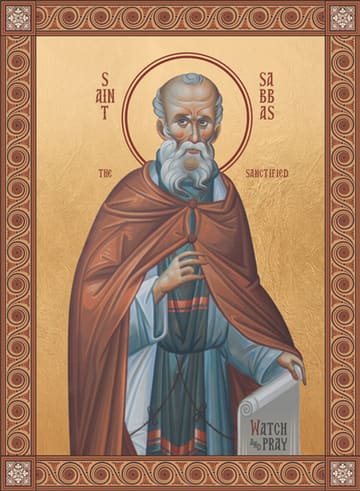
Hymn of Praise
Venerable Sabas, chief of monks,
Spiritual captain of Christ's warriors,
Glorified himself by fasting, vigils and meekness,
By prayer and faith and gracious mercy.
He taught monks not to worry about bread,
With labor and prayer to trust in heaven,
Not to seek primacy nor any rank,
Most rarely to taste oil and wine;
To keep to services at appointed time,
Let service be joy and not heavy burden.
All that Saint Sabas told the monks
All by his own example he showed to others.
Like a wise gardener he fenced the garden,
And many seedlings carefully planted,
The seedlings grew and bore fruit,
Bands of monks glorified Sabas.
Fifteen hundred years have passed,
Still Sabas's spiritual garden flowers;
Thousands of monks, hundreds of thousands,
Sabas's monastery has given until now.
O holy Sabas, glorious hermit,
Pray for us, God's favorite.
Reflection
A man can be great as a craftsman, statesman, commander, but no one among people is greater than a man great in faith, hope, and love. How great in faith and hope in God was Saint Sabas the Sanctified is best shown by this incident. One day the monastery steward reported to Sabas that on the coming Saturday and Sunday he would not be able to strike the semantron and by custom summon the brethren to common service and meal, because in the monastery there was not a grain of flour, nor anything at all of food and drink. Even the divine service could not be held for that same reason. The saint answered without hesitation: I will not omit the divine service because of lack of flour. Faithful is He who commanded us not to worry about the bodily, and mighty to feed us in time of hunger. And he placed all hope in God. In the extreme case he was ready to send some of the church vessels or vestments to the city and sell them, only that the divine service and the customary fraternal meal should by no means be omitted. But before Saturday arrived, some people, moved by God's Providence, drove to the monastery 30 mules loaded with wheat, wine and oil. What sayest thou now, brother, said Sabas to the steward, shall we not strike the semantron and summon the fathers? The steward was ashamed because of his little faith and asked the abbot for forgiveness.
Sabas's biographer calls this saint stern toward demons but gentle toward men. Once some monks rebelled against Saint Sabas, and for this they were by order of Patriarch Elias expelled from the monastery. They built themselves huts in the Tekoa ravine, where they suffered want in everything. Hearing that they were starving, Saint Sabas loaded a donkey with flour and carried it to them personally. Seeing that they had no church, he built them a church as well. The monks first received him with hatred, but later responded to his love with love and repented for their earlier deed toward him.
Contemplation
Contemplate the sinful fall of Adam and Eve, namely:
- How the most gracious God called to sinful Adam: Where art thou?
- How God even in Paradise shows Himself the Good Shepherd, who calls after the lost sheep;
- How even now God calls to every sinner: Where art thou? (wishing by these words both to rebuke him and to warn him).
Homily
On the absence of evil in God's works
And God saw that it was good
Gen. 1
The first revelation, brethren, about this world, which Holy Scripture communicates to us, is this: that the world proceeded from good and not from evil, from God and not from some power opposed to God, and not from some imagined primordial mixture of good and evil. The second revelation, brethren, about this world is this: that all is good which the good God created. Good is the light, good is the firmament of heaven, good is the dry land, good is the sea, good is the grass, plants and fruit-bearing trees, good are the heavenly luminaries: sun, moon and stars, good are the water creatures and birds of the air, good are all living souls according to their kinds, good are the cattle and small creatures and beasts of the earth; finally good also is man, lord over all creatures under God's lordship. And God saw that it was good. The evaluator of the worth of all this is not and cannot be someone who looks superficially and partially at this world, but only He who sees all creatures together and each separately, who knows their number, name, properties and essence incomparably better than all people on earth. He saw that all was very good. And yet there were people who slandered God's work, saying that this world is evil in its essence, that individual creatures are evil, and that the matter from which earthly beings are formed is evil. Evil, however, is in sin, and sin is from the evil spirit; evil, therefore, is in the spirit of evil and not in matter. The spirit fallen from God is the sower of evil in the world. Hence the tares among God's wheat. The spirit of evil strives to use as its instruments of evil both the human spirit and material things in general. He is the one who also casts the thought into the human mind, as if the whole created world were evil, and as if the matter from which creatures are formed were fundamentally evil. He slanders God's works to conceal his own; he accuses God, that he himself might not be accused. O my brethren, let us guard ourselves against the cunning of the evil spirit. Let us guard ourselves especially from evil thoughts which he sows in our mind.
O Lord Jesus Christ, true Enlightener and our Savior, into Thy hands we commit our mind and our hearts. Illumine us with Thy true light. To Thee be glory and praise forever. Amen.
From the Prologue from Ochrid, translated by Marcian Sakarya, OCHRID.COM. CC BY-SA 4.0.
The Prologue, every day
Axios! brings the day’s Hymn of Praise, Reflection, Contemplation and Homily to Today, with the saints, the feasts and the saying of the day, on iPhone, iPad and Android.