
January 14
Saints of the day
Hymn of Praise
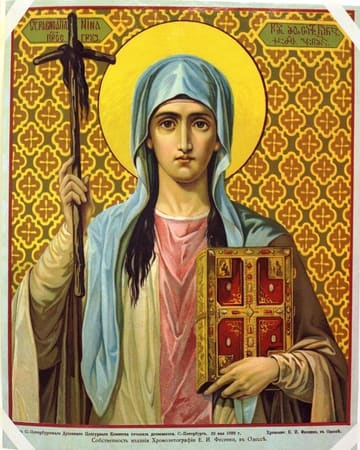
A virgin most beautiful, noble Nina,
Became by Providence an apostle of the Georgians.
Despite the persecution of Emperor Diocletian,
She with the cross baptized King Mirian
And his wife Nana and their son Bakhar,
Through them all the people and the flower of the leaders.
All of them she baptized with the cross of God's Son,
Saint Nina, the apostle of the Georgians.
From childhood Nina prayed to God
That she would baptize Georgia.
What she prayed to God, God graciously gave:
From Nina's hand the cross shone
To gentle Georgia, where it still shines,
Where Nina's hand still blesses.
There is Nina's tomb, above it a temple gleams
Glorifying holy Nina and the Lord Christ.
Reflection
If the dogmas of faith sometimes seem to you like hard food, then make an effort to first fulfill the dogmas of Christian morality, and understanding of the dogmas of faith will be opened to you. Curious investigation of high things, without effort to improve one's life, brings no benefit. Once Egyptian monks were debating about Melchizedek, and being unable to come to any clarity about the mysterious person of this ancient king and high priest, they called Abba Coprius to their gathering and questioned him about Melchizedek. Hearing this, Coprius struck himself three times on the mouth and said: "Woe to you, Coprius! You have abandoned what God commanded you to do, and you investigate what God does not require of you." Hearing this, the monks were ashamed and dispersed. Chrysostom writes: "Even if we hold right dogmas but do not care about conduct, we will have no benefit; likewise if we care about conduct but neglect right dogmas, we will gain nothing useful for our salvation. If we want to be delivered from gehenna and obtain the kingdom, we must be adorned on both sides: with correctness of dogmas and with virtue of life."
Contemplation
Contemplate the mercy of the Lord Jesus, namely:
- Toward sinners and the sick;
- Toward the people, who were confused like a flock without a shepherd;
- Toward the human race in general, for whom He gave Himself to be crucified.
Homily
On the vision of the invisible world
We look not at the things which are seen, but at the things which are not seen
2 Corinthians 4:18
We see this material and transient world, but we look at that spiritual and immortal world.
We see earthly joy, often interrupted by weeping and sighs, and in the end always finished by death, but we look at spiritual joy, among the angels and God's saints in the heavens, at joy uninterrupted and eternal.
We see the sufferings and failures of the righteous in this life, but we look at their glory and triumph in that world.
We see the many successes, and glory and honor of the unrighteous in this life, but we look at their defeat, condemnation and inexpressible torment in eternity.
We see God's Church often humiliated and persecuted in this world, but we look at her final victory over all opponents and adversaries, visible and invisible.
We see, brethren, tyrants and robbers often as rulers and rich men in this age, and saints as poor and oppressed and forgotten, but we look at another kingdom, in which the saints will reign, without a single, single tyrant or robber, the Kingdom of God, eternally sinless and immortal.
O Lord, long-suffering and most-merciful, open to us spiritual sight, that we might see what awaits us after this short-lived life, and that we might labor to fulfill Your law. To Thee be glory and praise forever. Amen.
From the Prologue from Ochrid, translated by Marcian Sakarya, OCHRID.COM. CC BY-SA 4.0.
The Prologue, every day
Axios! brings the day’s Hymn of Praise, Reflection, Contemplation and Homily to Today, with the saints, the feasts and the saying of the day, on iPhone, iPad and Android.