
July 11
Saints of the day
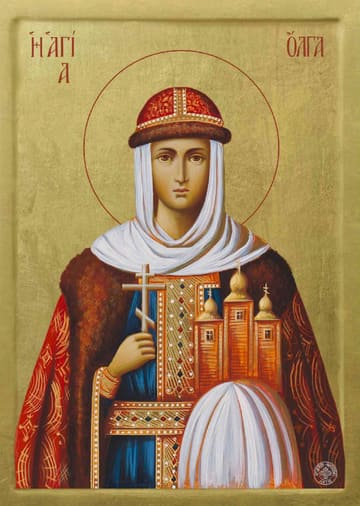

Hymn of Praise
The Lord loves the penitent,
For them He suffered,
To repentance He calls sinners,
And He calls them even now.
A penitent was Olga,
By Baptism she was born anew,
And from darkness the Russian people
She delivered by the Cross.
And Nicodemus of Elbasan
Turned away from Christ;
He repented, he returned,
And paid for his sin with blood.
Nectarius from Asia,
A blossom yet unripe,
Was made a Turk out of ignorance
And brought grief to the angels.
He repented and he mourned,
A stream of tears he poured out,
And more than life itself
He came to love a painful death.
He took off his turban and cast it
Before the dread judge;
For the Precious Cross went the head
Of holy Nectarius.
Christ loves the penitent
And will love them unto the ages.
Who is so dear to Christ
As a man who has repented?
Reflection
A reversal of fortune strikes hardest when it strikes suddenly. But he who expects blows and arms himself against them beforehand, can he be surprised? Emperor Charlemagne commanded his sons to learn a trade and his daughters to learn to spin wool, so that they would have a means of sustenance if fortune changed. The celebrated Belisarius, a great duke and great conqueror, was slandered before the emperor by the envious, and on the basis of those slanders was blinded and stripped of all his possessions. The blind Belisarius sat before the gate of Rome and begged for alms, saying to passersby: "Give alms to Belisarius, whom fortune raised high and envy cast down and robbed of his eyes!" Is not the life of man upon earth a warfare? says the righteous Job (7:1). One must therefore be like a watchful sentinel, prepared for everything that can happen. And what cannot happen to a man? And furthermore: in every torment place hope in God. The righteous Job upon the dunghill and amid the filth cries out: though He slay me, yet will I trust in Him (13:15)!
Contemplation
Contemplate the miraculous illumination of the face of Moses (Exodus 34), namely:
- How Moses, after conversing with God on Sinai, had his face illumined with light;
- How the people saw this and dared not approach Moses, so that he placed a veil over his face;
- How from heartfelt prayer and communion with God the face of the God-pleasing is illumined.
Homily
On Obedience and Humility
Likewise, ye younger, submit yourselves unto the elder. Yea, all of you be subject one to another, and be clothed with humility
I Peter 5:5
Behold the principle of true Orthodox conciliarity! It is founded upon the unconditional obedience of the younger to the elder, upon the mutual obedience of equals among themselves, and upon the humility of both the elder and the younger. Humility is a good word, but even better is meekness, and best of all is humble-mindedness; for humble-mindedness corresponds precisely to the Greek word that the Apostle used in his epistle, and humble-mindedness signifies a low estimation of oneself and a high estimation of God, and an unceasing acknowledgment of one's own weakness, one's own ignorance, one's own malice, and one's own unworthiness, together with an unceasing acknowledgment of God's power, God's wisdom, God's mercy, and God's worthiness.
God is the only King of men. Therefore God opposed the desire of the people of Israel that a king from among men be set over them. God reigns, and men serve God. Both those who govern and those who obey are equally servants of God. When it is known and acknowledged that God is King and all men are servants of God, then the foundation of conciliarity, the foundation of an angelic society, is thereby established. Upon that foundation the house of God is then built, an angelic society, by means of the obedience of the younger to the elder, the mutual obedience of equals among themselves, and the humble-mindedness of all. In this way two terrible evils in the world are avoided: tyranny (that is, the violent rule of one over all) and anarchy (that is, the rule of many). Both mono-tyranny and poly-tyranny are avoided.
The principle of conciliarity is an organic principle, that is, a vital one. It is the principle of mutual service, mutual help, and mutual love. May God grant us wisdom, brethren, to embrace this saving principle in our lives.
O Lord Jesus, obedient and humble Lover of mankind, implant in us and strengthen obedience to Thy law, mutual obedience born of love, and humble-mindedness before Thy ineffable power and wisdom. To Thee be glory and praise forever. Amen.
From the Prologue from Ochrid, translated by Marcian Sakarya, OCHRID.COM. CC BY-SA 4.0.
The Prologue, every day
Axios! brings the day’s Hymn of Praise, Reflection, Contemplation and Homily to Today, with the saints, the feasts and the saying of the day, on iPhone, iPad and Android.