
July 12
Saints of the day
Hymn of Praise
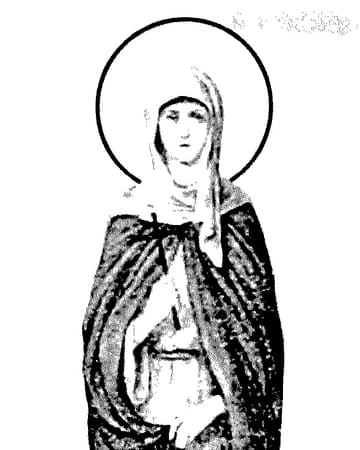
Golindukha, a Persian by her birth,
Beheld the heavens and became a Christian,
Upon the narrow path she began to walk,
From all sides receiving blows.
As iron strikes against the flint
And from the striking sparks of fire are born,
So suffering strikes the human heart
Until the flame bursts forth that hides within
And illumines human paths so dark,
And saves the soul from shameful lust.
Golindukha, filled with the Spirit of God,
Had neither roof nor bread.
She had no friend upon the earth,
The world to her was a camp of tormentors.
All she had, for Christ she gave,
And all from suffering turned to gold she became,
Like gold that is refined by fire,
So became her entire being.
The tormentors one by one passed away,
Of all their goods they took nothing hence
Save evil deeds and a name of shame.
But Golindukha stood before God
Like an olive tree, wondrous and fruitful,
A pure soul, kindred to the angels.
Reflection
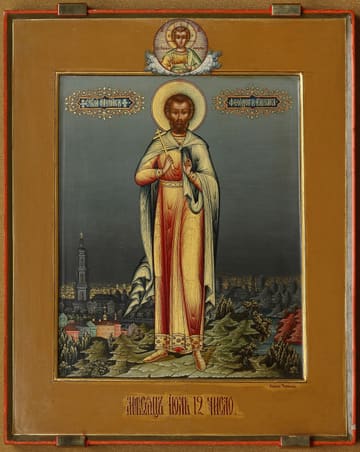
The fabric of justice is thinner than silk, but it is lasting and unbreakable, and it encompasses both worlds; while the fabric of injustice and violence is thick and easily torn. In the time of the Kievan Prince Vladimir there lived in Kiev only one Christian family: Theodore the Varangian and his young son John. When a certain vile idolatrous festival took place, the pagan citizens of Kiev, directed by the demon himself, decided to offer John, the son of Theodore, as a sacrifice to their idols. When some of them went and in the name of their "gods" demanded that Theodore hand over his son, Theodore said to them: "If your gods are alive, let them come themselves and take my son." The enraged pagans rushed upon the house of Theodore, demolished it, and left the God-pleasing man Theodore and his son John dead in the ruins. Thus far extends the fabric of violence. But the fabric of justice continues: Prince Vladimir soon accepted baptism and baptized his people as well, and upon that very spot where the house and grave of the Russian protomartyrs Theodore and John had stood, he erected a church of the Most Holy Theotokos.
Contemplation
Contemplate the miraculous punishment and healing of Miriam, the sister of Moses (Numbers 12), namely:
- How Miriam cried out against Moses, the meekest of all men on earth;
- How God punished her with sudden leprosy, and how God healed her at the prayer of Moses;
- How those who cry out against the men of God are even today overtaken by the punishment of God.
Homily
On God's Dealing with the Proud and the Humble
God resisteth the proud, and giveth grace to the humble
I Peter 5:5
Before whom and before what, brethren, can a man be proud? Before the angels? Behold, the angels are immortal, and man is mortal. Or before other men? Behold, he is dependent upon many men and is mortal as are all men. Or before the animals? But how would he live without the service of animals? Or before the sun and the stars? But without their light he would stumble for a few days in darkness and perish. Or before the grass? But grass is his chief food. Or before the black earth? But from the earth his body was fashioned. Or before the dead? But without them he would not have come into life. Or before the living? But there are so many living that he is among them as one thread in a carpet. Before God? But were it not for the will of God, he would exist neither among the living nor among the dead. Before whom and before what, then, brethren, can a man be proud? To the humble and the lowly God gives grace. That is, He gives them all that they need, all that they pray to God for in their humility and lowliness. Who are the humble and the lowly? They are those who feel their own weakness and their complete dependence upon their Creator. They are as full as the sea and as dependent as the sea. What water is fuller than the sea, and what more dependent upon rains and tributaries? But the proud man is like a closed well, closed off from heaven and from earth, self-sufficient while he is full. But being closed and cut off, he must quickly empty out.
Wisely does the wise Solomon say of God: surely He scorneth the scorners, but He giveth grace unto the lowly (Proverbs 3:34). But the scorn of God is not malicious as is human scorn; it is rather grief and wrath. Neither is the mercy of God limited as is human mercy; it is a royal mercy that astonishes by its splendor, beauty, and boundlessness.
O Lord God, our Creator, tame our hearts when they swell with pride, and tame our minds when they swell with pride, and help us in our moments of worthless pride to remember the Cross on Golgotha and Thy Only-Begotten Son in blood and torment for our sake. To Thee be glory and praise forever. Amen.
From the Prologue from Ochrid, translated by Marcian Sakarya, OCHRID.COM. CC BY-SA 4.0.
The Prologue, every day
Axios! brings the day’s Hymn of Praise, Reflection, Contemplation and Homily to Today, with the saints, the feasts and the saying of the day, on iPhone, iPad and Android.