
July 16
Saints of the day
Also commemorated
Commemoration of the Six Ecumenical Councils
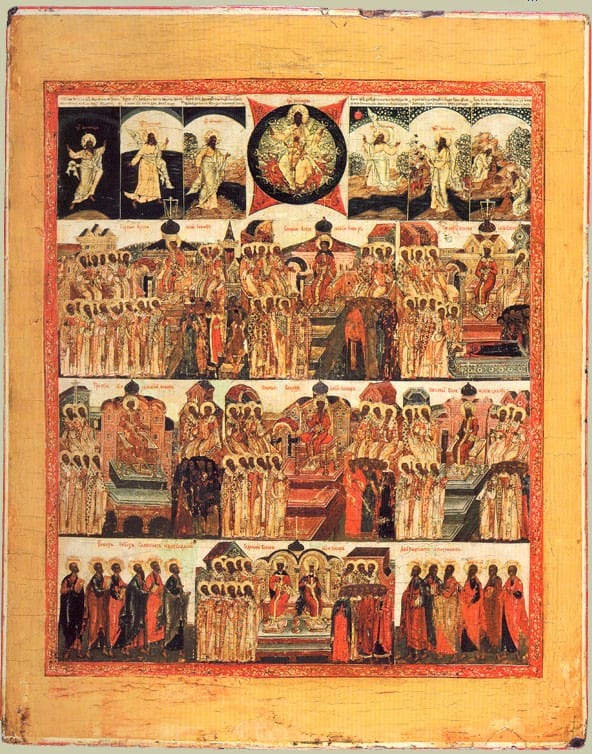
This joint commemoration of the first six Councils is observed on the Sunday that falls between July 13 and 19.
Hymn of Praise
The martyr Julia,
For her Christ crucified,
Invokes the power of Christ,
The power of the Precious Cross.
From six wounds she shed her blood,
With blood she stained the earth,
For she believed in Christ
And did not hide her faith.
Nor did Christ hide her;
He proclaimed her to the whole world,
And in the immortal kingdom
He glorified her in heaven.
When Julia breathed out
Her spirit, pure and holy,
From her lips a white dove
Soared aloft on high...
When the people saw this,
All cried out in fear:
"Woe to the wicked judges
Who shed the righteous blood!"
Reflection
The Ecumenical Councils were the greatest battlefields of the struggle of Orthodoxy against heresies. Under today's date the Church commemorates the first six Councils collectively, namely: the First Ecumenical Council in Nicaea in the year 325, with the participation of 318 holy Fathers. It is separately commemorated on May 29 and the seventh Sunday after Pascha. This Council refuted the heresy of Arius against God the Son. The Second Ecumenical Council in Constantinople in the year 381, with 150 holy Fathers. It is separately commemorated on May 22. This Council refuted the heresy of Macedonius against God the Holy Spirit. The Third Ecumenical Council in Ephesus in the year 431, with 200 holy Fathers. It is separately commemorated on September 9. This Council refuted the heresy of Nestorius against the Theotokos. The Fourth Ecumenical Council in Chalcedon in the year 451, with 630 holy Fathers. It is separately commemorated on July 16. This Council refuted the Monophysite heresy. The Fifth Ecumenical Council in Constantinople in the year 553, with 160 holy Fathers. It is separately commemorated on July 25. This Council refuted the heresy of Origen. The Sixth Ecumenical Council in Constantinople in the year 691, with 170 holy Fathers. It is separately celebrated on January 23. This Council refuted the Monothelite heresy. The Seventh Ecumenical Council, which met in the year 878 with 367 holy Fathers, is not commemorated on this occasion but only separately on October 11. This Council refuted the Iconoclast heresy. At these Councils, by the action of the Holy Spirit, all heresies were condemned and the Orthodox faith was explained and confirmed for all time.
Contemplation
Contemplate the miraculous drawing of water from the rock at Kadesh (Numbers 20), namely:
- How Moses, by the command of God, struck the rock with his staff but without faith, and how by the will of God water flowed forth;
- How God punished Moses and Aaron for their lack of faith by not permitting them to enter the Promised Land;
- How thereby it was shown that even a great righteous one such as Moses is prone to sin, so that none among mortals would boast of his own virtue.
Homily
On the Share of the Faithful in the Divine Nature
That by these ye might be partakers of the divine nature
II Peter 1:4
How can a mortal man, brethren, have a share in the divine nature? How can the eternal be united with the temporal, and the glorious with the inglorious, and the incorruptible with the corruptible, and the pure with the impure? It cannot be without certain conditions. And those conditions the Apostle mentions, namely: one condition on God's side and another on the side of man. As the condition on God's side he mentions His divine power that gives us all things that pertain unto life and godliness; and as the condition on man's side, having escaped the corruption that is in the world through lust. God has fulfilled His condition and given us His divine powers through the knowledge of Him that hath called us to glory and virtue. Now it is man's turn to fulfill his condition, that is, having come to know Christ the Lord, to escape from the carnal lusts of this world. The Lord Christ first opened heaven and all the treasures of heaven, and then called men to draw near and receive those treasures. How did He call them? Only by words? By words too, but not by words alone, rather by glory and virtue: by glory, that is, by His glorious Resurrection; by virtue, that is, by His wondrous ministry and suffering. Thereby He called us to receive the exceedingly great promises, so that for their sake we might have a share in the divine nature. But in order for us to know Christ and to hear His call, we must first escape from the carnal lusts of this world. If we do not escape, then we shall remain blind before Him, before His glory and virtue, and deaf to His call.
O brethren, how exceedingly great is the mercy of God toward us! By that exceedingly great mercy of God, adoption by the Immortal One is offered to us mortals, and to us sinners incorporation into the glorified Body of the Lord Jesus. But only under a condition, which is neither a great burden nor a heavy cross.
O Lord Jesus, fulfillment of all promises and source of all good things, heal us of our blindness and our deafness, and grant us the strength to escape from the carnal lusts of this world. To Thee be glory and praise forever. Amen.
From the Prologue from Ochrid, translated by Marcian Sakarya, OCHRID.COM. CC BY-SA 4.0.
The Prologue, every day
Axios! brings the day’s Hymn of Praise, Reflection, Contemplation and Homily to Today, with the saints, the feasts and the saying of the day, on iPhone, iPad and Android.