
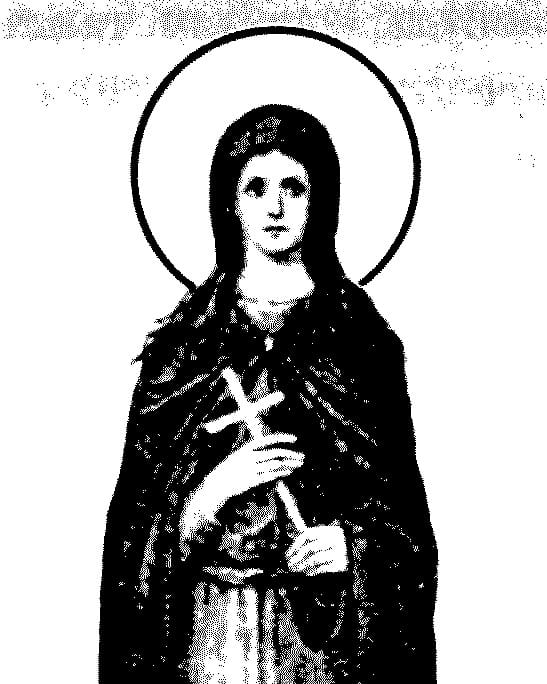
St. Julia of Carthage
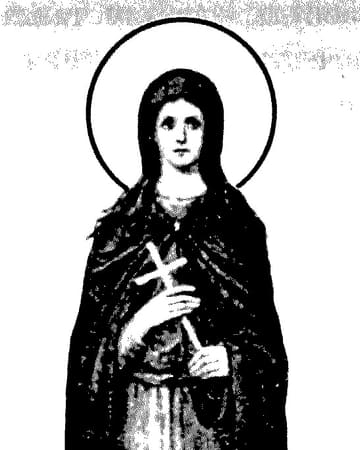
A native of Carthage, of a distinguished family. When the Persians conquered Carthage, many people were led away into captivity. Holy Julia also was seized and enslaved, and fell into the hands of a certain merchant in Syria. This merchant was a pagan. Seeing that Julia was a Christian, he counseled her many times to renounce Christ and become of one faith with him, but Julia would by no means consent to this. But since Julia was faithful and reliable in service, the merchant left her in peace and spoke no more to her about religion. Once the merchant loaded a ship with goods, took Julia with him, and set out by sea to distant lands for trade. When they reached Corsica, there was a certain pagan feast, and the merchant joined in the abominable sacrifice, while Julia remained in the ship weeping that so many people lived in foolish delusion and did not know the truth. But somehow the pagans learned of her, dragged her from the ship, even though her master opposed it, and began to torture her terribly. They cut off her breasts and cast her upon a stone, and then crucified her on a cross, upon which holy Julia surrendered her spirit to God. Her death was announced by an angel of God to monks on a nearby island, Margarita (or Gorgona), and they came and reverently buried the body of the martyr. Many miracles were manifested at the grave of Saint Julia through the ages, and she herself also appeared to some from the other world. She suffered honorably in the sixth century. After many years the faithful wished to build a new church on another site in honor of Saint Julia, since the old church was both small and dilapidated. They gathered, then, the materials: stone, brick, sand, and everything else needed at that new site. But it happened that during the night before the day on which they intended to lay the foundation, all that material was carried by an invisible hand to the old church. In perplexity the people again transferred the material to the new site, but the same thing happened again: the material was found at the old site beside the old church. And the night watchmen saw a most radiant maiden transporting the material to the old church on white oxen. From this everyone understood that Saint Julia did not wish her church to be built in another place, so they demolished the old church and on that very same spot erected a new one.
From the Prologue from Ochrid, translated by Marcian Sakarya, OCHRID.COM. CC BY-SA 4.0.
Sources
- The Prologue from Ochrid, July 16, translated by Marcian Sakarya, OCHRID.COM (https://ochrid.com), CC BY-SA 4.0
No recorded sayings. Read the Life to meet this saint.
Troparion · Tone 4
Your lamb Julia, O Jesus, cries with a great voice: For You, my Bridegroom, I yearn, and in seeking You I contend; I am crucified with You, and in Your baptism I am buried with You; I suffer for You, to reign with You; I die on Your behalf, so that in You I may also live. But receive as a blameless offering her who is slain for You with longing. At her intercessions, in Your mercy, save our souls.
Translated for Axios! from the Greek General Menaion (the common troparion of a virgin martyr)
Kontakion · Tone 2
Having found your all-honored temple to be a healing of souls, all of us faithful cry to you aloud, O virgin martyr Julia, of great renown: Pray to Christ God without ceasing for us all.
Translated for Axios! from the Church Slavonic General Menaion (the common kontakion of a virgin martyr)
Saints around July 16
Get the full library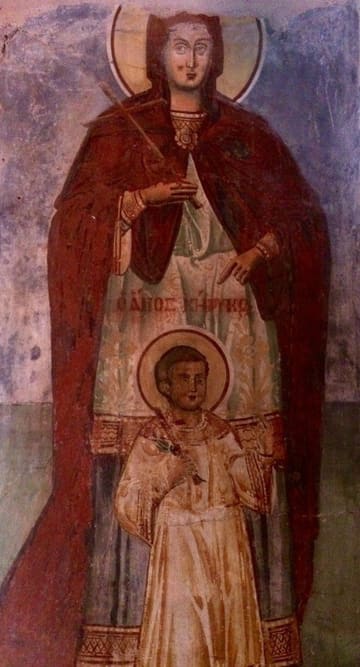

770+ saints, in your pocket
Their Lives, sayings and prayers, A to Z and by feast, with search. The Church calendar, the holy icons, and the saying of the day on your Home Screen. All in Axios! for iPhone, iPad and Android.