
July 20
Saints of the day
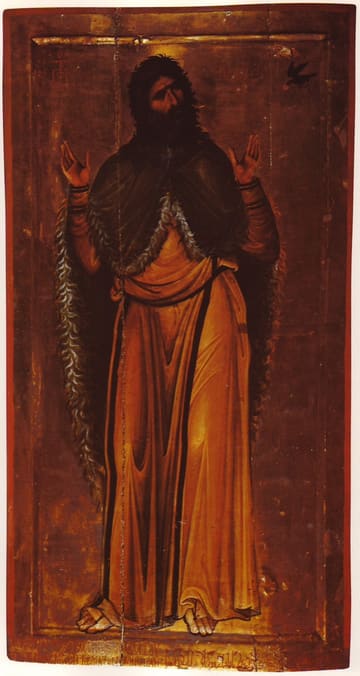
Hymn of Praise
O fiery man, Prophet Elijah,
Who on earth shone with the radiance of heaven
And by thy prayer didst please the Lord,
Thou dost shut the heavens, bring fire down from on high,
All by the help of God's almighty right hand:
Thou didst rebuke the people for their lukewarm faith.
Thou didst zealously contend for the Living God,
And so the Church doth glorify thee as her prophet.
The king did not frighten thee, the queen still less,
The Lord God is thy king and thine inheritance.
Thou didst care neither for food nor drink,
Thou wast wholly given to God's Providence.
Without fear of anyone, thou wast a terror to all,
As a mighty lion is the fear of small mice.
Thou didst zealously contend for the Living God,
And so the Church doth glorify thee as her prophet.
The Lord glorified thee as He has few others,
For thou too didst glorify the Living Lord:
God sent thee fire to kindle the sacrifice;
He gave thee power to raise the dead.
Thy mighty deeds amazed the whole world,
Thy prophecies were all fulfilled,
In soul and body thou wast alive and whole,
Therefore death had no portion in thee.
O fiery prophet, in spirit and in body,
Glory! we cry to thee with joyful soul.
Reflection
Writing about the life of his sister Saint Macrina, Saint Gregory of Nyssa hesitated to enumerate her miracles, "lest I become," he says, "the occasion of the sin of unbelief for the feeble." He calls those who do not believe "feeble." And truly, there is nothing more feeble than a man without faith. The unbeliever believes in the power of dead things and the dead elements of nature, but does not believe in the power of God or in the power of the people of God. This is spiritual dullness, and that dullness is equal to spiritual death. And so, living souls believe and dead ones do not believe. Living souls believe in the mighty miracles of the Prophet Elijah; those miracles gladden and embolden them, for they know that this is a manifestation of the power of God. When God manifests His power through dead things and elements, how shall He not manifest it through living and holy people? What especially gladdens the faithful is that the Prophet Elijah appeared alive on Mount Tabor, at the time of the Transfiguration of the Lord. During his life on earth, this great prophet gave proofs of the existence of the one and living God, and after death, and that several hundred years later, by his appearance on Tabor, he gave mankind a manifest proof of life after death.
Contemplation
Contemplate the wondrous help of God in the wars of Israel (Deuteronomy 2-3), namely:
- How Moses defeated the pagan kings, Sihon the Amorite and Og of Bashan, for God had doomed them to destruction;
- How Moses could not take the land of Moab, for God did not will it, on account of the descendants of the righteous Lot;
- How in general, victories and defeats in wars do not come to pass without the permission of God.
Homily
On the personal testimony of the Apostle
"This is My beloved Son, in Whom I am well pleased." And this voice which came from heaven we heard, when we were with Him on the holy mountain
2 Peter 1:17-18
Let us hear witnesses faithful and true, who were crucified on a cross for the sake of their testimony. Let us hear the Apostle Peter, who, what he could not prove by words, proved by his own bloody death on the cross, being crucified upside down by the pagans. He testifies that he was on the holy mountain, that is, Mount Tabor, when the Lord was transfigured, when Moses appeared with Elijah, and when the voice was heard from the heavens: "This is My beloved Son, in Whom I am well pleased." In this passage the Apostle does not speak of what he and his companions saw on the holy mountain (that is recounted in the Gospels) but repeats only what they heard. What they heard is equally as important as what they saw. Let the nations hear, therefore, that the apostles beheld the Lord Jesus transfigured in wondrous heavenly light, and let them know that He is the Son of God. Let the nations further hear that the apostles saw Moses and Elijah alive, and let them know that there is life after death and the Judgment of God. Let them further hear that the Lord Jesus was called the Son of God not by men, but by God the Father Himself. Faithful and true are the witnesses who proclaim this to the nations, and they report that which their eyes beheld and their ears heard. He who does not believe the apostles believes Judas, Caiaphas, Herod, and Nero: the persecutors of the apostles and betrayers of the truth. He who does not believe the righteous has no choice but to believe the unrighteous. He who does not believe the pure must believe the impure. He who does not believe those who suffered for the truth must believe the tormentors and the debauched. Each day dawns for no other reason than that men may decide for the one side or the other.
O Lord, our Savior and Enlightener, enlighten our souls with Thy holy words, for which Thy apostles suffered. To Thee be glory and praise forever. Amen.
From the Prologue from Ochrid, translated by Marcian Sakarya, OCHRID.COM. CC BY-SA 4.0.
The Prologue, every day
Axios! brings the day’s Hymn of Praise, Reflection, Contemplation and Homily to Today, with the saints, the feasts and the saying of the day, on iPhone, iPad and Android.