
June 11
Saints of the day
Also commemorated
Celebration of the Icon "it Is Truly Meet"
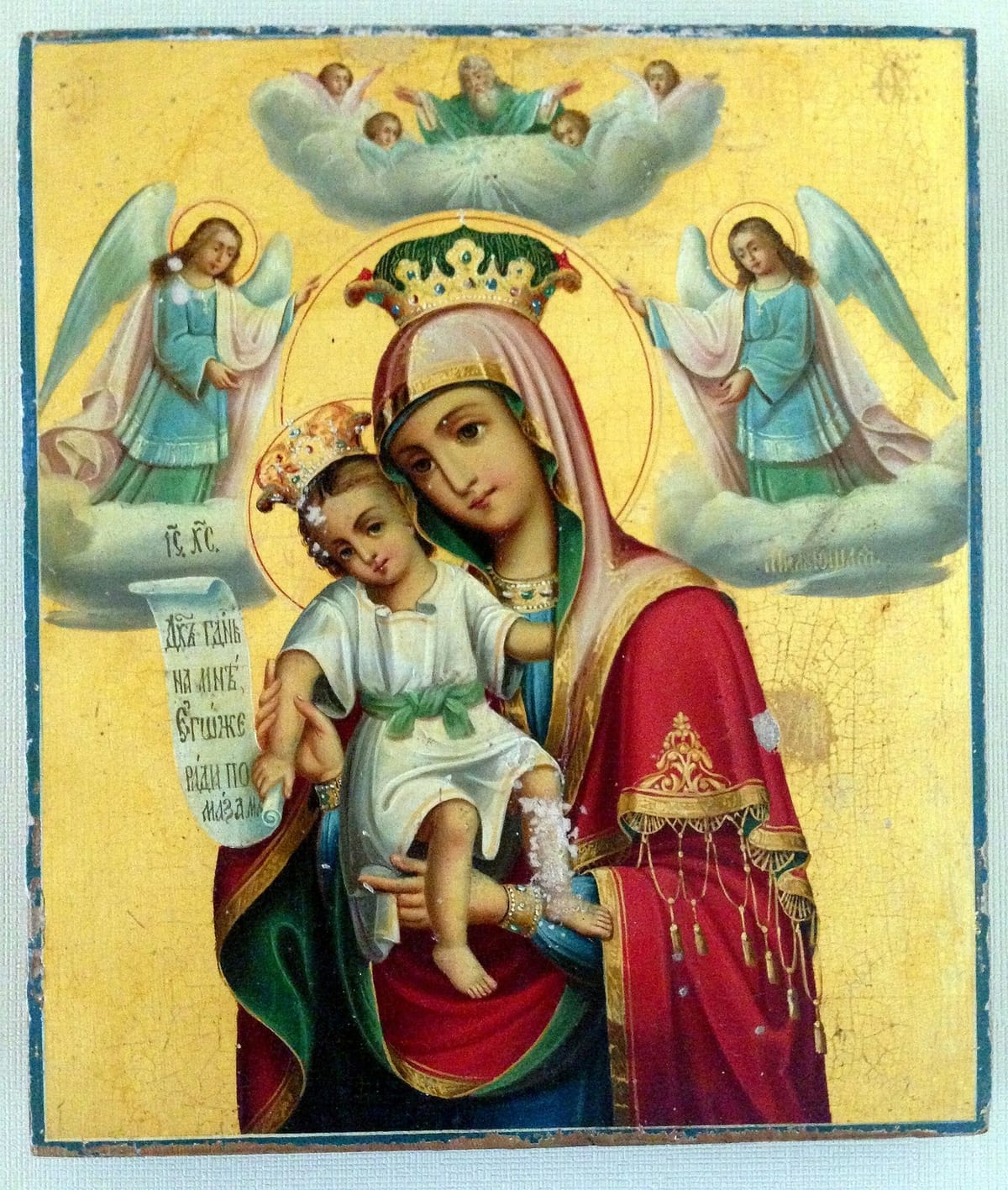
And the miracle that occurred before it in the time of Patriarch Nicholas Chrysoberges (983-996). This miracle consists in the following: One night a monk was reading the canon to the Theotokos and singing "More Honorable" in a cell of the Monastery of the Pantocrator, now called "It Is Truly Meet." His elder had gone to Karyes. Suddenly a man appeared in the church and began to sing: "It Is Truly Meet." That hymn had been until then unknown in the Church. The monk, hearing that hymn, was deeply moved, both by its content and by the wondrous heavenly singing. "Among us they sing thus," said the stranger to the monk. The monk wished to have that hymn written down and brought a tablet, on which the stranger inscribed the hymn with his finger as though on wax. And suddenly he vanished. That stranger was the Archangel Gabriel. The tablet was transferred to Constantinople, and the hymn has remained in the Church to this day.
Hymn of Praise
A solitary monk in the church at night
By fervent prayer drives darkness from his soul.
Then came a monk, in no way unusual,
He too stood and sang, as one skilled in singing.
Then the first monk began "More Honorable,"
Glorifying the Mother of God, the Mother "More Glorious."
The wondrous guest said to him of that hymn:
Among us, he said, they sing this song differently;
We do not begin as thou hast begun,
But with "It Is Truly Meet," O venerable father!
And he uttered to him the whole hymn "It Is Truly Meet."
The monk took care not to miss a word.
O my excellent brother, now I breathe more easily
From that song of thine; let me write it down!
But there is no pencil, there is no paper.
The church: a place of prayer, not of writing!
Then the midnight guest blessed the church with the Cross
And began to write upon the stone with his finger,
On the stone he wrote as on soft wax.
The monk marveled at this man.
Who art thou? the monk asked the unusual guest.
My name is Gabriel; let that suffice thee.
And then he vanished. The monk with awe
Recognized the Archangel beneath the monastic robe.
What he wrote, no one has erased;
The church was filled with a heavenly fragrance.
Reflection
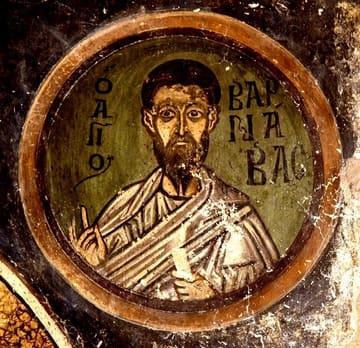
A true friend prays to God for his friend. A true friend is concerned for the salvation of his friend's soul. To turn a friend away from false paths and direct him to the path of truth: that is precious friendship. The saints of God are the best friends of men. Two young men, Barnabas and Paul, were friends while they attended the school of Gamaliel together. When Barnabas became a Christian, he persistently and tearfully prayed to God that God would also enlighten Paul's mind and turn his heart, so that he too might become a Christian. Barnabas often spoke to Paul about Christ the Lord, but Paul mocked him and considered him deluded. But the gracious Lord did not leave the prayers of Barnabas without fruit. The gracious Lord appeared to Paul and turned him from the path of falsehood to the path of truth. The converted Paul then fell at the feet of his friend and cried out: "O Barnabas, teacher of truth, now I am convinced that what thou hast told me about Christ is true!" Barnabas wept from joy and embraced his friend. A friend saved the soul of his friend by fervent prayer. Had Barnabas succeeded in making Paul the emperor of Rome, he would have done less for him than what he accomplished by prayer in bringing him to the truth.
Contemplation
Contemplate the miraculous healing of the man blind and mute (Matt. 12:22), namely:
- How the Lord healed the man, blind and mute,
- How my soul too, blind and mute because of its distance from Christ, can be instantly healed by the Lord, if only I bring my soul to the Lord.
Homily
On the Master and the Servant
He that spareth his rod hateth his son: but he that loveth him chasteneth him betimes
Prov. 13:24
The love of God for mankind surpasses the love of man for man as heaven surpasses the earth, and yet God Who loves mankind chastises men. God chastises men not to destroy them but to correct and save them. O blessed chastisement from love! Whom the Lord loveth He chasteneth, and scourgeth every son whom He receiveth (Heb. 12:6). With what does God chastise? With a rod. What kind of rod? The rod of illness, the rod of adversity, the rod of loss, the rod of hunger, the rod of poor harvest, the rod of drought, the rod of flood, the rod of the death of relatives and friends, the rod of evil demons when He allows them power over a man. These are the rods of God, with which God scourges His children, to correct them, to bring them to their senses, to enlighten and save them.
Why should a parent not chastise his children, if he truly loves them? The rod is an instrument of great love and care. If the child is insensitive to spiritual corrections, it is sensitive to the rod. And the more insensitive a child is in spirit and conscience, the more sensitive it is in body. The body was not given to man to be something in itself, but to be the servant of the spirit, to help the spirit, to benefit the spirit. If bodily punishment awakens the spirit in a man, and with the spirit the conscience, then the body has perfectly fulfilled its duty toward the spirit, its master. If the master sleeps, then the servants are struck to awaken him. If the servants awaken their master in the hour of danger, they will not regret the blows they received, for they have saved their master. And the awakened and saved master will know how to repay his servants. Therefore, truly, he that spareth his rod hateth his son. He who spares the servant betrays the master.
O Most Wise Lord, open the hearts of parents to receive this holy teaching of Thine. To Thee be glory and praise forever. Amen.
From the Prologue from Ochrid, translated by Marcian Sakarya, OCHRID.COM. CC BY-SA 4.0.
The Prologue, every day
Axios! brings the day’s Hymn of Praise, Reflection, Contemplation and Homily to Today, with the saints, the feasts and the saying of the day, on iPhone, iPad and Android.