
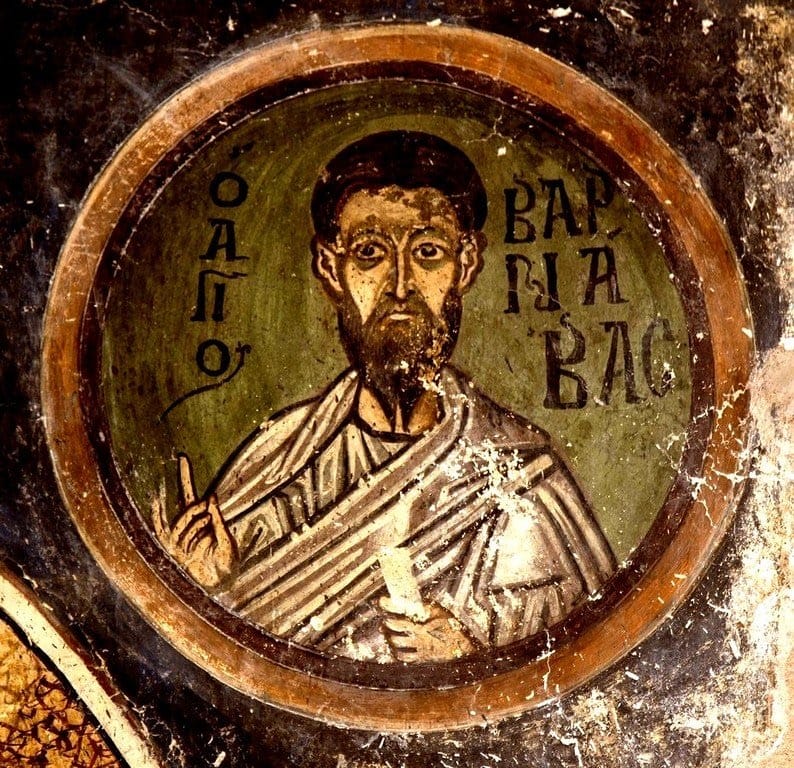
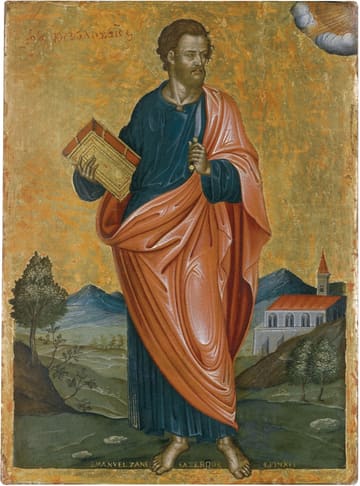
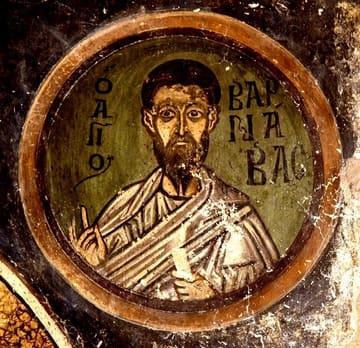
St. Barnabas the Apostle
St. Barnabas, the "Son of Encouragement" (Acts 4:36), was a Levite of Cyprus and one of the great missionaries of the apostolic age.
He vouched for the newly converted Saul, guided the young Church of Antioch, and shared St. Paul's first missionary journey. Acts names him an apostle (Acts 14:14), the Church honors him as the first of the Seventy, and the Church of Cyprus reveres him as its founder.
Acts introduces him as Joses, or Joseph, a Levite born in Cyprus who sold a field and laid the money at the apostles' feet (Acts 4:36-37). Clement of Alexandria counts him among the Seventy, and a later Cypriot tradition says he had studied under Gamaliel beside Saul. When the disciples in Jerusalem still feared their former persecutor, Barnabas brought Saul to the apostles (Acts 9:27).
Sent to Antioch, he rejoiced at the grace of God he found there, and Luke calls him "a good man, and full of the Holy Spirit and of faith" (Acts 11:24). He fetched Saul from Tarsus, and for a whole year they taught together at Antioch, where the disciples were first called Christians.
Set apart with Saul by the Holy Spirit (Acts 13:2), he crossed Cyprus with him and John Mark from Salamis to Paphos, where the proconsul Sergius Paulus believed, and then preached in the cities of Asia Minor. At Lystra the crowd took Barnabas for Zeus, and the two apostles tore their clothes to stop the sacrifice. At the council in Jerusalem they told of the signs God had worked among the Gentiles (Acts 15:12). Later the two parted over Mark, Barnabas's cousin, and Barnabas sailed with him to Cyprus (Acts 15:36-39; Colossians 4:10).
Here the account of Acts ends. The fifth-century Acts of Barnabas and the Encomium of the monk Alexander of Cyprus say that he was put to death at Salamis (burned in the first account, stoned in the second) and that Mark buried him in a cave with the Gospel of St. Matthew. Around 488, under Emperor Zeno, Archbishop Anthemios found the tomb after the apostle appeared to him in a dream, with the Gospel book lying on his breast.
The discovery confirmed that the Church of Cyprus was apostolic in origin, and Zeno upheld its independence from Antioch. An early Christian letter also bears Barnabas's name, but Eusebius already set it among the books not received as Scripture. The Church keeps his feast on June 11 together with St. Bartholomew, and remembers him with the Seventy on January 4.
Sources
- Acts 4:36-37; 9:26-27; 11:22-30; 13-15; Galatians 2:9; Colossians 4:10
- Clement of Alexandria, Stromata II.20; Eusebius, Church History I.12 and III.25
- Greek Menaion and Synaxarion, June 11; Church Slavonic Menaion, June 11
- OCA, Lives of the Saints: Apostle Barnabas of the Seventy
- Pravoslavnaya Entsiklopediya, 'Varnava'
So has the Lord commanded us, saying, 'I have set you as a light for the Gentiles, that you should bring salvation to the uttermost parts of the earth.'
Acts 13:47 (WEB), spoken by Paul and Barnabas together
Men, why are you doing these things? We also are men of the same nature as you, and bring you good news, that you should turn from these vain things to the living God, who made the sky, the earth, the sea, and all that is in them.
Acts 14:15 (WEB), cried out by Barnabas and Paul at Lystra
Troparion · Tone 3
O holy Apostle Barnabas, intercede with God, who is merciful, that He may grant to our souls the forgiveness of their trespasses.
Translated for Axios! from the Greek service of June 11 (the apostles' troparion, as sung for St. Barnabas in Cyprus)
Kontakion · Tone 3
You became a servant of the Lord, true in all things, and were shown to be the first of the Seventy Apostles. Together with Paul you made your preaching shine, proclaiming Christ the Savior to all. Therefore we keep your divine memory with hymns, O Barnabas.
Translated for Axios! from the Greek service of St. Barnabas, June 11 (the same hymn is in the Church Slavonic Menaion)
Saints around June 11
Get the full library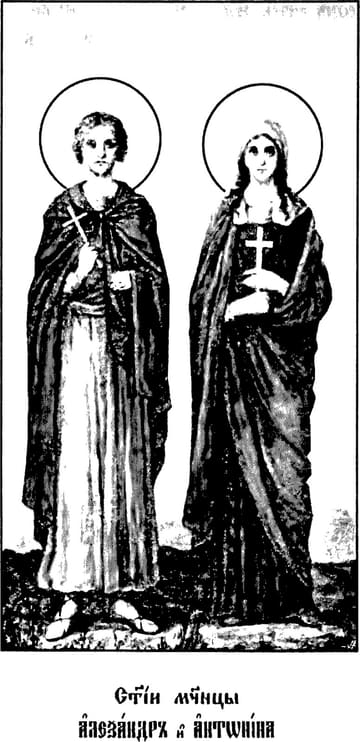
770+ saints, in your pocket
Their Lives, sayings and prayers, A to Z and by feast, with search. The Church calendar, the holy icons, and the saying of the day on your Home Screen. All in Axios! for iPhone, iPad and Android.