
March 4
Saints of the day
Hymn of Praise
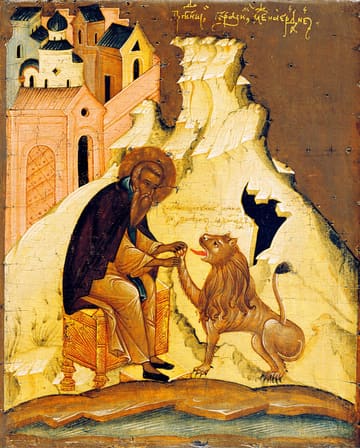
Saint James the Faster
He who falls from a greater height is more badly hurt,
He who has climbed to a height, let him guard himself well.
The holy apostle also writes: "Let him who thinks he stands
Take heed lest he fall"; let him fear God.
James the Faster was a giant in his lofty soul,
But he slipped from that height, and the devil brought him down:
One sin hastens to another: fornication speeds to murder,
James the Faster punished himself, and God consoled him.
A single sin can dissolve all virtue,
One hole in the granary drains out all the grain.
A house filled with fragrance: one handful of filth
Empties it of fragrance and fills it with stench.
A hundred victories help not, nor a hundred glories,
When in the very last battle the head is lost.
The spiritual life is a battle against the enemy's hordes,
In that battle pride is defeated from the very start.
He who calls upon the name of God with deep humility
Is protected in battle by the mercy of God.
Reflection
If human philosophy could satisfy man, why did the philosophers Justin and Origen become Christians? Why did Basil and Chrysostom and Gregory, who in Athens studied all of Hellenic philosophy, receive baptism? And Blessed Augustine, who knew both Greek and Roman wisdom, why did he cast all aside and seek salvation and light in the Christian faith? And the holy Clement of Rome, who was very wealthy and very learned? And the holy Catherine, who was of royal lineage and knew all the worldly wisdom of Egypt? And the young prince Joasaph in India, who was acquainted with all Indian philosophy? And so many, so many others who first sought an explanation of the riddle of the world and light for their souls in philosophy, and then came to the Church and bowed down before Christ the Lord?
Contemplation
Contemplate the Mystery of Holy Communion as the presence of the Lord Jesus in the Church on earth, namely:
- As the fulfillment of His promise: "Lo, I am with you always, even unto the end of the world";
- As His unceasing sustaining of the faithful to whom He said: "Without Me ye can do nothing."
Homily
On the wavering of Pilate
From thenceforth Pilate sought to release Him... Then delivered he Him therefore unto them to be crucified
John 19:12, 16
Whence this contradiction in Pilate? Whence this duality of will in one and the same man? While he stood under the light of Christ's countenance, Pilate with all his heart desired to release the Righteous One. But when the Jewish darkness seized hold of him, he consented to the deeds of darkness. This is the seed fallen among thorns. While the face of Christ shone over the seed, the seed sprouted; but the moment the seed was left without that light, the darkness of the thorns choked it. While the Lord Jesus spoke to Pilate with authority about the heavenly King, saying: "Thou couldest have no power at all against Me, except it were given thee from above," Pilate felt himself overcome by fear of God. But when the Jewish crowd cried out to Pilate: "If thou let this man go, thou art not Caesar's friend," Pilate was completely overcome by fear of the earthly king. And fear for the body prevailed over fear for the soul, as still happens sometimes even today.
Pilate was a disciple of worldly wisdom. But worldly wisdom gives no strength; it instills fear. Worldly wisdom does not sustain the soul but the body. Worldly wisdom instills not fear for the soul but fear for the body and for all that is bodily. Behold in Pilate one clear and lamentable example of what kind of men worldly wisdom apart from God and against Christ produces. But Pilate's weak-charactered and wavering soul is not an image of pagans alone, but also of unsteadfast Christians. Some Christians day after day, imperceptibly and often unconsciously, would at one moment release Christ from the dark and criminal instinct within themselves, and at another moment deliver Him up to that instinct for crucifixion. This happens always when a Christian tramples upon some commandment of Christ in order to fulfill some bodily desire. At one moment the light of that commandment illumines the heart of the wavering Christian; at another moment the bodily darkness presses upon him so powerfully that he surrenders himself to it entirely.
O long-suffering Lord, do not withdraw the light of Thy countenance from us even for an instant, lest darkness overcome us. Help us to remain children of the light unto the end, O Lord. To Thee be glory and praise forever. Amen.
From the Prologue from Ochrid, translated by Marcian Sakarya, OCHRID.COM. CC BY-SA 4.0.
The Prologue, every day
Axios! brings the day’s Hymn of Praise, Reflection, Contemplation and Homily to Today, with the saints, the feasts and the saying of the day, on iPhone, iPad and Android.