
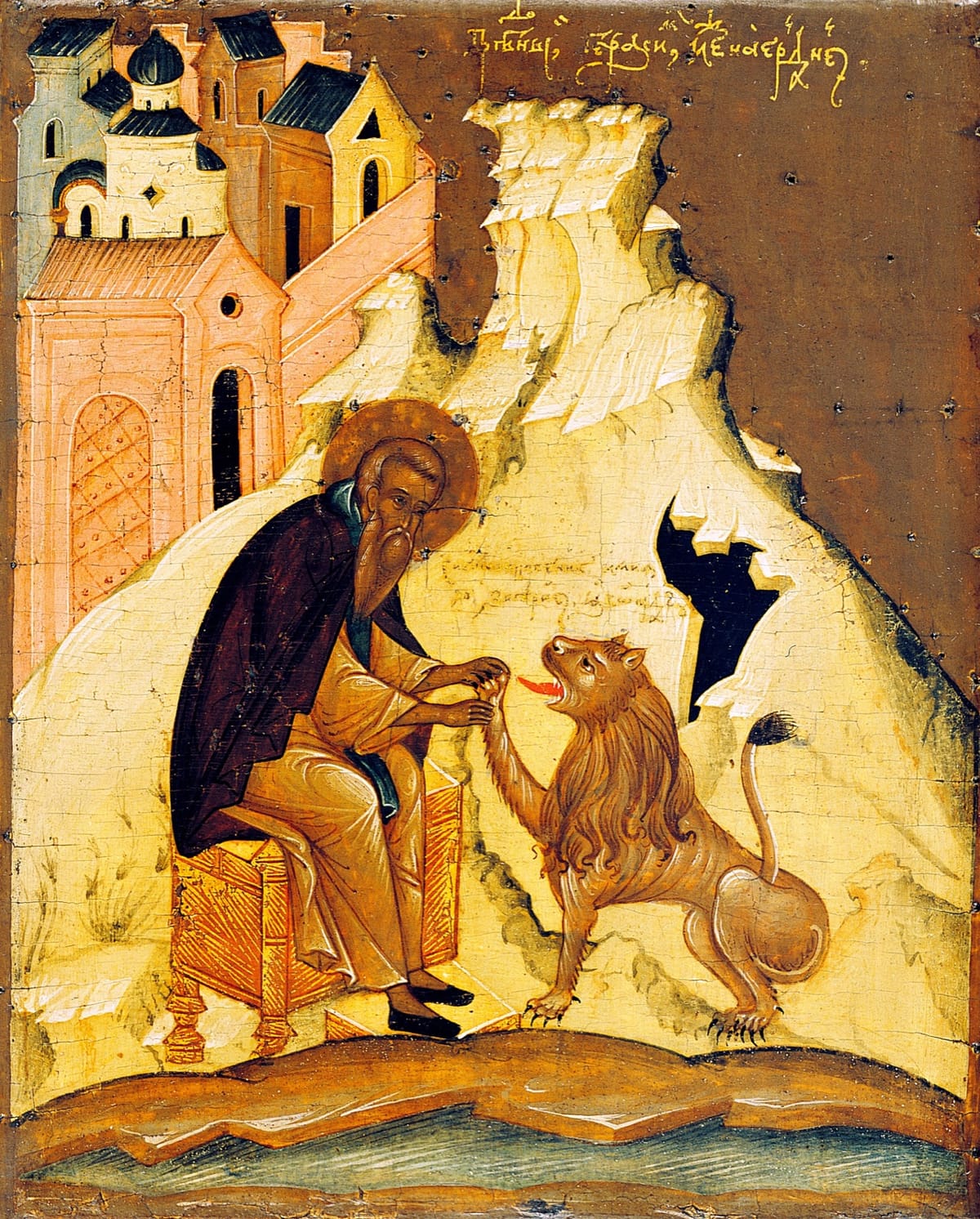
St. Gerasimos of the Jordan
St. Gerasimos of the Jordan was one of the founders of monastic life in the desert of Judea, a fifth-century abba whose lavra near the Jordan River trained hermits under a rule of rare strictness.
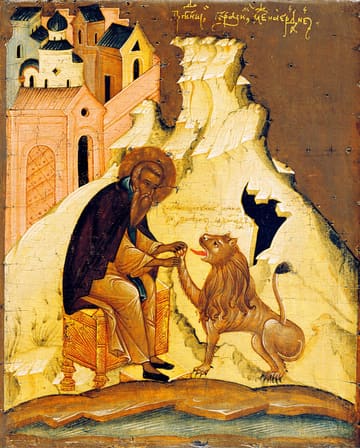
The Church loves him especially for the lion that, as John Moschus tells in the Spiritual Meadow, served him after he healed its paw and died of grief on his grave.
He came from Lycia in Asia Minor and became a monk in his homeland; according to his Lives he then lived for a time in the desert of the Thebaid in Egypt, and around 450 he settled beside the Jordan. For a while he leaned toward the teaching of Eutyches and Dioscorus, until St. Euthymius the Great brought him back to the Orthodox faith, and he took part in the Council of Chalcedon in 451 as a defender of Orthodoxy. The two became close friends, and when Euthymius died in 473, Gerasimos saw angels carrying his soul to heaven and hurried to his burial.
His lavra, about a mile from the river near Jericho, had a cenobium where beginners were trained and some seventy cells for hermits. The hermits spent five days of each week alone in silence, weaving baskets and praying, and ate dry bread, dates and water; no fire was lit in the cells, not even for a warm drink or a lamp to read by. On Saturday and Sunday they gathered for the Divine Liturgy and Holy Communion and shared a meal, then went back with fresh supplies.
They owned nothing but a mat and an old garment, and left their doors open for anyone in need. Gerasimos himself is said to have eaten nothing in Great Lent but Holy Communion. St. Cyriacus the Anchorite was among his disciples.
Moschus heard from the monks of the lavra that a lion once came to the elder limping, with a thorn in its paw. Gerasimos drew it out and dressed the wound, and the lion stayed with him, guarding the donkey that carried the monks' water. When the donkey was stolen, the lion was blamed and made to carry the water itself, until it found the donkey with the thieves' caravan and led them all back.
After the elder's death the lion would not eat, and roaring on his grave it died there; Moschus saw in this a sign of the obedience the beasts gave Adam before the fall. Gerasimos reposed in 475.
His feast is March 4 in the Greek and Slavic Menaia. The Greek Orthodox monastery of St. Gerasimos near Jericho keeps his memory not far from the site of his lavra.
Sources
- Cyril of Scythopolis, Life of Euthymius and Life of Cyriacus
- Life of Gerasimus (anonymous Greek, 6th century)
- John Moschus, Spiritual Meadow 107
- Greek Menaion and Synaxarion, March 4
- OCA, Lives of the Saints: Venerable Gerasimus of the Jordan
No recorded sayings. Read the Life to meet this saint.
Troparion · Tone 1
Citizen of the desert, angel in the body, worker of wonders: so you were revealed, O our God-bearing father Gerasimos. Through fasting, vigils and prayer you received heavenly gifts, and you bring healing to the sick and to the souls of all who run to you in faith. Glory to the One who granted you strength! Glory to the One who crowned you! Glory to the One who works healings for all through you!
Translated for Axios! from the Greek Menaion, March 4
Kontakion · Tone 4
Kindled with love for the things above, you preferred the harshness of the Jordan desert to all the sweet things of the world; therefore a beast obeyed you even until death, O father, and died, obedient and grieving, on your grave, for God had so glorified you. Praying to Him, remember us also, O father Gerasimos.
Translated for Axios! from the Church Slavonic Menaion, March 4
Saints around March 4
Get the full library
770+ saints, in your pocket
Their Lives, sayings and prayers, A to Z and by feast, with search. The Church calendar, the holy icons, and the saying of the day on your Home Screen. All in Axios! for iPhone, iPad and Android.