
October 8
Saints of the day
Hymn of Praise
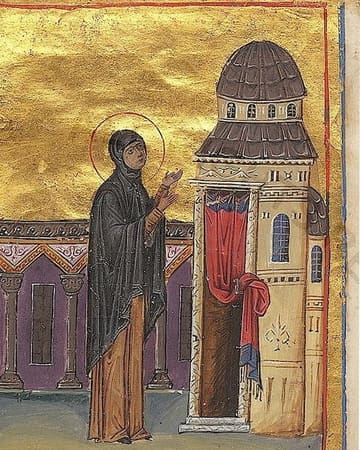
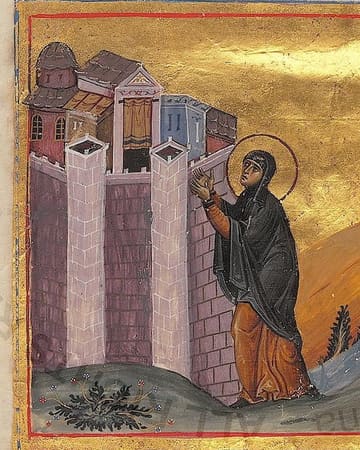
Pelagia was sinful,
Then she repented,
And by knowledge of the true faith
Her soul was illumined.
The world calls her, the world entices her,
She does not listen;
Conscience awakened within her,
Her soul shone brightly.
How much labor she had spent,
How much toil,
Around her sinful body,
A rotten apple,
Just as much labor, just as much toil,
She then invested,
Until her wretched soul
She adorned with faith.
The sun of God shone forth
Upon the heavens,
But brighter still the soul shone
Of Pelagia.
Repentance, repentance,
God left us repentance;
By repentance Pelagia
Glorified herself.
Reflection
O if only we would labor as much over the soul as we labor over the body! O if only we would gain the desire to adorn ourselves with virtues before God and the most radiant angels of God as much as we adorn ourselves with vain and passing outward finery! Pelagia and Taisia in the beginning knew only the body, while their souls were as bound slaves in the prison of the body. Both of them were adorned only with vanity, clothed in vanity, bedecked with vanity, surrounded by vanity, flattered by vanity. But what a sudden change! What a divine transformation in their lives! More wondrous than when a wild apple tree is grafted and begins to bear sweet fruit; or when a muddy and foul-smelling pool is somehow purified and becomes clear, drinkable water. When Bishop Nonnus, together with the other bishops, first saw the sinner Pelagia in all her outward splendor, clothed in the most expensive garments, adorned, embellished, bedecked with rings, necklaces and pendants, perfumed, surrounded by servants, when Bishop Nonnus saw her, he wept and said to his companions: "Truly I have learned much from this woman. The Lord will set her before His Dreadful Judgment Seat and by her will put us to shame. For what do you think: how many hours does this woman spend in her room, washing herself, dressing herself, adorning herself, gazing at herself in the mirror, and all this, why? Only in order to appear as beautiful as possible before people. And we, who have an immortal Bridegroom in heaven, we do not strive to adorn our wretched souls, we do not hasten to wash them with tears of repentance, and to clothe them in the beauty of virtues, so that they might appear as beautiful as possible before the eyes of God!"
Contemplation
Contemplate the injustice of King Ahab and the punishment of God through the Prophet Elijah (I Kings 16-17), namely:
- How Ahab gave himself wholly to idolatry and did all that was evil before the Lord;
- How the Prophet Elijah by prayer sealed the heavens, and there was no rain for three years.
Homily
On how the enemy's weapons shall come to an end
O thou enemy, destructions are come to a perpetual end: and thou hast destroyed cities; their memorial is perished with them
Psalm 9:6
The enemy of the human race, the murderer of men and man-slayer from the very beginning, has used every weapon and every intrigue against man. His task is day and night to devise new weapons and new intrigues, only to destroy someone. As a roaring lion he walketh about, seeking whom he may devour (I Peter 5:8); as a venomous serpent he lurks and awaits his prey; as a spider he spreads his webs everywhere, only, only to catch some human soul and cast it into his fetid kingdom. The pagan nations were as his cities. Until the coming of Christ, he ruled in them peacefully and completely. Idolatry was service to him; sorcery and divination were service to him; licentiousness and debauchery of life among men he protected and promoted; the offering of men as sacrifice, the fire of passions, quarrels, wars, crimes, all this was his delight. But at the end, his weapons were exhausted, his cities were destroyed, his memory perished with a roar. That end which the prophet mentions is the coming of Christ the Lord into the world. The Lord showed His power over the devil by overcoming the devil's temptations on the mountain; He showed His authority by casting demons out of men and commanding them to go here or there; He showed His invincible sovereignty over sin and death by His suffering and resurrection. And, what is perhaps most important, He destroyed Hades and scattered the power of the demons. He did not wish to annihilate the demons, but scattered them and broke their weapons; He shattered and scattered them like the Jews, and even more terribly than the Jews. He liberated the nations from their dominion; and above all, He gave men authority over the demons, that by His name they might drive them away from themselves. See how the Lord united His mercy toward men with His victory over the demons! He so weakened and broke the demons, and confounded them and scattered them, that He placed them under the authority of men. And so the former slaves became masters, and the former masters became slaves. But the Lord did not give authority over the demons to all men, but only to those who believe in Him and follow His commandments. He gave them authority, and He gave them a weapon. The weapon is the Cross.
O Lord our God, our Savior from the dominion of the devil, help us to do even that least part which Thou hast left for us to do. To Thee be glory and praise forever. Amen.
From the Prologue from Ochrid, translated by Marcian Sakarya, OCHRID.COM. CC BY-SA 4.0.
The Prologue, every day
Axios! brings the day’s Hymn of Praise, Reflection, Contemplation and Homily to Today, with the saints, the feasts and the saying of the day, on iPhone, iPad and Android.