
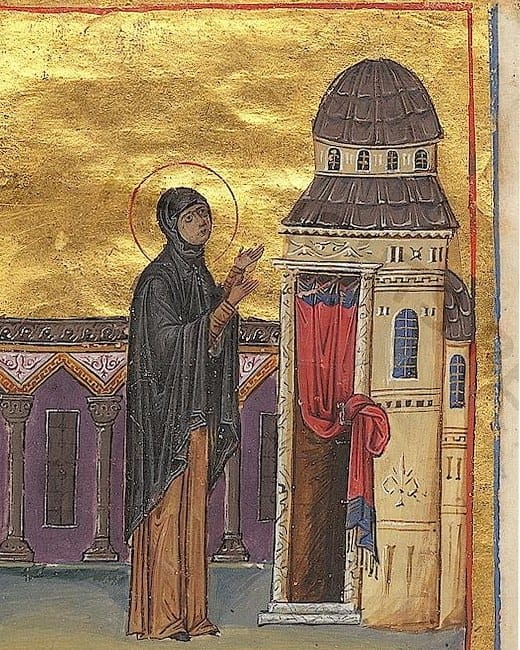
St. Pelagia the Penitent
St. Pelagia the Penitent, once the most celebrated dancer of Antioch, is honored with St. Mary of Egypt as one of the Church's great examples of repentance.
Her story is told in a fifth-century Life by James, who calls himself the deacon of the holy bishop Nonnus, and the Church has long read it as a witness to God's mercy.
According to the Life, the archbishop of Antioch had called eight bishops to his city, among them Nonnus, a monk from the Tabennesiote monasteries of Egypt who had baptized thousands of Arabs and won Heliopolis for Christ. As the bishops sat at the door of the church of the martyr Julian, the leading dancer of the city rode past on a donkey, covered in gold and pearls, with her head uncovered and a crowd of servants around her. The other bishops turned away. Nonnus gazed after her and wept: she spends hours adorning herself to please men who are here today and gone tomorrow, he said, while we neglect our souls for our immortal Bridegroom, and God will set her before us at the Judgment.
The next Sunday she entered the church as Nonnus preached on the judgment and the hope of salvation, and she was pierced to the heart. She wrote to him, fell at his feet before the bishops, and begged for baptism, calling herself a sea of sins and an abyss of wickedness. Her name, she said, was Pelagia, though Antioch called her Margarito, "Pearl", for her jewels.
Nonnus baptized her, with Romana, the first of the deaconesses, as her sponsor. When the devil came to reclaim her, she drove him off with the Cross. Three days later she gave all her wealth to Nonnus, who had it given to widows, orphans and the poor, and she set her slaves free.
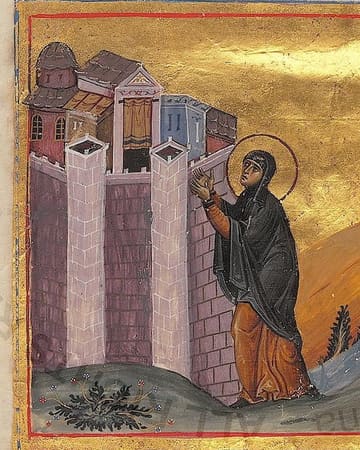
On the eighth day, when the newly baptized lay aside their white garments, she put on a hair shirt and the bishop's cloak and vanished by night. In Jerusalem she walled herself into a small cell on the Mount of Olives, where the monasteries knew her as Pelagius, a monk and eunuch famed for holiness. Three or four years later James spoke with her through her window, not recognizing her, so wasted was she by fasting.
When he returned, Pelagius had died. Only as the fathers anointed the body did they learn she was a woman, and monks and nuns from Jericho and the Jordan buried her with candles and hymns.
St. John Chrysostom told the people of Antioch of a famous actress of his own day who turned to Christ, and some scholars see in her the root of Pelagia's story.
Sources
- James the Deacon, The Repentance of St. Pelagia (Greek ed. H. Usener, Legenden der Pelagia, 1879; Latin version by Eustochius, PL 73.663-672)
- Synaxarion, October 8 (Greek Menaion)
- OCA, Lives of the Saints: Venerable Pelagia the Penitent
- St. John Chrysostom, Homily 67 on Matthew 3 (NPNF I/10)
No recorded sayings. Read the Life to meet this saint.
Troparion · Tone 8
In you, O Mother, God's image was preserved to perfection; for you took the cross upon yourself and followed Christ, and in your conduct you taught that one should think little of the flesh, for it is fleeting, and take care of the soul, a thing that does not die. And so, O venerable Pelagia, your spirit exults together with the angels.
Translated for Axios! from the Greek Menaion, October 8
Kontakion · Tone 2
Wasting away your body with fasting, in sleepless prayer you implored the Creator that you might receive, O mother, full forgiveness for your deeds; and this you truly received, having shown us the way of repentance.
Translated for Axios! from the Greek Menaion, October 8
Saints around October 8
Get the full library
770+ saints, in your pocket
Their Lives, sayings and prayers, A to Z and by feast, with search. The Church calendar, the holy icons, and the saying of the day on your Home Screen. All in Axios! for iPhone, iPad and Android.