
September 17
Saints of the day
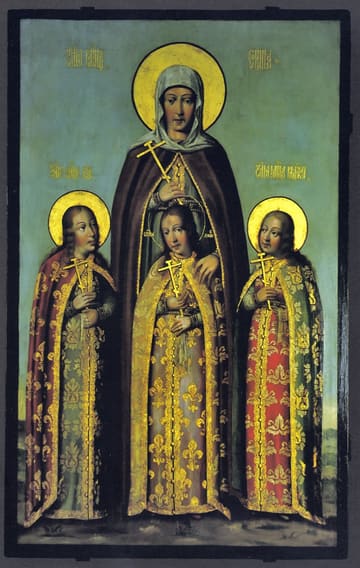
Hymn of Praise
Sophia the most wise glorified the Lord,
Three most beautiful daughters she offered as sacrifice to Him:
Then spoke to her daughters: fear not, my children,
Strengthen yourselves in Christ, endure in the faith.
Fear not torment nor bitter affliction,
Grieve not for your bodies; in heaven it is better:
A better body God will give you in heaven:
Grieve not for beauty; with greater beauty you will shine
In the Kingdom of God, among the angels,
As daughters of the King among kings;
Grieve not for life, for what is life worth?
Even a hundred years is measured by a span.
An endless life awaits you in heaven,
A life without end, a life without beginning.
Grieve not for the company of earthly friends,
For there is the company of wondrous saints.
Nor grieve for the company of earthly kinsmen,
In heaven is the company of glorious martyrs.
Thus the holy mother taught her holy daughters,
While one by one they flew away to heaven,
Three white doves, innocent and pure,
Swiftly flew into the arms of Christ.
And after them the mother rose up in spirit
And overtook her glorious daughters in Paradise.
Now they pray for us, the mother with her daughters,
And their prayers the merciful God receives.
Reflection
A God-fearing ruler faithful to God is a true heavenly blessing for the whole nation. King Wenceslaus of Bohemia was such a ruler. His zeal for the holiness of the faith and strictness of life remind us of the ancient ascetics. He devoted the day to affairs of state and the night to prayer. Together with his old servant Podivoj he often went barefoot in winter to matins in church. And often he himself kneaded and baked the prosphora, and unfailingly so when he wished to receive Holy Communion. Through his care many churches were built, in which the divine services were celebrated daily. He was especially solicitous for orphans and the poor. He was peace-loving, but nevertheless a great and fearless hero. When the neighboring prince Radislav attacked the Czech land, Wenceslaus sent him a letter asking what moved him to wage war against him. The proud Radislav answered that he demanded Wenceslaus cede all of Bohemia and his throne to him. Then Wenceslaus assembled a great army and went out to face his enemy. But seeing two mighty armies, he felt pity that so many men should perish, and he sent the following message to Radislav: "The dispute is between me and you; you wish to rule Bohemia and I do not yield. Let us settle this matter by combat between the two of us. Why a bloody battle of two armies?" Prince Radislav agreed to single combat, but was defeated by Wenceslaus, and on his knees begged him for forgiveness.
Contemplation
Contemplate the lawlessness of the Jews and the punishment of God (I Kings 14), namely:
- How both the people and King Rehoboam did what was evil before the Lord;
- How they set up idols in the temples, and how there were many sodomites in the land;
- How the king of Egypt attacked Jerusalem and plundered all the gold from the temple.
Homily
On the unity of essence of the Father and the Son
I and My Father are one
John 10:30
The more miracles the Lord Jesus performed, and the closer He drew to death, the more openly He spoke of Himself. Numerous miracles and the length of time, sufficient for reflection, had their effect on both the guileless and the malicious: the guileless became receptive to the revelation of the high mysteries of God, while the malicious through their malice increasingly darkened and incapacitated themselves for receiving those mysteries. Therefore the malicious took up stones to kill Him. I and My Father are one. The Father and the Son are one in the essence of being, but are not one in hypostases, for otherwise they would not be called by two names: Father and Son. All the attributes of the Father's essence the Son also has, and the Holy Spirit also has; but the attributes of the Father's hypostasis belong only to the Father, and the attributes of the Son's hypostasis belong only to the Son, and the attributes of the Spirit's hypostasis belong only to the Spirit. But when it is a matter of the divine essence, the Son can say: I and the Father are one; and the Father can say: I and the Son are one; and the Holy Spirit can say: I and the Father are one, and I and the Son are one. The Lord Jesus expressed the unity of His being with the Father in further words as well: the Father is in Me, and I in Him. Can one speak more clearly of the divinity of the Son? Can the human tongue more strongly express the unity of the Tri-hypostatic God? The dogma of the divinity of the Son of God and the dogma of the unity of the divine essence were revealed and established by the Lord Jesus Christ Himself. Let no one, therefore, give credence to the deceptions of certain unbelievers and heretics, as though the Lord Jesus Himself did not proclaim His divinity but that this dogma was supposedly put forth later in the Church. If Christ had not proclaimed His divinity, why would the Jews have said to Him: "Thou makest Thyself God"? And why would they have taken up stones against Him?
O Lord Jesus, Son of God, one in essence with the Father and the Holy Spirit, have mercy on us and save us by the power and goodness of Thy Divinity, all-powerful and all-good. To Thee be glory and praise forever. Amen.
From the Prologue from Ochrid, translated by Marcian Sakarya, OCHRID.COM. CC BY-SA 4.0.
The Prologue, every day
Axios! brings the day’s Hymn of Praise, Reflection, Contemplation and Homily to Today, with the saints, the feasts and the saying of the day, on iPhone, iPad and Android.