
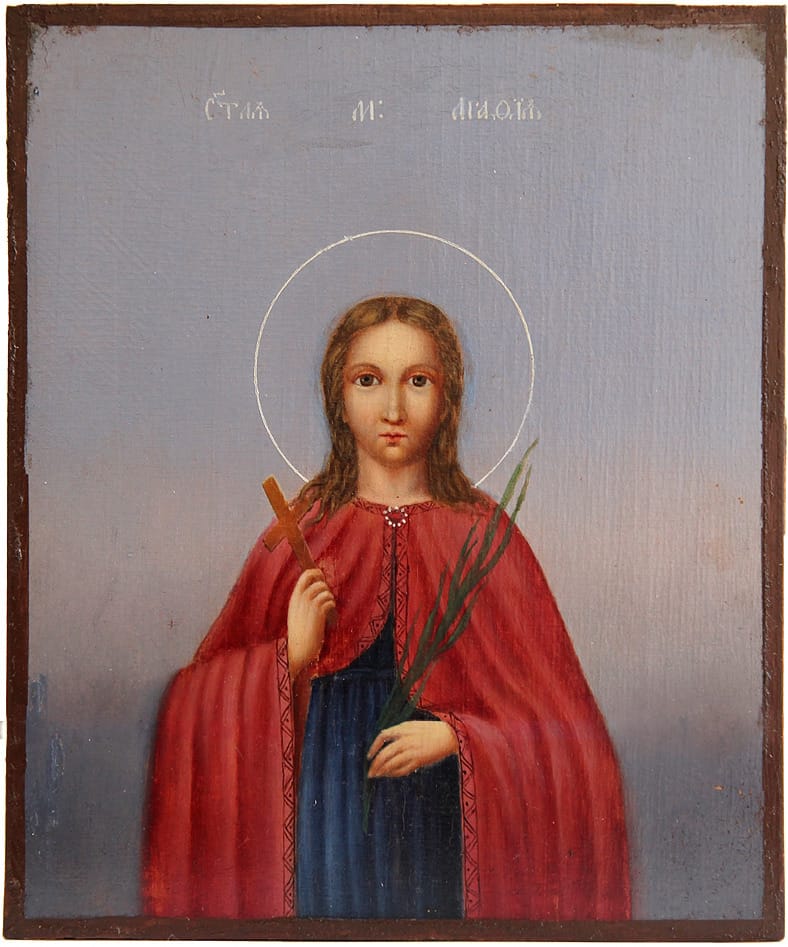
St. Agatha of Sicily
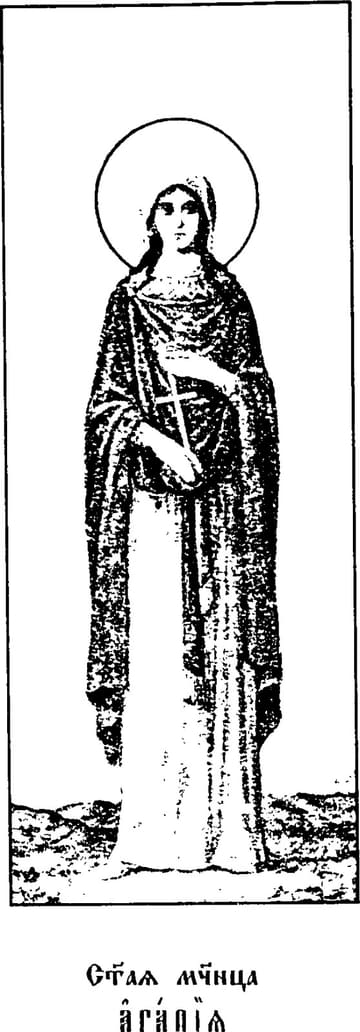
St. Agatha is the great virgin martyr of Sicily, among the most honored women martyrs of the early Church in East and West.
She died for Christ at Catania, probably in the persecution of Decius about 251, and the Church keeps her memory on February 5. Byzantine synaxaria, following St. Symeon Metaphrastes, say that she was born at Palermo (Panormus), and many Orthodox books call her 'of Palermo'; Catania, where she suffered, has always claimed her as its own daughter.
Her Passion, which survives in a Latin form no older than the 6th century and a differing Greek one, tells that she was a young woman of a noble family who had given herself to Christ. The governor Quintianus desired her and, when she refused him, gave her over for a month to a woman named Aphrodisia and her daughters to break her resolve. When that failed he put her on trial, had her tortured and ordered her breasts to be cut off.
That night, the Passion says, the Apostle Peter visited her cell and made her whole. Brought out again, she was rolled on sharp potsherds and burning coals; then an earthquake shook the city, the frightened people protested, and Quintianus had her taken back to prison, where she thanked God and gave up her spirit.
The details of the Passion cannot be trusted as history, but her martyrdom and early cult are certain. The 5th-century martyrology that bears St. Jerome's name and the calendar of Carthage already list her on February 5; Pope Gelasius at the end of the 5th century mentions a basilica of St. Agatha, and the poet Venantius Fortunatus in the 6th names her among the glorious virgins. In Rome St. Gregory the Dialogist reclaimed for Orthodox worship a church of hers that had been given to the Arian Goths. In the 9th century the Sicilian-born patriarch St. Methodius of Constantinople praised her in an encomium.
Catania honors her as its patron, and its people have often carried her veil against the lava of Mount Etna, first, by tradition, a year after her death. Her relics were taken to Constantinople in 1040 by the general George Maniakes and brought back to Catania in 1126; they rest in the cathedral there.
Sources
- Greek Menaion and Synaxarion, February 5
- Slavonic Menaion, February 5
- OCA, Lives of the Saints: Martyr Agatha of Palermo in Sicily
- Catholic Encyclopedia (1907), 'St. Agatha'
- Mystagogy Resource Center, 'The Life and Veneration of Holy Virgin Martyr Agatha'
- synaxarion.gr, 'Ἡ Ἁγία Ἀγάθη ἡ Μάρτυς'
No recorded sayings. Read the Life to meet this saint.
Troparion · Tone 4
Your lamb, O Jesus, cries with a great voice: For You, my Bridegroom, I yearn, and in seeking You I contend; I am crucified with You, and in Your baptism I am buried with You; I suffer for You, to reign with You; I die on Your behalf, so that in You I may also live. But receive as a blameless offering her who is slain for You with longing. At her intercessions, in Your mercy, save our souls.
Translated for Axios! from the Greek Menaion, February 5
Kontakion · Tone 4
Let the Church put on today a glorious purple robe, dyed in the pure blood of Agatha the martyr, and cry out: Rejoice, O boast of Catania!
Translated for Axios! from the Greek kontakion of February 5
Saints around February 5
Get the full library
770+ saints, in your pocket
Their Lives, sayings and prayers, A to Z and by feast, with search. The Church calendar, the holy icons, and the saying of the day on your Home Screen. All in Axios! for iPhone, iPad and Android.