
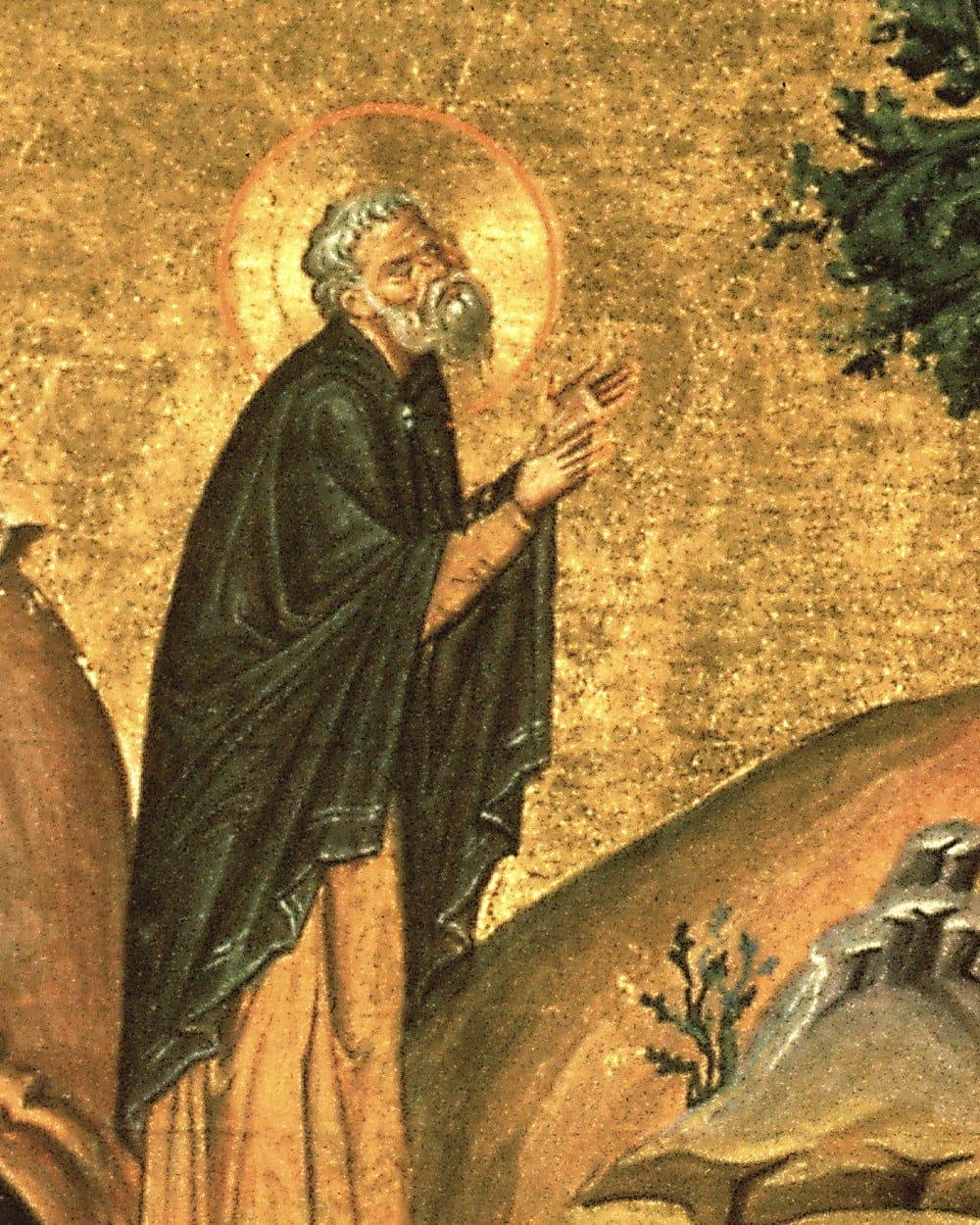
St. Isidore of Pelusium
St. Isidore of Pelusium was a monk and priest of the Nile Delta whose letters, some two thousand of which survive, written to bishops, emperors, officials and monks, make him one of the great teachers of the early Church.
The historian Evagrius, writing in the following century, said that he lived the life of the angels on earth.
According to the Synaxarion he came from a noble and devout family of Egypt (later accounts say of Alexandria), was related to the archbishops Theophilus and Cyril of Alexandria, and was trained in both sacred and secular learning. Leaving wealth and rank behind, he became a monk on the mountain near Pelusium, the frontier city at the eastern mouth of the Nile, where he was ordained a priest and spent his life in prayer, study and correspondence.
His letters explain the Scriptures, defend the faith in Christ as true God and true man, counsel monks, and rebuke unworthy clergy and officials without fear. He revered St. John Chrysostom, whom he called God-bearing, and grieved at the injustice done to him. He supported St. Cyril of Alexandria against Nestorius, yet at the time of the Council of Ephesus in 431 he warned Cyril that partiality does not see clearly and antipathy does not see at all, and urged him to judge justly.
His teaching joined deed and word: a life without words, he wrote, helps more than words without a life. St. Photius the Great later praised his letters as a model of style.
He reposed in old age, around 436 by the usual reckoning, though some scholars place his death a few years later. The Greek and Slavic Menaia keep his feast on February 4.
Sources
- St. Isidore of Pelusium, Letters (PG 78)
- Apophthegmata Patrum, alphabetical collection: Isidore of Pelusium 1-6 (PG 65, 221-224)
- Evagrius Scholasticus, Ecclesiastical History I.15
- Greek Menaion and Synaxarion, February 4
- OCA, Lives of the Saints: Venerable Isidore of Pelusium
A life without words does more good than words without a life. The one helps even by keeping silent; the other is a burden even when he shouts. But when word and life run together, they make one image of all true wisdom.
Apophthegmata Patrum, Isidore of Pelusium 1 (translated for Axios! from the Greek)
Honor the virtues, and do not court good fortune; for the virtues are an immortal possession, but good fortune is easily put out.
Apophthegmata Patrum, Isidore of Pelusium 2 (translated for Axios! from the Greek)
Many people long for virtue but shrink from walking the road that leads to it, and others do not even think that virtue exists. We must persuade the first to put away their sloth, and teach the second that virtue truly is virtue.
Apophthegmata Patrum, Isidore of Pelusium 3 (translated for Axios! from the Greek)
Wickedness has separated men from God and divided them from one another. So we must flee it with all speed and pursue virtue, which both brings us to God and joins us to one another.
Apophthegmata Patrum, Isidore of Pelusium 4 (translated for Axios! from the Greek)
Since great is the height of humility and great the fall of boastfulness, I counsel you to embrace the one and not to fall into the other.
Apophthegmata Patrum, Isidore of Pelusium 5 (translated for Axios! from the Greek)
The terrible and reckless love of money, which knows no fill, drives the soul it has captured to the last of evils. So let us drive it out above all at the beginning, for once it has the mastery it cannot be subdued.
Apophthegmata Patrum, Isidore of Pelusium 6 (translated for Axios! from the Greek)
Partiality does not see clearly, and antipathy does not see at all. If you wish to be free of both kinds of blindness, do not hand down violent sentences, but entrust the cases to a just judgment.
St. Isidore of Pelusium, Letters I.310, to Cyril of Alexandria (translated for Axios! from the Greek)
I hear that you have fled the corruptible life and run to the arena of the monks, yet have a rash tongue and speak at random. This is nothing else than to build a strong wall the enemy cannot approach and leave a gate open for him to come in.
St. Isidore of Pelusium, Letters I.309, to Cassian the monk (translated for Axios! from the Greek)
Troparion · Tone 8
In you, O Father, God's image was preserved to perfection; for you took the cross upon yourself and followed Christ, and in your conduct you taught that one should think little of the flesh, for it is fleeting, and take care of the soul, a thing that does not die. And so, O venerable Isidore, your spirit exults together with the angels.
Translated for Axios! from the Greek Menaion, February 4
Kontakion · Tone 4
The Church, having found in you another morning star, O glorious one, and shining with the lightning of your words, cries out to you: Rejoice, all-blessed Isidore, wise in God.
Translated for Axios! from the Greek, February 4
Saints around February 4
Get the full library

770+ saints, in your pocket
Their Lives, sayings and prayers, A to Z and by feast, with search. The Church calendar, the holy icons, and the saying of the day on your Home Screen. All in Axios! for iPhone, iPad and Android.