
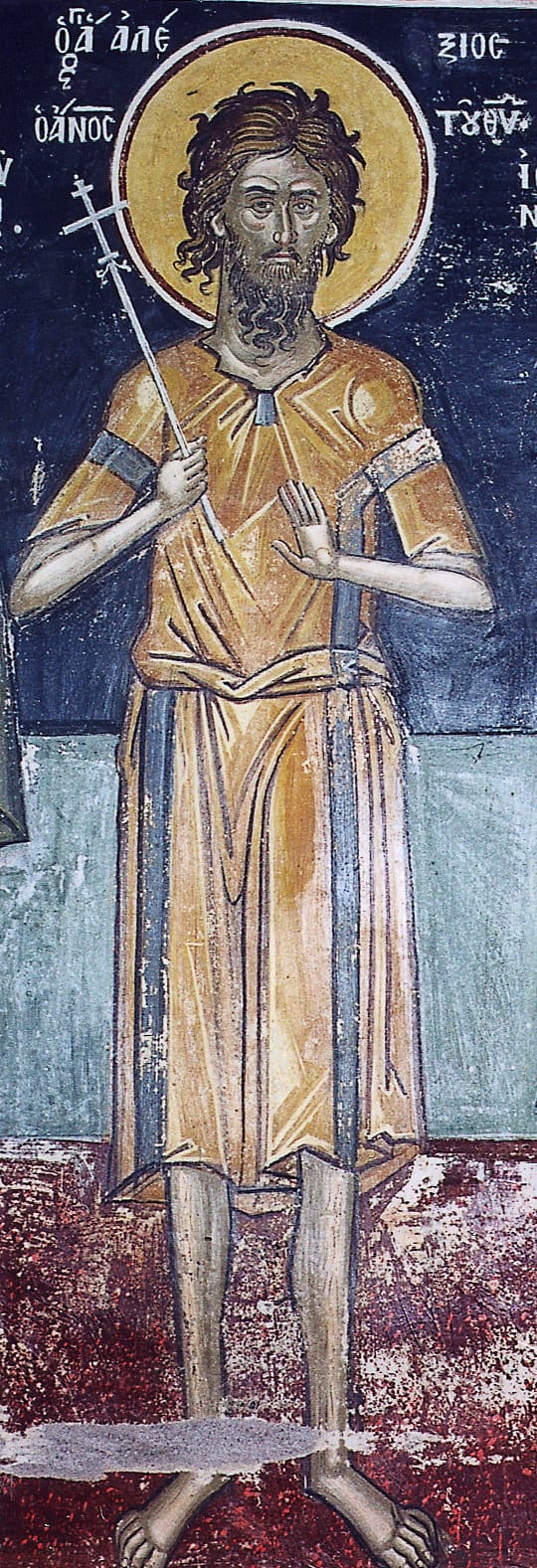
St. Alexis the Man of God
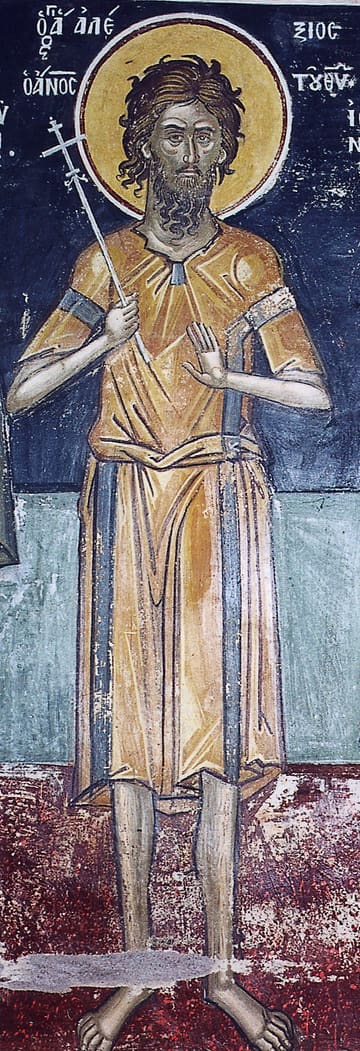
St. Alexis, called the Man of God, is honored in East and West as a model of voluntary poverty and hidden holiness. According to his Life, the only son of a noble Roman family left home on his wedding day and spent the rest of his days as an unknown beggar for Christ's sake.
Many named Alexios, Alexei or Alexis keep his memory as their name day.
The oldest form of his story is a Syriac Life written at Edessa in the fifth century and preserved in manuscripts of the late fifth and sixth centuries; it does not even give his name. A rich couple of Rome, it says, received a son after many prayers. The boy grew up grave and modest, and when his parents married him to a girl of noble family, he slipped away to the harbor on the first day of the wedding, prayed that God would open the door at which he knocked, and took a ship for Syria. He begged his way to Edessa, where he spent his days in the church and his nights in prayer among the poor, fasting until evening, keeping from the alms only enough bread and vegetables for the day and giving the rest away.
He told no one who he was, and the servants his father sent to look for him gave him alms without recognizing him. He died in the hospice for strangers in the time of Bishop Rabbula (412-435) and was buried among the poor. When the doorkeeper of the church, who had learned his story under oath, brought the bishop to honor him, the grave held only his rags.
A longer Life, known in Greek by the ninth century, when St. Joseph the Hymnographer wrote his canon, names him Alexis and his parents Euphemianus and Aglais. In it an icon of the Theotokos at Edessa reveals him as the Man of God, and he flees the fame that follows. Storms drive his ship to Rome, where he lives for seventeen years unrecognized at the gate of his father's house, bearing the mockery of the servants.
At his death, about 411, a voice in the church under Pope Innocent I reveals him, and the letter in his hand tells his parents and his bride who he is. The Church's hymns and Synaxarion follow this fuller account.
His head has been kept since 1398 at the Monastery of Agia Lavra near Kalavryta in Greece, a gift of Emperor Manuel II Palaiologos, and he is the patron saint of Kalavryta. In Rome the church of St. Alexis on the Aventine claims his relics.
Sources
- Syriac Life of the Man of God (ed. and trans. A. Amiaud, La légende syriaque de saint Alexis, l'homme de Dieu, 1889)
- Greek Menaion and Synaxarion, March 17
- OCA, Lives of the Saints: Venerable Alexis the Man of God
- saint.gr, 'Όσιος Αλέξιος ο άνθρωπος του Θεού'
No recorded sayings. Read the Life to meet this saint.
Troparion · Tone 4
You sprang from an illustrious and renowned root and blossomed in a royal and splendid city, O all-wise Alexis; yet you scorned all things as perishable and fleeting, and hastened to be joined to Christ, the Master. Therefore entreat Him always for our souls.
Translated for Axios! from the Greek Menaion, March 17
Kontakion · Tone 4
Keeping devoutly today the all-venerable feast of the all-blessed Alexis, let us sing his praises, saying: Rejoice, delightful adornment of the venerable!
Translated for Axios! from the Greek Menaion, March 17
Saints around March 17
Get the full library
770+ saints, in your pocket
Their Lives, sayings and prayers, A to Z and by feast, with search. The Church calendar, the holy icons, and the saying of the day on your Home Screen. All in Axios! for iPhone, iPad and Android.